
Close Menu
    Facebook X (Twitter) Instagram
    SciTechDaily
    • Biology
    • Chemistry
    • Earth
    • Health
    • Physics
    • Science
    • Space
    • Technology
    Facebook X (Twitter) Pinterest YouTube RSS
    SciTechDaily
    Home»Space»Probing the Cosmic Infrared Background
    Space

    Probing the Cosmic Infrared Background

    By Smithsonian Astrophysical ObservatoryAugust 14, 20122 Comments3 Mins Read
    Facebook Twitter Pinterest Telegram LinkedIn WhatsApp Email Reddit
    Share
    Facebook Twitter LinkedIn Pinterest Telegram Email Reddit
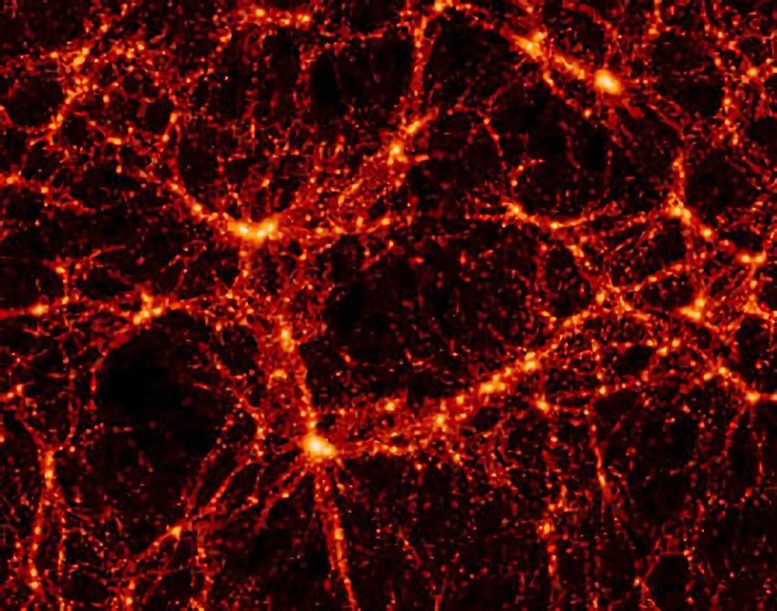
    Cosmic Infrared Background Filaments Simulation
    A computer simulation of the development of giant filaments of galaxies in the very early universe. Recent observations of the cosmic infrared background, the remnant radiation from many of these stars, provides support for current cosmological models. Credit: Jenkins; ApJ.

    Using the Infrared Array Camera on the Spitzer Space Telescope, a team of astronomers probed the cosmic infrared background, finding structural features produced by the first generation of stars dating from an epoch more than twelve billion years ago.

    The cosmic infrared background is the collective infrared radiation emitted by cosmic sources throughout the history of the universe, including sources inaccessible to current telescopes. The latter category, for example, includes the very first generation of stars, currently a subject of intense investigations. Because of the relative uniformity of this background, which is faint and might be interpreted as instrumental noise, fluctuations in it can often be more readily discerned than the actual background level itself. This property also lets astronomers discriminate against the significant foreground contributions from the solar system and our galaxy.

    CfA astronomers Matt Ashby and Giovanni Fazio joined with four colleagues to use the superb sensitivity and stability of the Infrared Array Camera (IRAC) on the Spitzer Space Telescope to probe the cosmic infrared background. They worked with very deep IRAC images of the sky, over an area of about 0.2 square degrees, that had been taken in a different program designed to study more recently formed but still very distant galaxies.

    After meticulously accounting for known stars, diffuse emission, and known galaxies, the scientists found large structural features (fluctuations) consistent with their having been produced by the first generation of stars dating from an epoch more than twelve billion years ago. These early stars, at least according to the best current models of cosmic evolution, were not uniformly distributed across space. They formed as part of stupendous, filamentary structures that evolved and grew from the tiny ripples in hot gas that pervaded the universe soon after the Big Bang. The results of this new paper lend support both to the current theory of the large-scale structure of the universe and to our ideas about how the first-generation stars formed.

    Reference: “New Measurements of the Cosmic Infrared Background Fluctuations in Deep Spitzer/IRAC Survey Data and Their Cosmological Implications” by A. Kashlinsky, R. G. Arendt, M. L. N. Ashby, G. G. Fazio, J. Mather and S. H. Moseley, 14 June 2012, The Astrophysical Journal.
    DOI: 10.1088/0004-637X/753/1/63

    Never miss a breakthrough: Join the SciTechDaily newsletter.
    Follow us on Google and Google News.

    Astronomy Astrophysics Harvard-Smithsonian Center for Astrophysics
    Share. Facebook Twitter Pinterest LinkedIn Email Reddit

    Related Articles

    X-Ray Emission From Mysterious Dark Matter

    Analyzing Dust Storm Sequences on Mars

    Intriguing Remains of a Rare Stellar Explosion Discovered in Milky Way Center

    Puzzling Astrophysics of Quasars in the Early Universe

    Four Exoplanets – Including a Super-Earth Planet – Discovered by High School Students

    Massive Rotating Stars in the Pleiades Cluster

    Astronomers Discover First Cloudless, Jupiter-Like Planet – “Smoking Gun Evidence”

    Chandra X-ray Observatory Studies Extraordinary Magnetar [Video]

    Chandra Studies Extraordinary Magnetar: Fastest Spinning and Possibly the Youngest Magnetar Known

    2 Comments

    1. Charlie on August 14, 2012 8:06 am

      Interesting how images like this always seem to be compared to the neuron structure of the human brain. Coincidence? There are no coincidences.

      Reply
    2. Madanagopal.V.C. on October 17, 2012 1:26 pm

      After Cosmic Microwave Backround , here comes the Cosmic Infra-red Backround . In electromagnetic spectrum the hierarchy from high energy to low energy is Gamma Rays, X-Rays , Ultra-violet, visible VIBGYOR, infra-red, micro-wave and other radio waves. They are all the feathers of the same bird and they are speeding at a constant velocity of light ‘c’. Due to the acceleration of galaxies and expanding universe, these waves from the first epoch big-bang , through first formation of stars from hot gases (in the present case) as the case may be undergo Doppler Shift thereby their wavelengths becoming longer. Initial Gamma Rays from Big Bang epoch is received by us as microwave by sheer relative speed. Similarly in later gaseous stars their infra-red is observed by us. For visible stars we observe the red shift in our laboratories. Thank You.

      Reply
    Leave A Reply Cancel Reply

    • Facebook
    • Twitter
    • Pinterest
    • YouTube

    Don't Miss a Discovery

    Subscribe for the Latest in Science & Tech!

    Trending News

    Wasp Colonies Explode Into Violence After Losing Their Queen

    Scientists Create “Living Plastic” That Self-Destructs in Just Six Days

    Your Blood May Carry a 700-Million-Year-Old Secret

    Scientists Discover Some “Zombie Cells” May Actually Help You Live Longer

    Earth May Be Seeding Venus With Life, According to New Research

    What Scientists Found Inside a 117-Year-Old Woman Reveals New Clues to Long Life

    Scientists Discover Mysterious Creature Living in the Great Salt Lake – and It Exists Nowhere Else on Earth

    It’s Alive? Surprising Discovery Changes What We Know About Fog

    Follow SciTechDaily
    • Facebook
    • Twitter
    • YouTube
    • Pinterest
    • Newsletter
    • RSS
    SciTech News
    • Biology News
    • Chemistry News
    • Earth News
    • Health News
    • Physics News
    • Science News
    • Space News
    • Technology News
    Recent Posts
    • Scientists Crack Major Ammonia Problem With a Platinum Catalyst Breakthrough
    • MIT Engineers Solve a Major Lidar Problem That Has Stumped Researchers for Years
    • NASA’s X-59 Sonic Boom Killer Is Ready for Its Biggest Test Yet
    • Why Some Cancers Turn Deadly: Researchers Uncover a Hidden Trigger
    • The Best Exercise Combination for Longevity, According to a 30-Year Study
    Copyright © 1998 - 2026 SciTechDaily. All Rights Reserved.
    • Science News
    • About
    • Contact
    • Editorial Board
    • Privacy Policy
    • Terms of Use

    Type above and press Enter to search. Press Esc to cancel.