
Close Menu
    Facebook X (Twitter) Instagram
    SciTechDaily
    • Biology
    • Chemistry
    • Earth
    • Health
    • Physics
    • Science
    • Space
    • Technology
    Facebook X (Twitter) Pinterest YouTube RSS
    SciTechDaily
    Home»Space»Hubble Views the Cosmic Riches of Messier 69
    Space

    Hubble Views the Cosmic Riches of Messier 69

    By NASAOctober 8, 2012No Comments2 Mins Read
    Facebook Twitter Pinterest Telegram LinkedIn WhatsApp Email Reddit
    Share
    Facebook Twitter LinkedIn Pinterest Telegram Email Reddit
    the globular cluster Messier 69
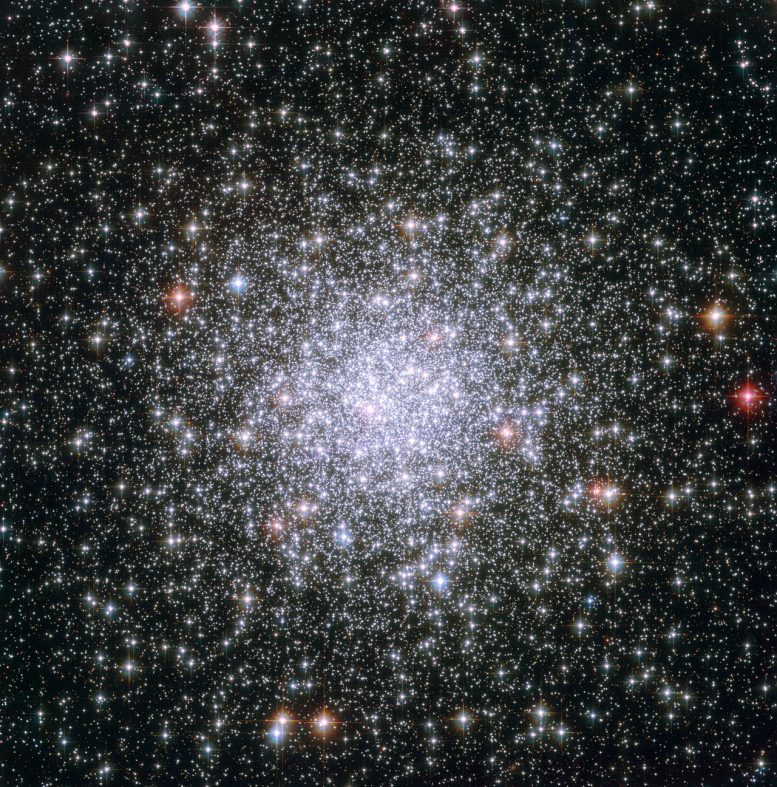
    Hubble Space Telescope image of the globular cluster Messier 69, also known as NGC 6637. Credit: ESA/NASA

    This Hubble image shows the globular cluster Messier 69, also known as NGC 6637, which is located 29,700 light-years away in the constellation Sagittarius.

    This dazzling image shows the globular cluster Messier 69, or M69 for short, as viewed through the NASA/ESA Hubble Space Telescope. Globular clusters are dense collections of old stars. In this picture, foreground stars look big and golden when set against the backdrop of the thousands of white, silvery stars that make up M69.

    Another aspect of M69 lends itself to the bejeweled metaphor: As globular clusters go, M69 is one of the most metal-rich on record. In astronomy, the term “metal” has a specialized meaning: it refers to any element heavier than the two most common elements in our Universe, hydrogen and helium. The nuclear fusion that powers stars created all of the metallic elements in nature, from the calcium in our bones to the carbon in diamonds. Successive generations of stars have built up the metallic abundances we see today.

    Because the stars in globular clusters are ancient, their metallic abundances are much lower than more recently formed stars, such as the Sun. Studying the makeup of stars in globular clusters like M69 has helped astronomers trace back the evolution of the cosmos.

    M69 is located 29,700 light-years away in the constellation Sagittarius (the Archer). The famed French comet hunter Charles Messier added M69 to his catalog in 1780. It is also known as NGC 6637.

    The image is a combination of exposures taken in visible and near-infrared light by Hubble’s Advanced Camera for Surveys, and covers a field of view of approximately 3.4 by 3.4 arcminutes.

    Never miss a breakthrough: Join the SciTechDaily newsletter.
    Follow us on Google and Google News.

    Astronomy Hubble Space Telescope NASA Popular
    Share. Facebook Twitter Pinterest LinkedIn Email Reddit

    Related Articles

    The Great Escape: NASA’s Hubble and MAVEN Help Solve Mystery of Mars’ Vanishing Water

    Webb and Hubble Unite: A Breathtaking 3D Journey Through the Pillars of Creation

    Stellar Sleuths: Citizen Scientists and AI Uncover Hidden Asteroids With Hubble

    Stellar Fireworks: Hubble Revisits a Strange Star’s 40-Year Nova Mystery

    Cosmic Geode: Hubble Captures the Birth of a Sun-like Star

    Hubble Celebrates 34th Anniversary With a Spectacular View of the Little Dumbbell Nebula

    Jupiter Unveiled: Hubble Captures the Giant’s Roaring Storms and Volcanic Moon Io

    Galaxies Collide, Stars Awaken: Hubble’s Stunning Revelation

    Hubble Spots Water Vapor in Small Exoplanet’s Atmosphere

    Leave A Reply Cancel Reply

    • Facebook
    • Twitter
    • Pinterest
    • YouTube

    Don't Miss a Discovery

    Subscribe for the Latest in Science & Tech!

    Trending News

    Doctors May Need To Rethink Calcium and Vitamin D Recommendations After Major Review

    Scientists Discover a Hidden Cause of Cellular Aging That Can Be Reversed

    Archaeologists Have Found Something Unexpected Inside a 1,600-Year-Old Egyptian Mummy

    Scientists May Have Found a Completely New Way To Treat Depression

    New 7-Dimensional Theory May Finally Solve the Black Hole Information Paradox

    Scientists Made Older Mice Biologically Younger Using Gut Microbes

    Scientists Finally Uncover Why Ozempic Stops Working for Some People

    Wasp Colonies Explode Into Violence After Losing Their Queen

    Follow SciTechDaily
    • Facebook
    • Twitter
    • YouTube
    • Pinterest
    • Newsletter
    • RSS
    SciTech News
    • Biology News
    • Chemistry News
    • Earth News
    • Health News
    • Physics News
    • Science News
    • Space News
    • Technology News
    Recent Posts
    • Scientists Uncover the Earliest Brain Changes That May Predict Alzheimer’s Decades Before Symptoms
    • Mystery Solved: The Decades-Old Secret Lurking Beneath North Carolina’s Blueberry Farms
    • Surprising New Study Challenges a Century-Old Theory of Habit Formation
    • Scientists Turn Seawater Into Drinking Water Without Toxic Brine
    • A Psychologist Explains Why 40% of People Are Avoiding the News
    Copyright © 1998 - 2026 SciTechDaily. All Rights Reserved.
    • Science News
    • About
    • Contact
    • Editorial Board
    • Privacy Policy
    • Terms of Use

    Type above and press Enter to search. Press Esc to cancel.