
Close Menu
    Facebook X (Twitter) Instagram
    SciTechDaily
    • Biology
    • Chemistry
    • Earth
    • Health
    • Physics
    • Science
    • Space
    • Technology
    Facebook X (Twitter) Pinterest YouTube RSS
    SciTechDaily
    Home»Physics»Waveguide Nanoscale Device Makes Light Travel Infinitely Fast
    Physics

    Waveguide Nanoscale Device Makes Light Travel Infinitely Fast

    By SciTechDailyNovember 8, 20122 Comments3 Mins Read
    Facebook Twitter Pinterest Telegram LinkedIn WhatsApp Email Reddit
    Share
    Facebook Twitter LinkedIn Pinterest Telegram Email Reddit
    waveguide-light-speed
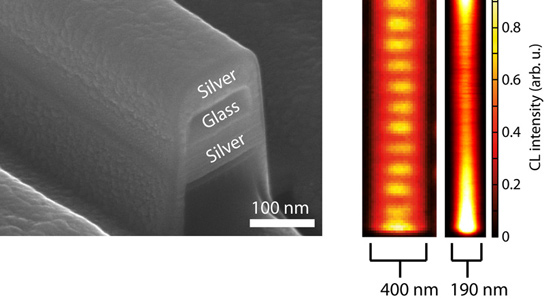
    Within the carefully sculpted waveguide, (left) light waves typically overlap to make a banded pattern (middle). However, depending on the width of the waveguide, waves of a certain wavelength travel infinitely fast, making the whole waveguide light up. Credit: AMOLF and University of Pennsylvania

    A team of scientists and engineers report that within a nanometer-scale device, visible light can travel infinitely fast. While this won’t lead to instantaneous communication, since it would violate causality, such a device could be used as an element of optical circuitry.

    The scientists published their findings in the journal Physical Review Letters. In space, light always travels at 300,000,000 meters per second. In materials like glass, light is slower and it depends upon the material’s index of refraction.

    Scientists have begun to manipulate the interactions of light and matter by tuning the refractive index in strange ways, like making it negative. This leads to an unusual bending of light.

    In this study, scientists have developed a nanoscale device in which the index of refraction for visible light is zero, implying that light waves of a particular wavelength travel infinitely fast.

    The device is made up of a rectangular bar of insulating silicon dioxide, 85 nanometers thick and 2,000 nanometers long, surrounded by conducting silver, which light can’t generally penetrate. This light-conveying chamber is called a waveguide and researchers have fashioned different devices in which the silicon dioxide ranges from 120 to 400 nanometers.

    In such a waveguide, light behaves differently because electromagnetic fields must obey certain boundary conditions on the side of the device. Short wavelengths of light are bounced back and forth between the ends of these devices. The peaks and troughs of the counter-propagating light waves overlap to create a pattern of bright and dark bands that looks like pressure patterns with a ringing organ pipe.

    At the cutoff wavelength, things get interesting. Instead of producing a banded pattern, the whole waveguide lights up. That means that instead of acting as waves with phase fronts, the wave behaves as if its peaks are moving infinitely fast and everywhere at once and the light oscillates in synchrony along the length of the waveguide.

    Light has two speeds. The phase velocity describes how fast waves of a given wavelength move and the group velocity describes how fast light conveys energy or information. Only the group velocity must stay below the speed of light in a vacuum.

    Reference: “Experimental Verification of n=0 Structures for Visible Light” by Ernst Jan R. Vesseur, Toon Coenen, Humeyra Caglayan, Nader Engheta and Albert Polman, 2 January 2013, Physical Review Letters.
    DOI: 10.1103/PhysRevLett.110.013902

    Never miss a breakthrough: Join the SciTechDaily newsletter.
    Follow us on Google and Google News.

    Light Nanotechnology
    Share. Facebook Twitter Pinterest LinkedIn Email Reddit

    Related Articles

    ICARUS Experiment Claims Neutrinos Aren’t Faster Than Light

    New Nanofabrication Process for Metamaterials

    Researchers Explain Mysterious Nanoscale Crop Circles

    Researchers Discover Electrical Switch for Magnetic Current

    Possible Mistakes Found in Faster Than Light Neutrino Measurement

    Researchers Create Electron Vortex Beams Inside Electron Microscopes

    Two-Dimensional Polymers Created for the First Time

    JILA Scientists Create the World’s First Extreme Ultraviolet (EUV) Frequency Comb

    Researchers Demonstrate a Quantum Connection Between Light and Mechanics

    2 Comments

    1. Stephen on May 3, 2013 3:40 pm

      If phase velocity cannot carry energy or information,
      how can it be used in optical processing?
      If the light can’t even transmit its “on” state,
      how can it be detected in a time interval approaching zero?
      (I’m just an engineer, not a physicist)

      Reply
    2. Kevin A Murphy on July 27, 2022 10:56 am

      Hi,
      I have been fascinated with a concept of predicting the future by harnessing the speed of light inside waveguide in the shape of the infinity symbol so I can win the Powerball Lottery (whenever I wanted to). I would settle for harnessing this concept purely for science fiction. Where the waveguide of the infinity figure eight passes over each other is where I would attempt to measure time within the passing speed of light which should be somewhere between infinitely small and infinitely large. This is where I start to lose myself. Best regards and sorry for disturbing your reality with sci fi.

      Reply
    Leave A Reply Cancel Reply

    • Facebook
    • Twitter
    • Pinterest
    • YouTube

    Don't Miss a Discovery

    Subscribe for the Latest in Science & Tech!

    Trending News

    Scientists Discover Gut Signal That Turns Off Sugar Cravings

    Scientists Discover Rogue Gene That Could Unlock New Cancer Treatments

    Constantly Tired? Scientists Say These Vitamin Deficiencies May Be Why

    A Surprising Discovery Inside Fish Could Change What We Know About the Ocean

    Scientists May Have Finally Solved the Mystery of the Strange Hum Heard Around the World

    A Cannibal Star Finally Solves One of Astronomy’s Biggest Mysteries

    Scientists Finally Uncover How a “Forever Chemical” Causes Birth Defects

    Scientists Uncover the Earliest Brain Changes That May Predict Alzheimer’s Decades Before Symptoms

    Follow SciTechDaily
    • Facebook
    • Twitter
    • YouTube
    • Pinterest
    • Newsletter
    • RSS
    SciTech News
    • Biology News
    • Chemistry News
    • Earth News
    • Health News
    • Physics News
    • Science News
    • Space News
    • Technology News
    Recent Posts
    • Oak Trees Outsmart Caterpillars With a Brilliant Spring Trick
    • Scientists Discover a Hidden Disease Crisis Spreading Through Wild Snakes
    • Humpback Whale Stuns Scientists With 15,000 Kilometer Journey Across Oceans
    • The Laser That Once Filled a Lab Now Fits on a Tiny Chip
    • Scientists Recreate a Nuclear Fireball and Uncover Fallout’s Hidden Chemistry
    Copyright © 1998 - 2026 SciTechDaily. All Rights Reserved.
    • Science News
    • About
    • Contact
    • Editorial Board
    • Privacy Policy
    • Terms of Use

    Type above and press Enter to search. Press Esc to cancel.