
Close Menu
    Facebook X (Twitter) Instagram
    SciTechDaily
    • Biology
    • Chemistry
    • Earth
    • Health
    • Physics
    • Science
    • Space
    • Technology
    Facebook X (Twitter) Pinterest YouTube RSS
    SciTechDaily
    Home»Biology»Pitcher Plant’s Ingenious Way of Trapping Ants
    Biology

    Pitcher Plant’s Ingenious Way of Trapping Ants

    By SciTechDailyDecember 29, 2012No Comments3 Mins Read
    Facebook Twitter Pinterest Telegram LinkedIn WhatsApp Email Reddit
    Share
    Facebook Twitter LinkedIn Pinterest Telegram Email Reddit
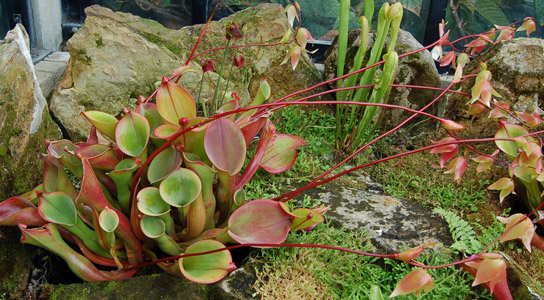
    Pitcher Plant's Ingenious Ways of Trapping Ants
     Pitcher plants. Credit: alexlomas/Flickr

    The carnivorous pitcher plant lures insects to their doom with drops of nectar. South American pitcher plants have developed an ingenious insect-trapping mechanism to keep insects from escaping their grasp.

    Plant biologist Ulrike Bauer of the University of Cambridge in the United Kingdom and colleagues published their findings in the journal Proceedings of the Royal Society B. The throat of Heliamphora nutans is covered in a pelt of tiny, precisely oriented hairs that are difficult to ascend. The hairs create a slippery, wet film on the pitcher plant’s inner walls, making it almost impossible for its victims to get a grip. They end up plunging into the bottom of the pitcher, where they drown in a pool of water.

    The features described in this study are quite sophisticated. These kinds of plants aren’t easy to study in the wild. H. nutans lives atop high plateaus in the wilds of southeastern Venezuela. Scientists need to a helicopter and a permit from the Venezuelan government to access this area. The permits aren’t easy to get, so Bauer and his team worked with specimens of the plant from the collections of London’s Royal Botanic Gardens in Kew.

    When examined with a scanning electron microscope, researchers saw that the pitcher’s throat was covered in dense hair, numbering more than 100,000 and all pointing downwards. An Asian ant species, Camponotus rufifemur, was allowed to stroll into a dry pitcher, only 29% fell into the abyss. The ants that ventured onto the longer hairs toward the bottom were the most likely to fall. When ants were released onto a wet pitcher, 88% went down the slope. The researchers dubbed this phenomenon insect aquaplaning.

    Another Asian ant species, Oecophylla smaragdina, was equipped with tiny strain gages. The team also removed the adhesive foot pads, which help ants grip onto smooth surfaces from one group, but left another group intact. The ants were then placed onto sections of a pitcher wall, which were pulled out from underneath their feet.

    In tests replicating an ant’s journey down into a pitcher, ants without adhesive pads couldn’t get a grip on a dry pitcher wall, whereas intact ants couldn’t get a grip on a wet pitcher wall but did manage to get a purchase on a dry wall. The wet pitcher surface counteracts the ant’s adhesive foot pads. The claws of the ants can’t save them because all of the hairs are pointing downward.

    Some Asian pitcher plants also use the “aquaplaning” method—a textbook example of convergent evolution, Bauer says, because Asian and South American pitchers are as related to each other “as we are to flatworms.”

    Reference: “‘Insect aquaplaning’ on a superhydrophilic hairy surface: how Heliamphora nutans Benth. pitcher plants capture prey” by Ulrike Bauer, Mathias Scharmann, Jeremy Skepper and Walter Federle, 22 February 2013, Proceedings of the Royal Society B.
    DOI: 10.1098/rspb.2012.2569

    Never miss a breakthrough: Join the SciTechDaily newsletter.
    Follow us on Google and Google News.

    Horticulture Plants
    Share. Facebook Twitter Pinterest LinkedIn Email Reddit

    Related Articles

    Beating the Freeze: Unlocking the Frost-Defying Secrets of the White Water Lily

    Roots Show Similar Growth Patterns in Space

    High Levels of Anthocyanins Give Black Dahlias Their Color

    DNA Jumps Directly From the Cell’s Chloroplasts Into Its Nucleus

    Complete Structure of the “Salvia Receptor” Revealed

    Pleistocene-Era Plant Revived from Siberian Permafrost

    Researcher Studies Root Growth to Develop Hardier, Weather-resistant Crops

    Researchers Discover Chloroplast Genomes Transfer from Plant to Plant

    Mesodinium Chamaeleon Is A Unique Life Form That is Half Plant Half Animal

    Leave A Reply Cancel Reply

    • Facebook
    • Twitter
    • Pinterest
    • YouTube

    Don't Miss a Discovery

    Subscribe for the Latest in Science & Tech!

    Trending News

    Doctors May Need To Rethink Calcium and Vitamin D Recommendations After Major Review

    Scientists Discover a Hidden Cause of Cellular Aging That Can Be Reversed

    Archaeologists Have Found Something Unexpected Inside a 1,600-Year-Old Egyptian Mummy

    Scientists May Have Found a Completely New Way To Treat Depression

    New 7-Dimensional Theory May Finally Solve the Black Hole Information Paradox

    Scientists Made Older Mice Biologically Younger Using Gut Microbes

    Scientists Finally Uncover Why Ozempic Stops Working for Some People

    Wasp Colonies Explode Into Violence After Losing Their Queen

    Follow SciTechDaily
    • Facebook
    • Twitter
    • YouTube
    • Pinterest
    • Newsletter
    • RSS
    SciTech News
    • Biology News
    • Chemistry News
    • Earth News
    • Health News
    • Physics News
    • Science News
    • Space News
    • Technology News
    Recent Posts
    • Researchers Solve the Mystery Behind a Billion-Dollar Dental Implant Disease
    • Scientists Finally Uncover How a “Forever Chemical” Causes Birth Defects
    • Scientists Uncover the Earliest Brain Changes That May Predict Alzheimer’s Decades Before Symptoms
    • Mystery Solved: The Decades-Old Secret Lurking Beneath North Carolina’s Blueberry Farms
    • Surprising New Study Challenges a Century-Old Theory of Habit Formation
    Copyright © 1998 - 2026 SciTechDaily. All Rights Reserved.
    • Science News
    • About
    • Contact
    • Editorial Board
    • Privacy Policy
    • Terms of Use

    Type above and press Enter to search. Press Esc to cancel.