
Close Menu
    Facebook X (Twitter) Instagram
    SciTechDaily
    • Biology
    • Chemistry
    • Earth
    • Health
    • Physics
    • Science
    • Space
    • Technology
    Facebook X (Twitter) Pinterest YouTube RSS
    SciTechDaily
    Home»Space»A Multi-Colored Mercury
    Space

    A Multi-Colored Mercury

    By NASAFebruary 22, 20131 Comment1 Min Read
    Facebook Twitter Pinterest Telegram LinkedIn WhatsApp Email Reddit
    Share
    Facebook Twitter LinkedIn Pinterest Telegram Email Reddit
    NASA Image of the Day A Colorful View of Mercury
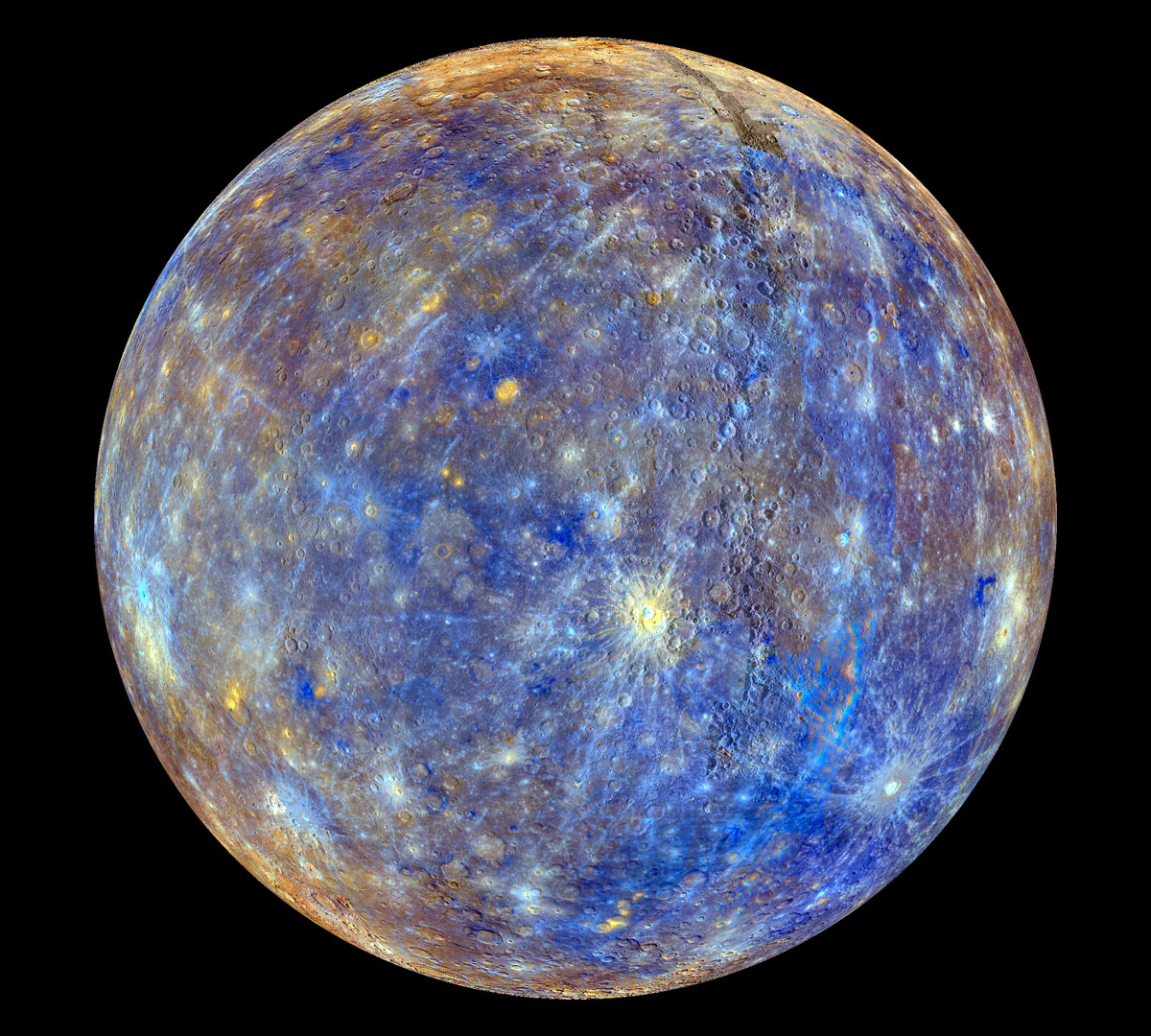
    This colorful image of Mercury was created using images from the color base map imaging campaign during MESSENGER’s primary mission. These enhanced colors highlight the chemical, mineralogical, and physical variations in Mercury’s surface, not visible to the human eye. Credit: NASA/Johns Hopkins University Applied Physics Laboratory/Carnegie Institution of Washington

    This NASA image of the day shows a multi-colored Mercury using color to enhance the differences between the rocks that make up Mercury’s surface.

    Colors of the Innermost Planet

    This colorful view of Mercury was produced by using images from the color base map imaging campaign during MESSENGER’s primary mission. These colors are not what Mercury would look like to the human eye, but rather the colors enhance the chemical, mineralogical, and physical differences between the rocks that make up Mercury’s surface.

    Never miss a breakthrough: Join the SciTechDaily newsletter.
    Follow us on Google and Google News.

    Astronomy Mercury NASA Planetary Science Popular
    Share. Facebook Twitter Pinterest LinkedIn Email Reddit

    Related Articles

    NASA Research Reveals That Mercury is Active

    Scientists Unveil the First Global Topographic Model of Mercury

    NASA’s Opportunity Discovers Geological Mystery on Mars

    NASA Data Suggests “Dry Ice” Snowfall on Mars

    “Habitable Zone” Might Help Extreme Life Forms Survive on Exoplanets

    NASA’s Kepler Mission Discovers Multiple Transiting Planets Orbiting Two Suns

    Kepler Data Used to Identify 41 New Transiting Planets

    NASA’s Curiosity Readies for First Drive on Mars

    Color HiRISE Image of Curiosity Rover on Mars

    1 Comment

    1. Madanagopal.V.C on February 22, 2013 9:01 am

      A fantastic panaromic sight indeed. There seems to be a fissure near the northern pole which is rather geometric in shape probably suggesting the tectonic plate fissures which are common in all spherical heavenly planets.The fissures should have been enhanced by a heavy meteoric fall near the site probably. Moreover the barren rocks which are igneous rocks mostly were prompted by several volcanoes in the past spewing out magma. The planet mercury is almost naked just like our moon, because of the hottest atmosphere near the Sun driving out all the gases. No cloud formation as in the case of Venus is possible. Water could have existed in the poles now either submerged as under-ground storage or evaporated away. After all it is the heavenly dance of comets which brought all the meteors and water to the members of the solar system. Even if the planet is Mercury is nearer to the Sun, the way it is gravitationally locked to the Sun for some time (and now actually it is in the reverse gear of spinning) and the alignment of Poles away from the Sun’s rays permanently should have contributed to the early collection of water and probably rivers and oceans in the distant past. The high density of meteoric impact on the planet’s surface suggests that the planet has borne the brunt of all the meteors from Oort the Cloud, i.e., through the cometary journeys innumerable, before impacting on the Sun finally.Thank You.

      Reply
    Leave A Reply Cancel Reply

    • Facebook
    • Twitter
    • Pinterest
    • YouTube

    Don't Miss a Discovery

    Subscribe for the Latest in Science & Tech!

    Trending News

    Scientists Finally Uncover How a “Forever Chemical” Causes Birth Defects

    Scientists Uncover the Earliest Brain Changes That May Predict Alzheimer’s Decades Before Symptoms

    Surprising New Study Challenges a Century-Old Theory of Habit Formation

    Scientists Turn Seawater Into Drinking Water Without Toxic Brine

    Vitamin D Drug Shows Surprising Promise Against One of the Deadliest Cancers

    NASA’s X-59 Sonic Boom Killer Is Ready for Its Biggest Test Yet

    The Best Exercise Combination for Longevity, According to a 30-Year Study

    Popular Weight-Loss Drug Found To Slow Biological Aging in Landmark Human Trial

    Follow SciTechDaily
    • Facebook
    • Twitter
    • YouTube
    • Pinterest
    • Newsletter
    • RSS
    SciTech News
    • Biology News
    • Chemistry News
    • Earth News
    • Health News
    • Physics News
    • Science News
    • Space News
    • Technology News
    Recent Posts
    • According to Scientists, This Simple Dietary Change Is Linked to Lower Depression Scores
    • Researchers Discover a Hidden Vitamin D Problem That Persists Year-Round
    • Scientists Are Building Electronics That Stretch Like Human Skin and Learn Like a Brain
    • Ancient Romans Were Obsessed With This Remarkable Herb – Then It Vanished Forever
    • AI Reveals Simple Ways To Make Your Meals Healthier and Cheaper
    Copyright © 1998 - 2026 SciTechDaily. All Rights Reserved.
    • Science News
    • About
    • Contact
    • Editorial Board
    • Privacy Policy
    • Terms of Use

    Type above and press Enter to search. Press Esc to cancel.