

Close Menu
    Facebook X (Twitter) Instagram
    SciTechDaily
    • Biology
    • Chemistry
    • Earth
    • Health
    • Physics
    • Science
    • Space
    • Technology
    Facebook X (Twitter) Pinterest YouTube RSS
    SciTechDaily
    Home»Health»Scientists Find a “Pain Switch” That Could Shut Down Arthritis Pain
    Health

    Scientists Find a “Pain Switch” That Could Shut Down Arthritis Pain

    By University of WarwickSeptember 28, 20262 Comments3 Mins Read
    Facebook Twitter Pinterest Telegram LinkedIn WhatsApp Email Reddit
    Share
    Facebook Twitter LinkedIn Pinterest Telegram Email Reddit
    Bilateral Knee Joint Pain Inflammation
    Researchers have identified a heat-sensing protein that may play an unexpected role in chronic arthritis pain. Credit: Shutterstock

    A protein involved in sensing warmth could offer a way to relieve arthritis pain without reducing inflammation, based on experiments in mice.

    For people with arthritis, pain relief can be incomplete or short-lived even with treatment. Scientists at the University of Warwick have identified a possible way to interrupt that pain directly at nerve endings by blocking a protein called TRPM2 that helps the body detect gentle warmth.

    In mice, a single injection of a drug that blocks TRPM2 completely reversed arthritis pain, with relief lasting two days. The inflammation in the treated joint persisted, suggesting that researchers could target the pain without having to suppress the underlying inflammation.

    Blocking pain while inflammation persists

    Chronic pain, including arthritis pain, affects more than a third of adults in the United Kingdom. Existing treatments include methotrexate and nonsteroidal anti-inflammatory drugs (NSAIDs), which act on immune activity or inflammation. Treatments that suppress the immune system can also leave patients more vulnerable to infection.
    The new research, published in PNAS, instead focuses on how sensory nerves turn signals from the body into pain. Its findings identify a potential treatment target, with pain relief demonstrated so far in mice.

    Lead author Dr. Xuming Zhang, of Warwick’s School of Life Sciences, said, “What surprised us most was how completely and how long TRPM2 blockade relieved chronic arthritis pain. That points to TRPM2 as a genuinely promising drug target for treating chronic pain more effectively than current options allow.”
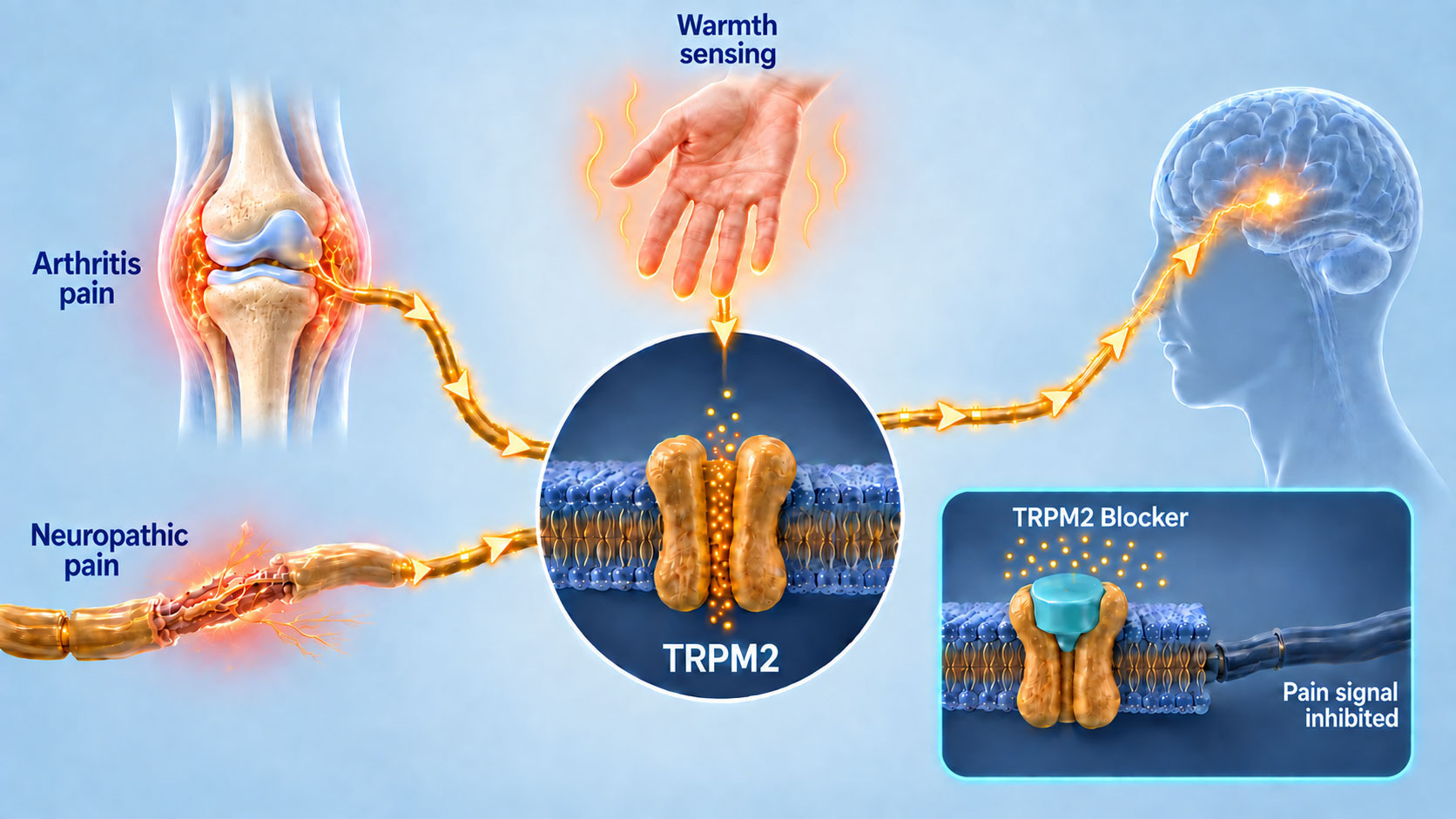
    Artistic Illustration of TRPM2 Channels in Chronic Pain
    TRPM2 channels are expressed in immune inflammatory cells participating in immune inflammation and pain. In this research, we demonstrated that TRPM2 channels in sensory neurons are essential to directly transduce chronic arthritis pain and neuropathic pain with little involvement of TRPM2 in immune inflammatory cells. Credit: Dr Xuming Zhang / University of Warwick

    Two triggers, one pain switch

    The drug experiment was supported by tests in mice whose nerve cells lacked TRPM2. Removing the protein substantially reduced chronic arthritis pain and pain from nerve injury, while the underlying immune and inflammatory responses continued largely as normal.

    Removing TRPM2 also completely prevented pain caused by two specific triggers. One was prostaglandin E2, a chemical released during inflammation. The other was autoantibodies, immune proteins that target the body’s own tissues.

    The researchers found that both triggers act directly on TRPM2, which forms a channel in sensory nerve cells. This gives the protein a role in generating pain as well as detecting mild, nonpainful warmth.

    “We found that TRPM2 works like a convergent pain switch, taking very different immune and inflammatory signals and converting them into the electrical impulses that the brain reads as pain,” said Zhang. “These signals also switch TRPM2 on through completely unexpected routes, bypassing the cell’s usual signaling pathways entirely.”

    How TRPM2 handles those two different jobs remains unresolved. Zhang’s team suggests that separate populations of nerve cells carrying the protein may be responsible for sensing harmless warmth and driving persistent pain, a possibility they hope to investigate next.

    Reference: “TRPM2 is a direct pain transducer” by Linda Varghese, Mujahid Alizada, Jinquan Yang, Ye Feng, Xiaoqiu Yuan, Mitali Malhotra and Xuming Zhang, 16 September 2026, Proceedings of the National Academy of Sciences.
    DOI: 10.1073/pnas.2532289123

    This study was funded by the UK Medical Research Council (MR/V04077/2), BBSRC (BB/T01668X/2), and Versus Arthritis UK (21971).

    Never miss a breakthrough: Join the SciTechDaily newsletter.
    Follow us on Google and Google News.

    Arthritis Chronic Pain Neuroscience Pain Management Popular University of Warwick
    Share. Facebook Twitter Pinterest LinkedIn Email Reddit

    Related Articles

    Researchers Have Discovered a New Way To Reduce Chronic Nerve Pain

    Common Osteoarthritis Treatment Fails a Major Test

    Stanford Scientists Discover Hidden Brain Circuit That Fuels Chronic Pain

    Brain’s “Pain Map” Discovered: Scientists Find Opioid-Free Path to Relief

    Scientists Uncover the Brain’s Hidden Pain Switch

    Antipsychotic Drug Opens New Pathway To Beat Chronic Pain

    Social Isolation Increases Your Risk of Dementia by 26% and Shrinks Your Brain

    Natural Painkiller: New Research Advances the Treatment of Chronic Pain

    Pioneering Sensory Neuron Replication: New Technique to Fast-Track Pain Research

    2 Comments

    1. Fred McGillicuddy on September 29, 2026 5:35 pm

      That pain is trying to send you a message. Why would you want to cover it up?

      Reply
    2. Don on September 29, 2026 6:26 pm

      If you just cover up the pain, but ignore the cause, it’s like putting a piece of electrical tape over the check engine light on a car dashboard. Use some of that science and focus on fixing the root cause of the pain.

      Reply
    Leave A Reply Cancel Reply

    • Facebook
    • Twitter
    • Pinterest
    • YouTube

    Don't Miss a Discovery

    Subscribe for the Latest in Science & Tech!

    Trending News

    Scientists Find an Unexpected Way To Fight Knee Arthritis

    Look Up: Dragon Fireballs, Disappearing Planets, Hunter’s Moon Fill October’s Spooky Skies

    Hubble Spots a Bizarre Galaxy Whose Center Rotates Sideways

    Humpback Whale Mother Stays Beside Her Dead Calf in Heartbreaking Encounter

    A Giant Diplodocus Just Turned Up Where Scientists Never Expected

    Red Meat Contains a Sugar Humans Can’t Make – Scientists Think It May Trigger Inflammation

    This Strange New Magnetism Could Change How Computers Work

    Scientists Decode a 12,000-Year-Old Mystery Hidden in Ancient Spear Points

    Follow SciTechDaily
    • Facebook
    • Twitter
    • YouTube
    • Pinterest
    • Newsletter
    • RSS
    SciTech News
    • Biology News
    • Chemistry News
    • Earth News
    • Health News
    • Physics News
    • Science News
    • Space News
    • Technology News
    Recent Posts
    • Scientists Discover a Surprising Link Between Obesity and Dementia Survival
    • One-Third of Older Adults With Cognitive Disorders Take Drugs That Could Harm Them
    • Inflammation May Awaken Dormant Cancer Cells Years After Treatment
    • The Fossil Record May Be Missing 200 Million Years of Animal History
    • Stanford Scientists Discover We’ve Lost Ancient Gut Microbes That Traveled With Humans for Thousands of Years
    Copyright © 1998 - 2026 SciTechDaily. All Rights Reserved.
    • Science News
    • About
    • Contact
    • Editorial Board
    • Privacy Policy
    • Terms of Use

    Type above and press Enter to search. Press Esc to cancel.