
New research shows that it might be a good idea to look for inspiration in nature when designing load-bearing foundations for buildings.
Despite human inventiveness and ingenuity, we still lag far behind the elegant and efficient solutions forged by nature over millions of years of evolution.
This also applies for buildings, where animals and plants, have developed extremely effective digging methods, for example, that are far more energy-efficient than modern tunneling machines, and even self-repairing foundations that are unusually resistant to erosion and earthquakes (yep, we’re talking about roots here).
Researchers from all over the world are therefore seeking inspiration in nature to develop the buildings of the future, and researchers from Aarhus University and University of California Davis have now in collaboration published an article in the scientific journal Acta Geotechnica about constructing foundations inspired by the scales on a snake.
Snakeskin Geometry and Soil Interaction
“Previous studies have shown that surface geometry inspired by snakeskin can result in different shear strengths, depending on the load direction. We’ve taken this knowledge one step further in this research and investigated the interaction between different soil types and these snakeskin surfaces,” says Assistant Professor Hans Henning Stutz from the Department of Civil and Architectural Engineering at Aarhus University.
Modern pile foundations are usually made by driving, drilling, or pushing piles into the ground to achieve sufficient bearing capacity for a building.
Today, the piles are usually prefabricated with quadratic or circular cross-sections and a load-bearing capacity that is isotropic (identical in all shear directions) due to the mainly symmetrical, smooth profile of the surface.
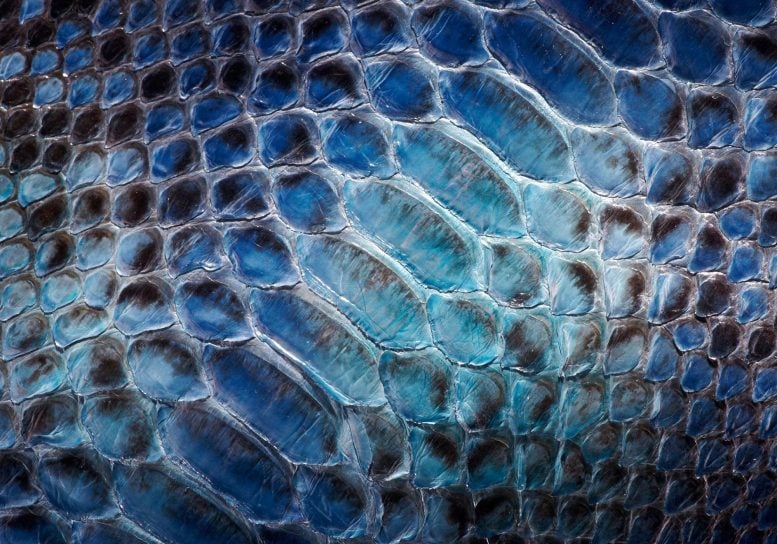
However, in the study, the researchers experimented with asymmetric micro-structural features on the surface, resembling the scales along the underside of a snake. These so-called ventral scales are elongated in shape, relatively smooth, and have cross-sections shaped like an elongated, right-angled triangle.
Significant Efficiency Gains in Lab Testing
“By experimenting with ‘scales’ measuring 0.5 mm in height and 20-60 mm in length, we’ve achieved — in lab conditions — a significantly increased load-bearing capacity in the media we’ve examined: more specifically different types of sand. The results of the project show that piles with this surface pattern give 25-50 percent less resistance during installation compared with the pressure they can subsequently support,” says Hans Henning Stutz.
According to the assistant professor, there is still a lot to be gained from biology when optimizing structures and durable foundations, and he believes that future construction will find much more inspiration in biology.
“Evolution has come up with some quite inspiring solutions during the ages, and there’s a lot to be gained in a geotechnical perspective. I’m convinced that in the future we’ll see major developments in bio-inspired and very effective solutions, especially in areas such as anchoring, tunnels, and marine constructions,” he says.
Reference: “Directionally dependent strength and dilatancy behavior of soil–structure interfaces” by Hans Henning Stutz and Alejandro Martinez, 28 April 2021 Acta Geotechnica.
DOI: 10.1007/s11440-021-01199-5
Never miss a breakthrough: Join the SciTechDaily newsletter.
Follow us on Google and Google News.