
Close Menu
    Facebook X (Twitter) Instagram
    SciTechDaily
    • Biology
    • Chemistry
    • Earth
    • Health
    • Physics
    • Science
    • Space
    • Technology
    Facebook X (Twitter) Pinterest YouTube RSS
    SciTechDaily
    Home»Space»NASA’s Psyche Launches: Liftoff at 5 Million Pounds of Thrust
    Space

    NASA’s Psyche Launches: Liftoff at 5 Million Pounds of Thrust

    By NASAOctober 13, 2023No Comments3 Mins Read
    Facebook Twitter Pinterest Telegram LinkedIn WhatsApp Email Reddit
    Share
    Facebook Twitter LinkedIn Pinterest Telegram Email Reddit
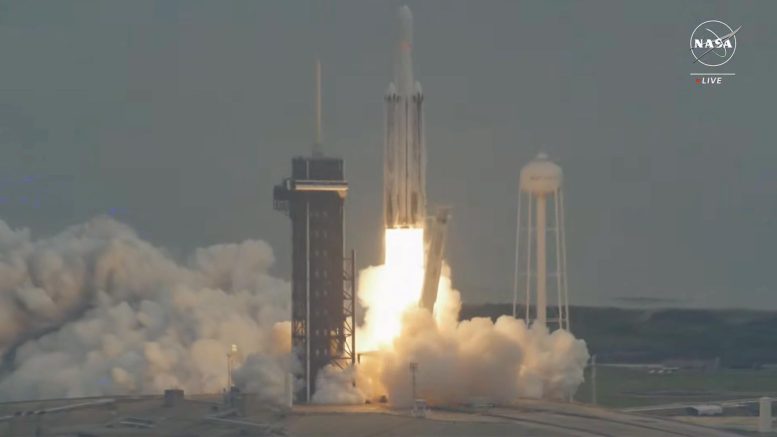
    NASA Psyche and DSOC Experiment Liftoff
    NASA’s Psyche spacecraft, in collaboration with the DSOC technology demonstration, has successfully launched from Florida’s Kennedy Space Center. The launch utilized SpaceX’s Falcon Heavy, which comprises three Falcon 9 boosters, and its 27 Merlin engines produced over 5 million pounds of thrust. Credit: NASA TV

    We have liftoff! NASA’s Psyche spacecraft, along with the agency’s DSOC (Deep Space Optical Communications) technology demonstration, launched from Launch Complex 39A at Kennedy Space Center in Florida at 10:19 a.m. EDT.

    The Falcon Heavy’s 27 Merlin engines are generating more than 5,000,000 pounds of thrust, quickly pushing the vehicle through the atmosphere and away from the Florida spaceport. The Falcon Heavy first stage consists of three Falcon 9 boosters strapped together – two sides and a central booster. An upper second stage atop the central booster carries the Psyche spacecraft.

    SpaceX will land the side boosters in about eight minutes at Landing Zones 1 and 2 at Cape Canaveral Space Force Station, nearby Kennedy.

    Coming up next, the launch vehicle will reach Max Q, or moment of peak mechanical stress on rocket, followed by booster engine cutoff just over a minute later.

    10:22 a.m. – Launch Vehicle Reaches Max Q, Booster Engines Cutoff

    The Falcon Heavy passed Max Q, or the moment of peak mechanical stress on the rocket, and reached booster engine cutoff (BECO), where both boosters cease firing and separate from the center core to begin their descent back to Earth. They have begun their journey back to Landing Zones 1 and 2 at Cape Canaveral Space Force Station in Florida, which will be followed in a few minutes by separation of the central booster from the second stage that carries the Psyche spacecraft.

    10:25 a.m. – Separation of First and Second Stages, Second Engine Starts

    Just moments ago, the first and second stages of the Falcon Heavy center core separated, and the second stage engine started.

    10:28 a.m. – Successful Landing of Side Boosters

    The side boosters from the Falcon Heavy have landed successfully at SpaceX’s Landing Zone 1 and Landing Zone 2 at Cape Canaveral Space Force Station in Florida, nearby Kennedy Space Center.

    10:29 a.m. – Second Stage Engine Cutoff Reached

    The initial second stage engine cutoff (SECO-1) is complete. The second stage engine will restart for its second burn (SES-2) in just about 44 minutes. This second burn (SECO-2) will give the Psyche spacecraft the additional thrust needed to escape Earth’s gravity, after which the spacecraft will separate from the second stage. The deployed Psyche spacecraft will then continue its roughly six-year journey to the asteroid Psyche.

    11:23 a.m. – Psyche Spacecraft Separates From Falcon Heavy Second Stage

    The Psyche spacecraft separated from the SpaceX Falcon Heavy second stage. Psyche mission control has acquired the carrier wave signal, which provides real-time data prior to deployment of the spacecraft’s solar arrays and before full acquisition of signal, expected in the next few hours.

    While NASA’s DSOC (Deep Space Optical Communications) – integrated on the Psyche spacecraft – will begin its demonstration in the weeks after launch, the tech demo will not relay Psyche mission data. The success of each project is evaluated independently of the other.

    Never miss a breakthrough: Join the SciTechDaily newsletter.
    Follow us on Google and Google News.

    NASA NASA Psyche
    Share. Facebook Twitter Pinterest LinkedIn Email Reddit

    Related Articles

    NASA’s Psyche Spacecraft Just Used Mars as a Giant Slingshot

    NASA’s Psyche Spacecraft Is About To Fly Shockingly Close to Mars

    NASA’s Psyche Could Reveal the Secret Inside This Metal World

    NASA Is Sending a Spacecraft to Asteroid 16 Psyche – It Might Not Be What Scientists Expected

    NASA’s Metal Mission: Final Assembly of Psyche Spacecraft Begins – Destined to Explore a Metal-Rich Asteroid

    NASA’s Psyche Mission to Explore a Metal-Rich Asteroid Passes Key Milestone

    NASA’s Big Plans to Explore Small Bodies: DART, Lucy, and Psyche Missions

    Ring of Firepower: Electric Hall Thruster for NASA’s Psyche Spacecraft Propulsion

    Design Complete for NASA’s Psyche – Spacecraft to Explore a Metal-Rich Asteroid

    Leave A Reply Cancel Reply

    • Facebook
    • Twitter
    • Pinterest
    • YouTube

    Don't Miss a Discovery

    Subscribe for the Latest in Science & Tech!

    Trending News

    This Copper Drug Clears Alzheimer’s Brain Toxins and Boosts Memory

    Adults Over 65 Lost Massive Amounts of Weight With Ozempic

    How Flocking Birds “Defy” One of Physics’ Most Fundamental Laws

    Physicists Create a New Kind of Schrödinger’s Cat State From Exotic Quantum Building Blocks

    Your Diet Could Be Missing the Key Ingredient for Heart Protection

    Researchers Warn Widely Prescribed Blood Pressure Drugs Could Be Harming Diabetic Kidneys

    James Webb Spots Something Strange Between Day and Night on an Alien Planet

    How Ancient People Moved a 6-Ton Stone 700 Kilometers to Stonehenge

    Follow SciTechDaily
    • Facebook
    • Twitter
    • YouTube
    • Pinterest
    • Newsletter
    • RSS
    SciTech News
    • Biology News
    • Chemistry News
    • Earth News
    • Health News
    • Physics News
    • Science News
    • Space News
    • Technology News
    Recent Posts
    • Scientists Just Found Something Weird Inside Moss
    • Scientists Just Repeated a Nobel Prize-Winning Experiment in a Creature Older Than Jellyfish
    • Scientists Finally Uncover Why Solid-State Batteries Short-Circuit
    • Scientists Discover the “Achilles’ Heel” of Two of the World’s Deadliest Diarrhea Bacteria
    • Why Older Adults Need To Pay Closer Attention to Vitamin B12
    Copyright © 1998 - 2026 SciTechDaily. All Rights Reserved.
    • Science News
    • About
    • Contact
    • Editorial Board
    • Privacy Policy
    • Terms of Use

    Type above and press Enter to search. Press Esc to cancel.