
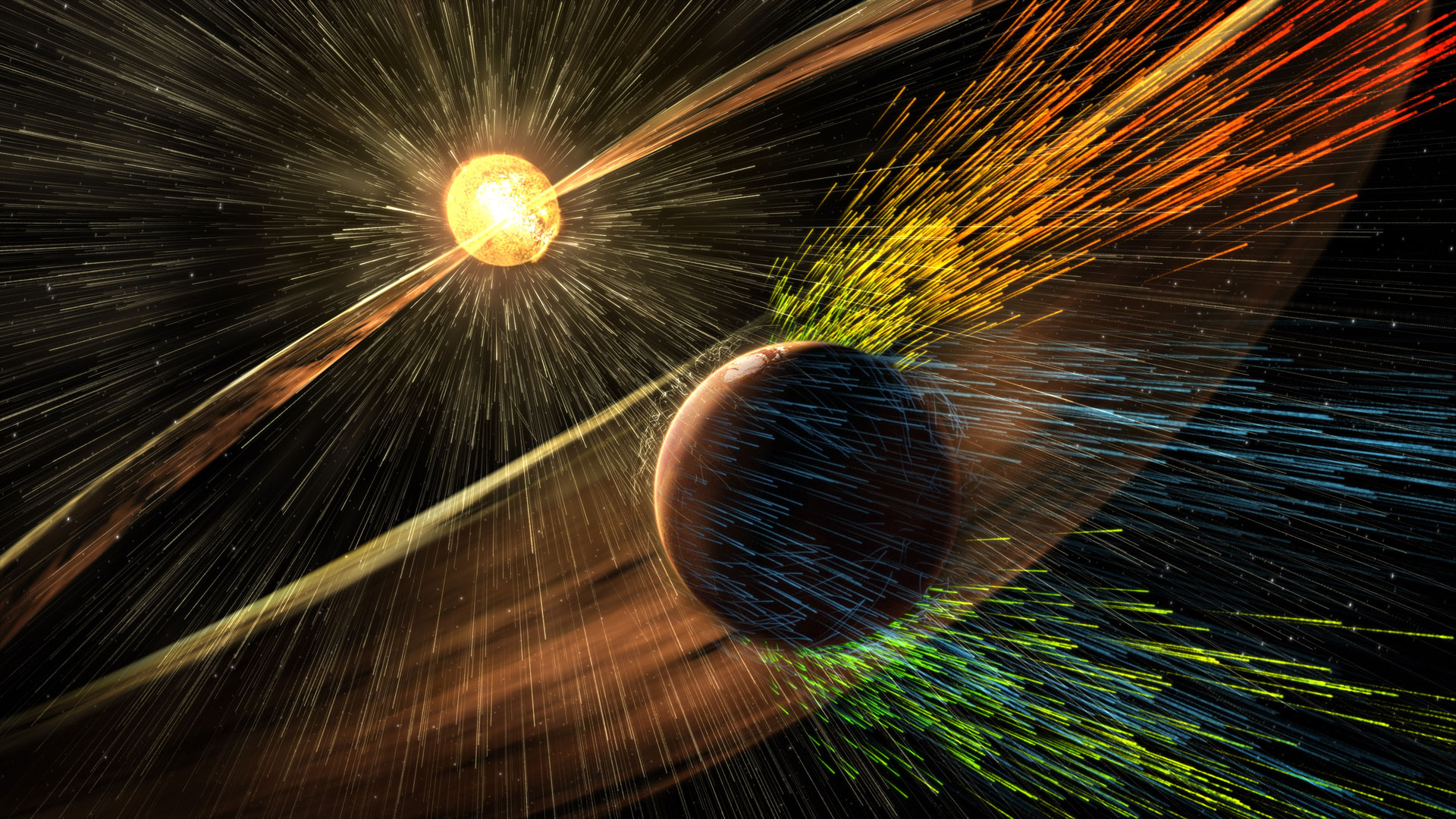
Kelvin–Helmholtz waves may help the solar wind strip atmospheric particles from Mars.
Mars is continually exposed to a stream of charged particles racing outward from the Sun. Earth’s global magnetic field deflects much of this solar wind, but Mars lacks a comparable shield. The flow can therefore strike the planet’s upper atmosphere directly and gradually carry some of its particles into space.
Researchers led by Boston University have identified one way this atmospheric loss may occur. Their study, published in Science Advances, found that the solar wind can disturb the outer edge of the Martian atmosphere much as wind agitates the surface of water. The interaction produces large rolling structures called Kelvin–Helmholtz waves, which can help pull atmospheric material away from the planet.
Two spacecraft reveal the missing link
First author Chi Zhang, a research scientist at BU’s Center for Space Physics, worked with colleagues using measurements from NASA’s MAVEN spacecraft and China’s Tianwen-1 mission. The Center for Space Physics is a collaboration between BU’s College of Arts & Sciences and College of Engineering.
Tianwen-1 measured the undisturbed solar wind before it reached Mars, while MAVEN detected atmospheric ions escaping closer to the planet. Combining the observations allowed the researchers to compare real-time solar wind conditions directly with changes in the loss of Martian atmospheric particles.
Scientists already knew that large clouds of plasma in Mars’ upper atmosphere can carry away groups of ions through a process known as “bulk escape.” Several possible explanations had been proposed for how these clouds formed, but their origin remained uncertain because researchers lacked direct observational evidence.
A single spacecraft could not solve the problem because it could not simultaneously measure the upstream solar wind and the escaping ions near Mars. In an earlier study published in Nature Communications, Zhang and colleagues showed that coordinated observations from MAVEN and Tianwen-1 could connect changes in the incoming solar wind with conditions around the planet.
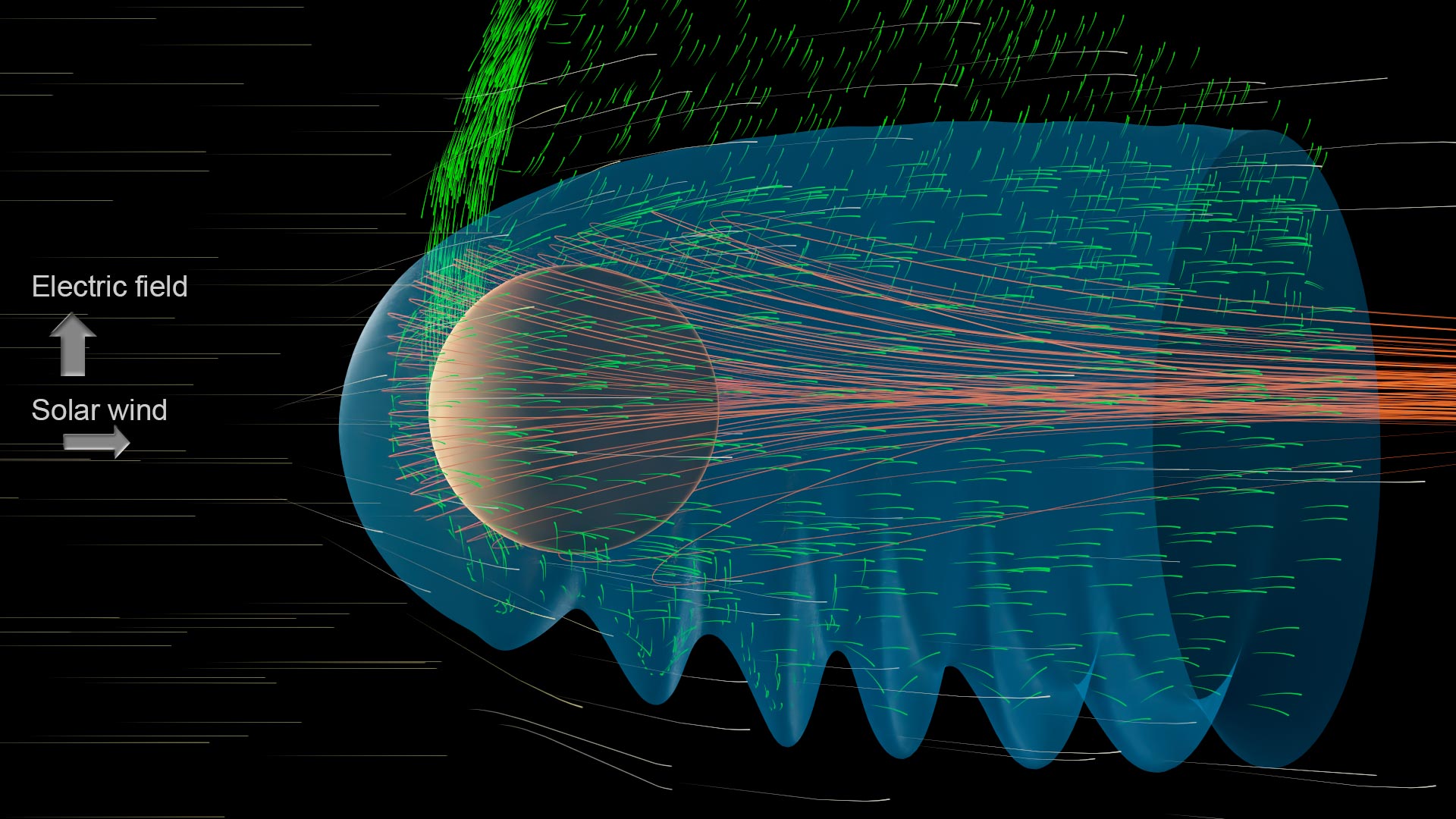
Using that same two-spacecraft approach, the Science Advances study identified Kelvin–Helmholtz waves as an important driver of atmospheric ion escape. The waves form where moving plasma flows past the edge of Mars’ upper atmosphere, stirring the boundary and producing large clouds that can carry atmospheric particles outward.
Atmospheric escape favors one side
Zhang and colleagues found direct evidence that Kelvin–Helmholtz waves generated the observed plasma clouds. The measurements also showed that the resulting atmospheric loss was not distributed evenly around Mars.
“Instead, it is mainly observed on one side of the planet, depending on the direction of the solar wind electric field,” said Zhang.
The direction of that electric field appears to determine where the waves form most effectively and where the enhanced escape occurs. The results therefore connect the incoming solar wind, the development of Kelvin–Helmholtz waves and the removal of atmospheric ions in one observational sequence.
Future missions will measure the impact
Researchers still need to determine how frequently these waves form, which solar wind conditions strengthen them, and how much of Mars’ total atmospheric loss they produce.
“Future research will focus on identifying the conditions that favor the formation and growth of Kelvin–Helmholtz waves and determining how much they contribute to atmospheric escape from Mars,” Zhang noted.
Answering those questions will require additional spacecraft measurements and more advanced numerical simulations. MAVEN is entering the closeout stage of its mission, but Zhang said another spacecraft mission could extend this work.
“With MAVEN transitioning to the closeout stage of its mission, “its rich scientific legacy will be complemented by NASA’s ESCAPADE mission, which has already launched and will provide an important new opportunity to investigate solar-wind-driven atmospheric loss at Mars,” said Zhang.
ESCAPADE is expected to provide another opportunity to observe how solar wind conditions influence the Martian atmosphere. Those measurements could help researchers estimate the importance of Kelvin–Helmholtz waves relative to other processes that remove atmospheric particles.
“We want to know when these waves are most likely to form, how they evolve, and how strongly they can drive atmospheric escape,” said Chuanfei Dong, a BU Center for Space Physics faculty member and a College of Arts & Sciences assistant professor of astronomy. “This process could also occur on other planets that lack a strong magnetic field, including some exoplanets.”
The findings may therefore apply beyond Mars. Planets without strong global magnetic fields could experience similar boundary waves when stellar winds interact directly with their upper atmospheres.
“Mars is thought to have once been potentially habitable, with a thicker atmosphere and surface liquid water. Understanding how it became the cold, dry planet we see today is important for understanding how planetary environments evolve over time,” said Zhang.
References: “Simultaneous Mars-orbit observations reveal Kelvin-Helmholtz instability–driven bulk atmospheric ion escape” by Chi Zhang, Chuanfei Dong, Gangkai Poh, Jasper Halekas, Xuanye Ma, Ruhunusiri Suranga, Kathleen G. Hanley, Han-Wen Shen, Hongyang Zhou, Xinmin Li, Liang Wang, Jiawei Gao, Shannon Curry and Christian Mazelle, 31 July 2026, Science Advances.
DOI: 10.1126/sciadv.aed9072
“Anomalous transient enhancement of planetary ion escape at Mars” by Chi Zhang, Chuanfei Dong, Hongyang Zhou, Jasper Halekas, Masatoshi Yamauchi, Hans Nilsson, Terry Z. Liu, Moa Persson, Shannon Curry, Yaxue Dong, Yoshifumi Futaana, Yuxi Chen, Muni Zhou, Ruhunusiri Suranga, Kathleen G. Hanley, Christian Mazelle, Shaosui Xu, Robin Ramstad, Mats Holmström and Li-Jen Chen, 2 April 2025, Nature Communications.
DOI: 10.1038/s41467-025-58351-y
This work was supported by the NASA grant NNH10CC04C under the MAVEN project (to S.C.), the NASA Solar System Workings grants 80NSSC23K0911 (to C.D.) and 80NSSC24K1843 (to C.F.D.), the Alfred P. Sloan Research Fellowship (to C.D.), and the IBM Einstein Fellow Fund at the Institute for Advanced Study, Princeton (to C.D.).
Never miss a breakthrough: Join the SciTechDaily newsletter.
Follow us on Google and Google News.