
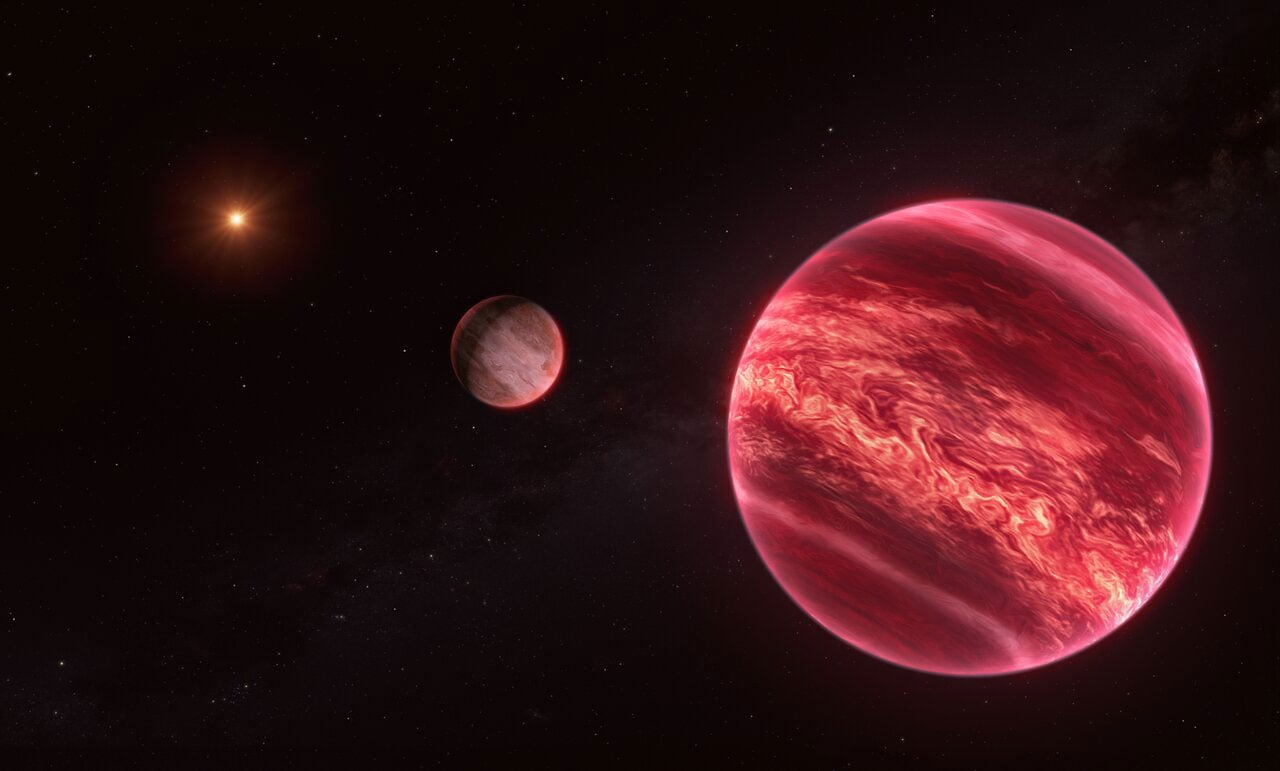
A Jupiter-mass object orbiting a brown dwarf could become the first confirmed moon beyond our Solar System.
A massive object appears to be circling a brown dwarf in the CD-35 2722 system, but calling it a moon is not straightforward. Unlike moons in our Solar System, it does not orbit a planet. Instead, it travels around a brown dwarf that itself circles the star CD-35 2722.
Observations from the European Southern Observatory’s Very Large Telescope (ESO’s VLT) provide evidence for this unusual arrangement. If the finding is confirmed, the object could become the first moon detected beyond our Solar System.
Kevin Hoy, an ESO student in Chile and lead author of the study published today in Nature, spent months analyzing a system he describes as “super weird” compared with our own. CD-35 2722, the largest and most massive member of the young system, is a star with about half the Sun’s mass. A brown dwarf, too massive to qualify as a planet but not massive enough to become a star, orbits it. The newly identified object then orbits that brown dwarf.
A giant world defies familiar labels
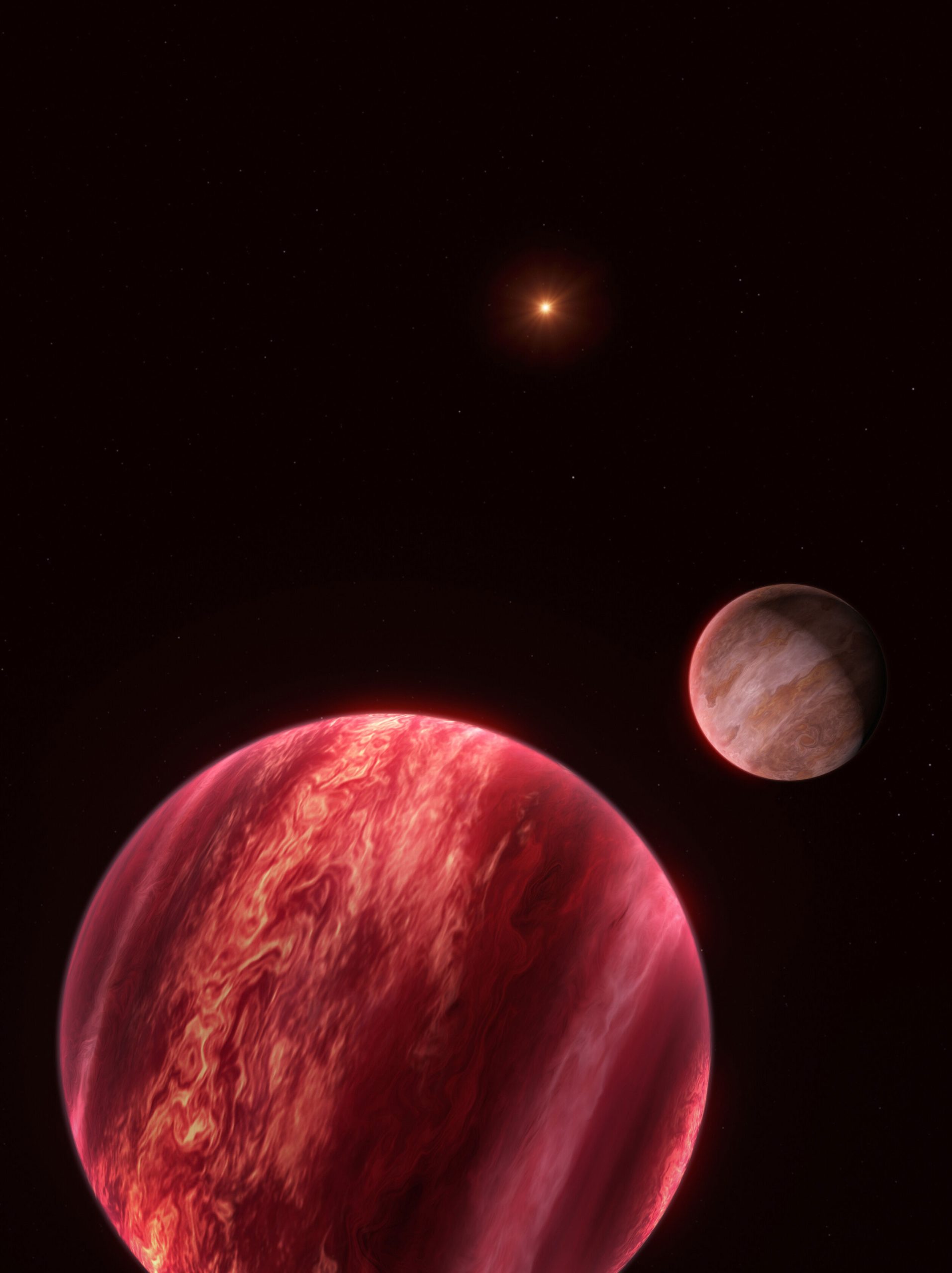
“This system is somewhat hard to define using Solar-System-based words like ‘planet’ and ‘moon’,” states Hoy, who is also affiliated with the Universidad Diego Portales and the Millennium Nucleus of Young Exoplanets and their Moons (YEMS) in Chile.
The researchers refer to the object as an exosatellite. It has at least as much mass as Jupiter, while the brown dwarf it circles is more than 30 times Jupiter’s mass.
“The exosatellite is clearly massive enough to be a planet, but it does not orbit a star, though it orbits an object that orbits a star,” says Hoy. “Being the third wheel in this system makes us want to call it a moon, even if it is nothing like the small, rocky moons we have in our system.”
The exosatellite, or ‘exomoon’, is a natural satellite outside our Solar System. Its enormous size and unusual host make it difficult to classify using categories based on the familiar structure of our own planetary system.
Alice Zurlo, YEMS Director and collaborator on the study, explains: “The satellite we report is a giant gaseous body orbiting a highly massive companion, itself several times the mass of Jupiter.”
“We have a clear delineation between the planets and the Sun in the Solar System, so defining things like moons is simple. In the CD-35 2722 system, where we are blurring the lines between stars, planets, and moons, the whole thing becomes more complicated to describe,” adds Zurlo, who is also an astrophysicist at Universidad Diego Portales.
Whatever its eventual classification, the object could resolve a long and difficult search. Astronomers have spent years looking for natural satellites beyond the Solar System, but none has yet been detected with confidence.
More than 6,000 exoplanets have been found, yet only a small number of possible exomoons have emerged, and the supporting evidence remains limited. A few months ago, a group led by Quentin Kral reported observations of the HD 206893 system made with ESO’s Very Large Telescope Interferometer. Those measurements suggested the presence of a satellite but did not produce a firm detection.
A brown dwarf wobble reveals evidence
Hoy, Zurlo and their colleagues observed CD-35 2722 using the CRIRES+ instrument on ESO’s VLT. They relied on the same general technique that revealed the first exoplanet around a Sun-like star.
Known as the radial velocity method, the approach searches for small changes in an object’s motion caused by the gravitational pull of an unseen companion. In this case, the measurements detected slight wobbles in the brown dwarf that the researchers believe were produced by the object orbiting it.
“As exotic as it is, this system is truly unique and represents a breakthrough: the first plausible detection of an exosatellite,” says Zurlo.
Future telescopes will search smaller worlds
Finding satellites in other star systems could reveal how widely their formation and evolution differ from what astronomers observe around planets in the Solar System.
ESO’s upcoming Extremely Large Telescope (ELT), equipped with a 39-meter mirror and advanced instruments, should enable astronomers to search for smaller exomoons. Those future detections may force researchers to reconsider how they define and classify objects in planetary systems that bear little resemblance to our own.
Reference: “Planetary-mass exosatellite detected around the substellar companion of a star” by Kevin Hoy, Alice Zurlo, Pablo A Peña R, Jana Köhler, Silvano Desidera, Raffaele Gratton, Cecilia Lazzoni, Simon Petrus, Florian Rodler, Jonathan Smoker, Valentina D’Orazi, Ilaria Carleo and Ilaria Giovannini, 22 July 2026, Nature.
DOI: 10.1038/s41586-026-10751-w
Funding from ANID–Millennium Science Initiative Program–Center Code NCN2024_001.
Never miss a breakthrough: Join the SciTechDaily newsletter.
Follow us on Google and Google News.