
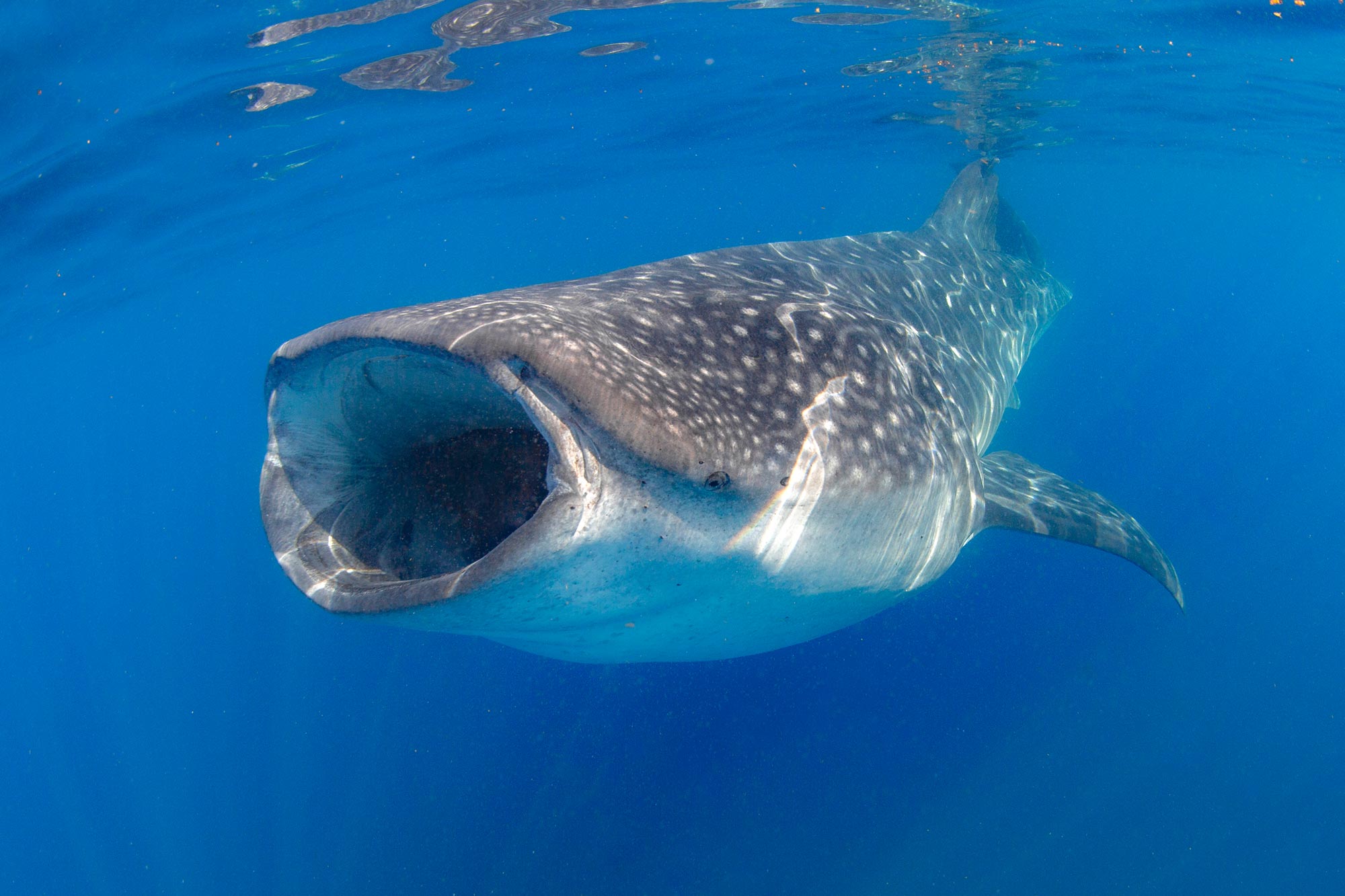
Whale sharks use a wider range of feeding strategies and depths than surface observations previously revealed.
A whale shark can vanish beneath the surface in seconds, leaving researchers with little idea of what the world’s largest fish does once it disappears from view. Whale sharks (Rhincodon typus) are among the ocean’s most recognizable animals, inspiring fascination among people fortunate enough to encounter them and strong interest in their protection.
Most knowledge of whale shark behavior has come from snorkeling encounters or observations made from boats. Because these methods cover only the ocean’s surface, much of the animals’ underwater lives has remained hidden.
Whale sharks inhabit tropical seas where prey is often scarce and unevenly distributed, forcing them to adjust continually as they search for food. Climate change may make these resources even less reliable, increasing the need to understand how the sharks feed.
In research published in Marine Biology, we attached cameras to whale sharks gathering at a tropical coastal site and followed their activity below the surface.
The footage revealed previously unseen behaviors and provided the most complete view yet of how whale sharks forage throughout the water column, from the surface to the seafloor.
Surface observations captured only fragments
Before our study, researchers mainly described whale shark behaviors from watching them in person while at the surface of the ocean.
This would only provide a snapshot of whale sharks’ full lives, and often these observations ended prematurely when the fish decided to dive deep. For example, one description of a possible mating attempt was cut short because the whale sharks dove out of sight of our research team.
A common method scientists use to investigate animal behavior in the wild is by attaching electronic tags. These small trackers provide data on movements beyond where we can see them. For marine species, that’s both away from the coast but also when diving beyond the surface.
Although info from tags is incredibly valuable to understand movement patterns, we can’t infer specific behaviors from this data – because we still can’t see the animals.
Through our new study, we could finally address the question: “What do whale sharks do when no one is watching?” Filling these research gaps is essential so we can help these majestic, yet endangered filter-feeding animals.
Shark-mounted cameras expose hidden behavior
We used tags that collect high-resolution movement data and have a small camera. The camera provided footage of the front half of the shark, along with their own point of view. It’s as close as we can get to seeing the ocean through their eyes.
With these cameras, we could see what the shark was doing while the tag was also collecting data on their movement. We attached our tag to the dorsal (top) fin while snorkeling alongside the shark. Unbothered, these gentle giants continued to swim while we watched them disappear into the open blue water.
After a pre-set 24-hour period, the clamp and camera tag fell off, leaving nothing on the animal and allowing us to retrieve the data without impacting the whale shark.
Feeding stretches from surface to seafloor
Using our video data alongside a review of more than 100 scientific publications describing whale shark behavior, we built the largest catalog of whale shark behaviors to date, defining 36 distinct behaviors.
We discovered whale sharks use a mix of several feeding behaviors throughout the water column and along the seafloor, up to 70 meters deep in our study site. Researchers previously thought whale sharks predominantly feed at the surface, but this finding challenges that assumption.
The range of feeding behaviors spanned from effectively sinking to the seafloor with an open mouth (gliding slow feeding), to vigorously swimming after krill swarms – their preferred prey – at the surface (active surface feeding).
The whale sharks in our study spent most of their time performing six low-effort feeding behaviors. This suggests they often snack in water with low prey density until they come across a patch with higher prey density, such as a krill swarm. Then, their behavior changes to active feeding. It’s like snacking from the pantry while you decide what you’re going to cook for dinner.
We also found that whale sharks have a much wider variety of foraging strategies compared to other filter-feeding megafauna, such as basking sharks and whales. This could help explain how they manage to thrive in tropical waters where prey is limited and patchy.
One site leaves larger questions
Our study captured behaviors from just one gathering of juvenile whale sharks near a coast at Ningaloo Reef, Western Australia. If researchers can attach more cameras to whale sharks at aggregation sites around the world, we will hopefully discover new insights and continue to grow our understanding of this iconic species.
Excitingly, we are beginning to understand the secret lives of the biggest fish on Earth, and from what we have seen, they are the ultimate snackers of the sea.
Reference: “An ethogram for the whale shark (Rhincodon typus) with insights into foraging plasticity” by Christine Barry, Luciana C. Ferreira, Adrian C. Gleiss, Mark G. Meekan, E. W. Misty Paig-Tran, Robert Harcourt and Michele Thums, 21 July 2026, Marine Biology.
DOI: 10.1007/s00227-026-04900-y
This research was funded by Santos Ltd. and the Australian Institute of Marine Science.
Adapted from an article originally published in The Conversation. 
Never miss a breakthrough: Join the SciTechDaily newsletter.
Follow us on Google and Google News.