

A memristor chip brought complex brain modeling into millisecond-scale operation while preserving detailed cortical structure.
Reconstructing the brain’s deeply folded surface in real time requires enormous numbers of calculations. Researchers in China have now developed a chip that performs this work in less than 10 milliseconds, a speed they say is comparable to the functioning pace of the human brain.
The research was led by Yuchao Yang of Peking University in collaboration with scientists at the Shanghai Institute of Microsystem and Information Technology, Chinese Academy of Sciences. The findings were published in Science under the title “A sub-10-millisecond neural dynamical system based on phase-change memristors.”
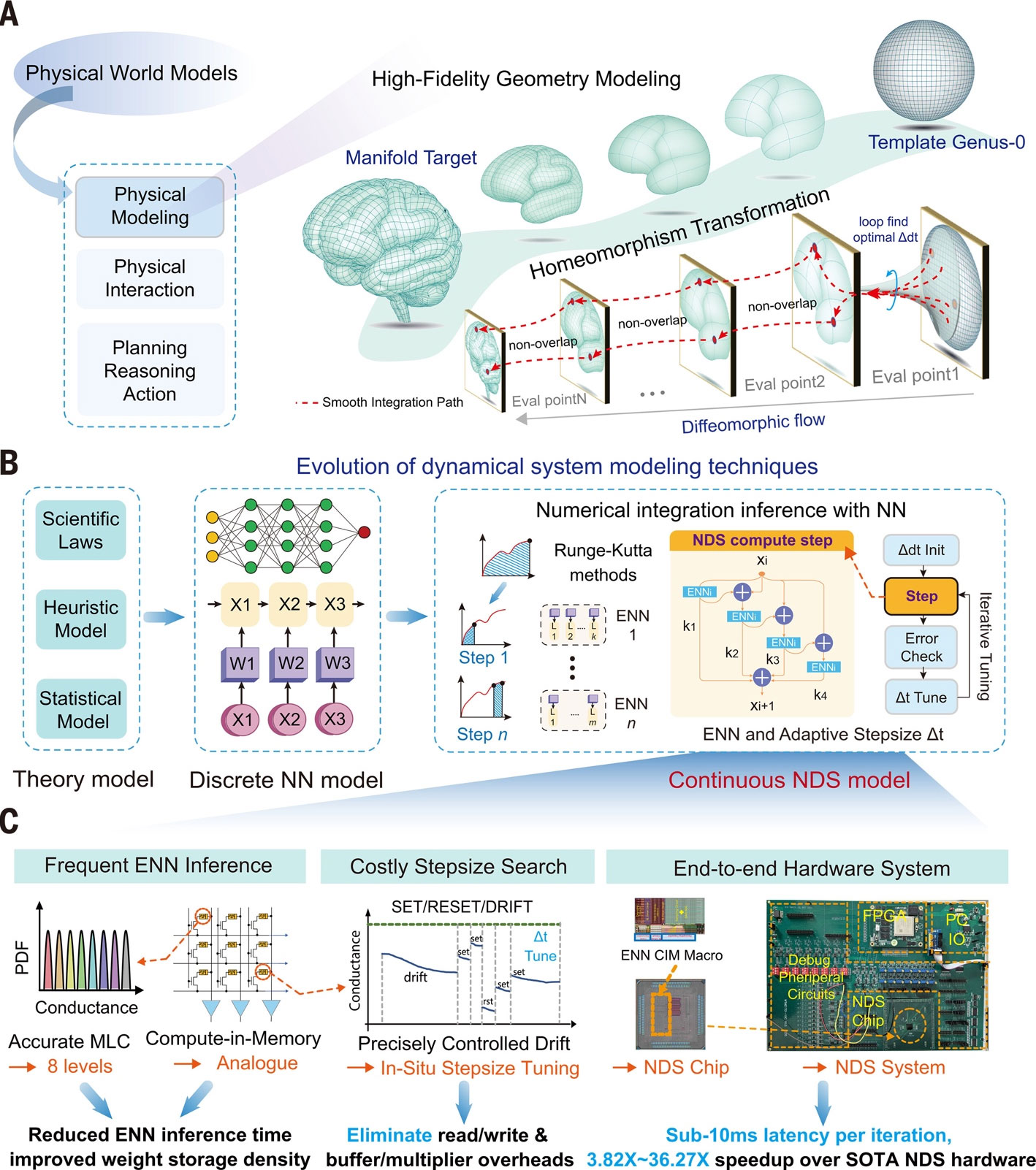
Neural dynamical systems pair neural networks with mathematical equations that track how complex systems evolve over time. They are used in physical modeling, medical imaging, and three-dimensional brain reconstruction, but they demand repeated calculations, accuracy checks, and continuous adjustments to the size of each computational step.
Conventional computers must repeatedly transfer information between memory and the processor. This movement slows processing and consumes substantial energy, creating a major obstacle for applications that require immediate results.
Calculating in memory speeds brain modeling
Real-time brain modeling could support technologies such as brain–computer interfaces, surgical navigation, and medical imaging. Current hardware, however, often takes too long and requires too much power to complete the necessary calculations.
The new chip addresses this bottleneck by performing important operations directly where the data is stored. Reducing transfers between memory and the processor allows the system to complete high-quality brain modeling faster and with less energy.
The chip outpaces specialized hardware
Built with a 40-nm manufacturing process, the chip contains in-memory computing and conductance-drift arrays covering just 0.28 square millimeters. It runs at 50 MHz and completes each integration step through nine pipeline stages.
During neural dynamics calculations, the chip operated 3.82× to 36.27× faster than state-of-the-art ASICs, or application-specific integrated circuits. It also consumed 11.75× to 24.73× less power. In cortical surface reconstruction, it achieved a speedup of as much as 478.18× compared with an NVIDIA A100 GPU.
The researchers tested the chip by reconstructing the boundaries of the brain’s white and gray matter and producing 3D manifold-based surface meshes in real time. The resulting cortical surfaces were smooth, closed, and topologically consistent while preserving the brain’s intricate folds.
The system also performed strongly on average symmetric surface distance and Hausdorff distance measurements, two methods used to assess how closely reconstructed surfaces match their targets. These results demonstrated that the chip could combine rapid processing with high-fidelity brain modeling.
By reducing complex neural modeling from slow offline computation to millisecond-scale operation, the technology could eventually support brain–computer interfaces, digital brain twins, real-time surgical navigation, brain-surface reconstruction, and research tools for neurodegenerative diseases such as Alzheimer’s and Parkinson’s.
Reference: “A sub–10-millisecond neural dynamical system based on phase-change memristors” by Lei Cai, Yaoyu Tao, Chenchen Xie, Longhao Yan, Shiqian Li, Ruihong Shen, Zelun Pan, Xile Wang, Bowen Wang, Daijing Shi, Yihang Zhu, Teng Zhang, Yixin Zhu, Xi Li, Zhitang Song, Ru Huang and Yuchao Yang, 2 July 2026, Science.
DOI: 10.1126/science.aee6277
Never miss a breakthrough: Join the SciTechDaily newsletter.
Follow us on Google and Google News.
2 Comments
Is keeping this chip cool of going to be a problem?
Not at 50MHz with a 40nm process.