
Close Menu
    Facebook X (Twitter) Instagram
    SciTechDaily
    • Biology
    • Chemistry
    • Earth
    • Health
    • Physics
    • Science
    • Space
    • Technology
    Facebook X (Twitter) Pinterest YouTube RSS
    SciTechDaily
    Home»Technology»In a Striking Discovery, AI Shows Human-Like Memory Formation
    Technology

    In a Striking Discovery, AI Shows Human-Like Memory Formation

    By Institute for Basic ScienceDecember 20, 2023No Comments4 Mins Read
    Facebook Twitter Pinterest Telegram LinkedIn WhatsApp Email Reddit
    Share
    Facebook Twitter LinkedIn Pinterest Telegram Email Reddit
    Neuroscience Brain AI Neural Network Concept
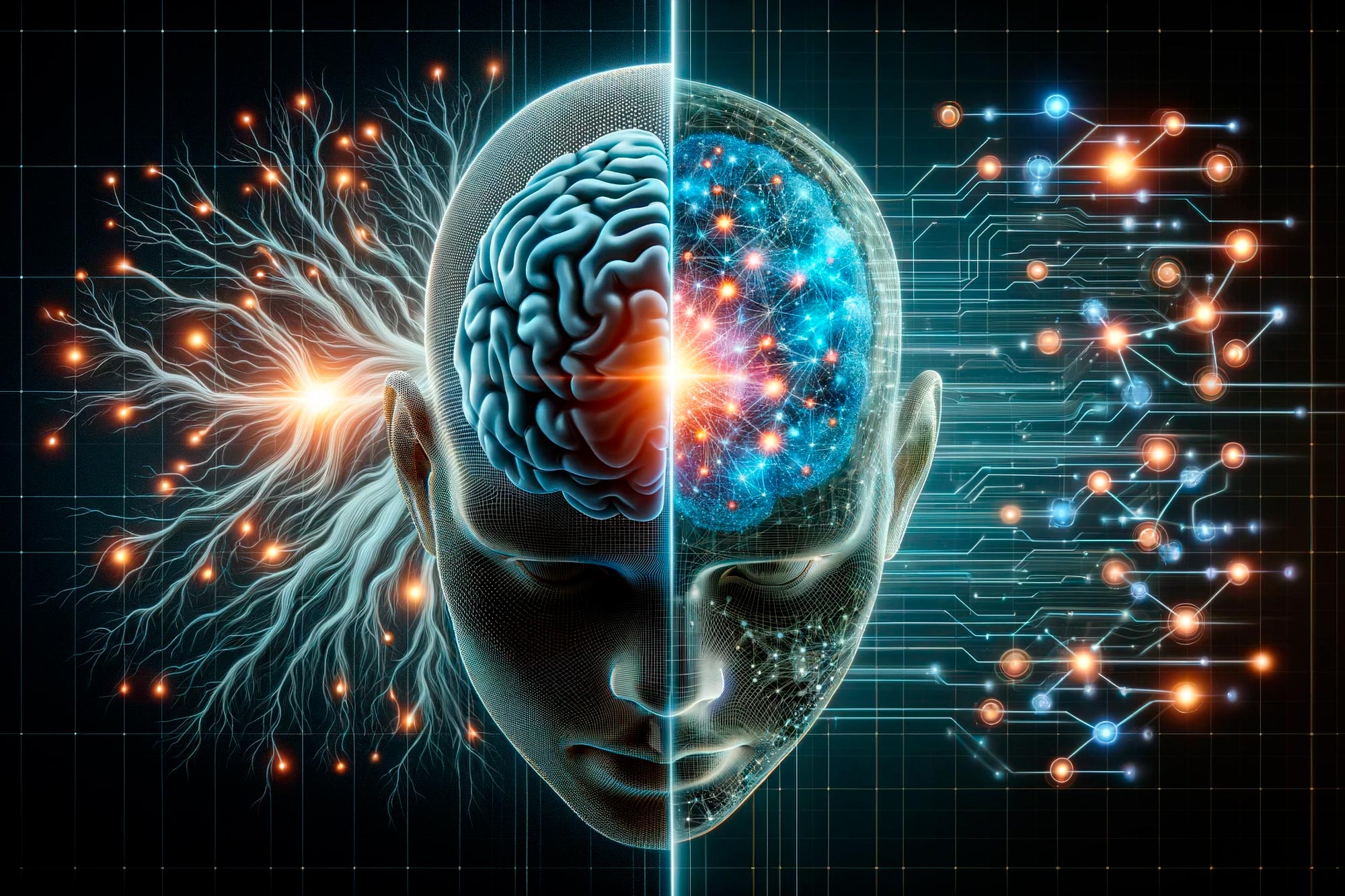
    An interdisciplinary team has found that AI models, particularly the Transformer, process memory in a manner similar to the human brain’s hippocampus. This breakthrough suggests that applying neuroscience principles, like those of the NMDA receptor, to AI can improve memory functions, advancing the field of AI and offering insights into human brain function. Credit: SciTechDaily.com

    Researchers have discovered that AI memory consolidation processes resemble those in the human brain, specifically in the hippocampus, offering potential for advancements in AI and a deeper understanding of human memory mechanisms.

    An interdisciplinary team consisting of researchers from the Center for Cognition and Sociality and the Data Science Group within the Institute for Basic Science (IBS) revealed a striking similarity between the memory processing of artificial intelligence (AI) models and the hippocampus of the human brain. This new finding provides a novel perspective on memory consolidation, which is a process that transforms short-term memories into long-term ones, in AI systems.

    Advancing AI Through Understanding Human Intelligence

    In the race towards developing Artificial General Intelligence (AGI), with influential entities like OpenAI and Google DeepMind leading the way, understanding and replicating human-like intelligence has become an important research interest. Central to these technological advancements is the Transformer model [Figure 1], whose fundamental principles are now being explored in new depth.
    Memory Forming Mechanism Brain AI
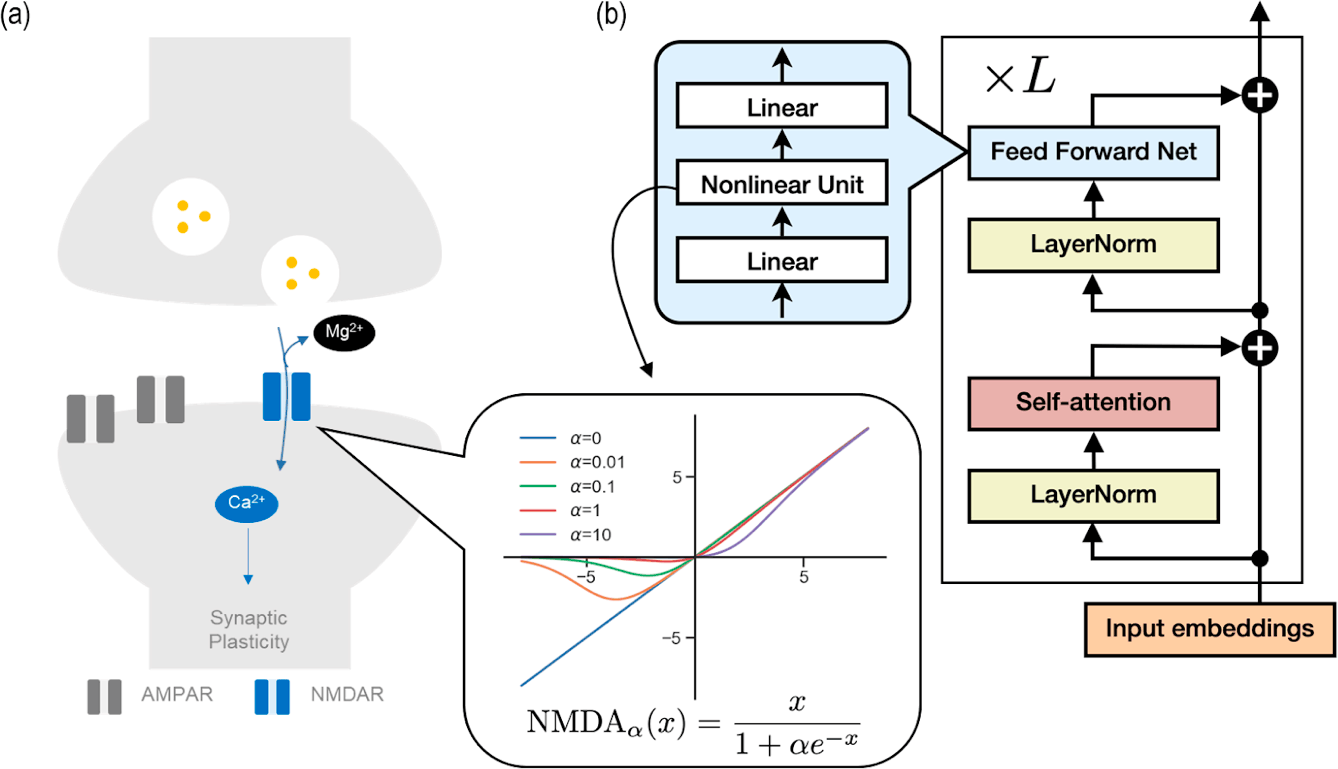
    Figure 1. (a) Diagram illustrating the ion channel activity in post-synaptic neurons. AMPA receptors are involved in the activation of post-synaptic neurons, while NMDA receptors are blocked by magnesium ions (Mg²⁺) but induce synaptic plasticity through the influx of calcium ions (Ca²⁺) when the post-synaptic neuron is sufficiently activated. (b) Flow diagram representing the computational process within the Transformer AI model. Information is processed sequentially through stages such as feed-forward layers, layer normalization, and self-attention layers. The graph depicting the current-voltage relationship of the NMDA receptors is very similar to the nonlinearity of the feed-forward layer. The input-output graph, based on the concentration of magnesium (α), shows the changes in the nonlinearity of the NMDA receptors. Credit: Institute for Basic Science

    The Brain’s Learning Mechanisms Applied to AI

    The key to powerful AI systems is grasping how they learn and remember information. The team applied principles of human brain learning, specifically concentrating on memory consolidation through the NMDA receptor in the hippocampus, to AI models.

    The NMDA receptor is like a smart door in your brain that facilitates learning and memory formation. When a brain chemical called glutamate is present, the nerve cell undergoes excitation. On the other hand, a magnesium ion acts as a small gatekeeper blocking the door. Only when this ionic gatekeeper steps aside, substances are allowed to flow into the cell. This is the process that allows the brain to create and keep memories, and the gatekeeper’s (the magnesium ion) role in the whole process is quite specific.

    AI Models Mimicking Human Brain Processes

    The team made a fascinating discovery: the Transformer model seems to use a gatekeeping process similar to the brain’s NMDA receptor [see Figure 1]. This revelation led the researchers to investigate if the Transformer’s memory consolidation can be controlled by a mechanism similar to the NMDA receptor’s gating process.

    In the animal brain, a low magnesium level is known to weaken memory function. The researchers found that long-term memory in Transformer can be improved by mimicking the NMDA receptor. Just like in the brain, where changing magnesium levels affect memory strength, tweaking the Transformer’s parameters to reflect the gating action of the NMDA receptor led to enhanced memory in the AI model. This breakthrough finding suggests that how AI models learn can be explained with established knowledge in neuroscience.

    Expert Insights on AI and Neuroscience

    C. Justin LEE, who is a neuroscientist director at the institute, said, “This research makes a crucial step in advancing AI and neuroscience. It allows us to delve deeper into the brain’s operating principles and develop more advanced AI systems based on these insights.”

    CHA Meeyoung, who is a data scientist in the team and at KAIST, notes, “The human brain is remarkable in how it operates with minimal energy, unlike the large AI models that need immense resources. Our work opens up new possibilities for low-cost, high-performance AI systems that learn and remember information like humans.”

    The Fusion of Cognitive Mechanisms and AI Design

    What sets this study apart is its initiative to incorporate brain-inspired nonlinearity into an AI construct, signifying a significant advancement in simulating human-like memory consolidation. The convergence of human cognitive mechanisms and AI design not only holds promise for creating low-cost, high-performance AI systems but also provides valuable insights into the workings of the brain through AI models.

    Never miss a breakthrough: Join the SciTechDaily newsletter.
    Follow us on Google and Google News.

    Artificial Intelligence Brain Institute for Basic Science Neuroscience Popular
    Share. Facebook Twitter Pinterest LinkedIn Email Reddit

    Related Articles

    MIT Researchers Discover That Deep Neural Networks Don’t See the World the Way We Do

    Not Science Fiction: Brain Activity Decoder Transforms Thoughts Into Text

    Neuromorphic Chip: Artificial Neurons Recognize Biosignals in Real Time

    “Mindwriting” – Software Is Able to Turn Thoughts About Handwriting Into Words and Sentences

    Blind Spots Uncovered at the Intersection of AI and Neuroscience – Dozens of Scientific Papers Debunked

    Reading Minds With Ultrasound: Caltech’s New Brain–Machine Interface

    Human Brain-Like Functions Emerge in Neuromorphic Metallic Nanowire Network

    Neuroscientist: Animal Brains Key for Next Generation of Artificial Intelligence

    Robot Outperforms Humans in Neuroscience Procedure

    Leave A Reply Cancel Reply

    • Facebook
    • Twitter
    • Pinterest
    • YouTube

    Don't Miss a Discovery

    Subscribe for the Latest in Science & Tech!

    Trending News

    The Universe Is Expanding Too Fast and Scientists Can’t Explain Why

    “Like Liquid Metal”: Scientists Create Strange Shape-Shifting Material

    Early Warning Signals of Esophageal Cancer May Be Hiding in Plain Sight

    Common Blood Pressure Drug Shows Surprising Power Against Deadly Antibiotic-Resistant Superbug

    Scientists Uncover Dangerous Connection Between Serotonin and Heart Valve Disease

    Scientists Discover a “Protector” Protein That Could Help Reverse Hair Loss

    Bone-Strengthening Discovery Could Reverse Osteoporosis

    Scientists Uncover Hidden Trigger Behind Stem Cell Aging

    Follow SciTechDaily
    • Facebook
    • Twitter
    • YouTube
    • Pinterest
    • Newsletter
    • RSS
    SciTech News
    • Biology News
    • Chemistry News
    • Earth News
    • Health News
    • Physics News
    • Science News
    • Space News
    • Technology News
    Recent Posts
    • Scientists Overcome Major Quantum Bottleneck, Potentially Transforming Teleportation and Computing
    • Quantum Physics’ Strangest Problem May Hold the Key to Time Itself
    • Scientists Create “Liquid Gears” That Spin Without Touching
    • The Simple Habit That Could Help Prevent Cancer
    • Forgotten Medicinal Plant Shows Promise in Fighting Dangerous Superbugs
    Copyright © 1998 - 2026 SciTechDaily. All Rights Reserved.
    • Science News
    • About
    • Contact
    • Editorial Board
    • Privacy Policy
    • Terms of Use

    Type above and press Enter to search. Press Esc to cancel.