
New observations of a young star system reveal an unexpected cosmic structure
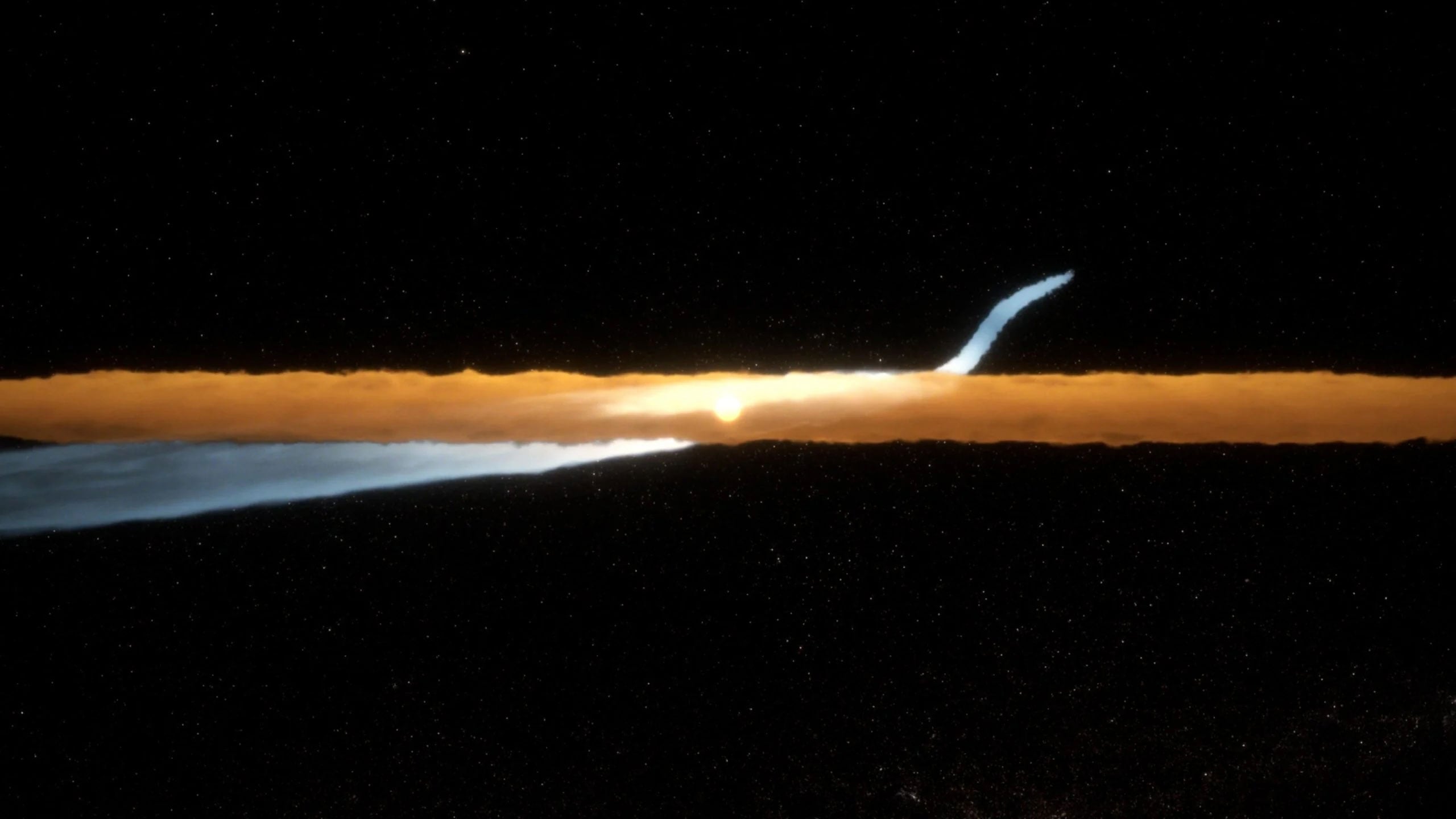
Astronomers have finally detected a mysterious, enormous dust structure in visible light, uncovering new details about what may be the remains of a violent collision between planetary bodies. Known as the “Cat’s Tail,” the feature stretches across as much as 1,000 astronomical units (about 93 billion miles) in the young Beta Pictoris star system.
Located 63 light-years from Earth in the constellation Pictor (which is Latin for “painter”), Beta Pictoris is surrounded by a vast disk of dust and rocky debris. The Cat’s Tail was discovered in infrared observations from the James Webb Space Telescope, but had remained hidden from telescopes observing shorter wavelengths. Now, new Hubble Space Telescope images, combined with observations spanning more than 14 years, are helping astronomers investigate its composition, geometry, and possible origins.
Why This Enormous Dust Structure Was Nearly Invisible
“Oddly, this feature had previously only been seen with the James Webb Space Telescope, which detects infrared light, but remained invisible at shorter wavelengths, which has puzzled the community for a while,” said Arin Avsar, a doctoral student at the University of Arizona who led the research.
The explanation may lie in the dust itself. “We think the Cat’s Tail has eluded our observations in visible light until now because of what it’s made of,” Avsar explained. “It consists almost entirely of we call organic refractory material, which is heavily carbon-based. These long chains of carbon atoms absorb visible light, so they’re quite black.”
The observations also suggest that the structure contains microscopic dust grains with an exceptionally porous, fluffy composition. Although the particles are only about a micron across, their internal structure is difficult to explain through conventional models of planetary collisions. “How you can get dust grains that small that are as porous as we see here, no one really understands, and that’s part of why we study this feature,” Avsar said.
Could a Violent Collision Have Created the Cat’s Tail?
Beta Pictoris is roughly 20 million years old, making it a valuable laboratory for studying the turbulent environments in which planets develop. Its debris disk contains material left behind from planet formation, including particles produced when larger objects collide.
“The Cat’s Tail is thought to be the aftermath of a collision between large bodies – think something like Pluto,” said Avsar, who works with the research groups of Daniel Apai and Kevin Wagner at the University of Arizona’s Lunar and Planetary Laboratory and Steward Observatory. Such an impact could have scattered enormous quantities of dust, although the exact process that produced the observed particles remains uncertain.
One possibility is that the impact generated enough heat to transform solid carbon into vapor, which later cooled and formed new particles. “It’s possible that the velocities involved in the collisions were so high that the carbon grains vaporized, turned into gas, and then recondensed as they cooled, and that’s how they became so porous,” said Wagner, a NASA Sagan Postdoctoral Fellow at Steward Observatory.
Hubble Reveals an Unexpected Shape
The new observations have also changed astronomers’ understanding of the Cat’s Tail’s position in space. Earlier interpretations suggested that the feature extended far behind Beta Pictoris from Earth’s perspective, creating the appearance of a long structure stretching away from the star.
By combining Hubble’s visible-light images with Webb’s infrared observations and computer modeling, the researchers developed a revised picture of its three-dimensional geometry. “We find that instead of extending for 1,000 astronomical units behind the star, the Cat’s Tail may extend straight sideways relative to us, and there is no third dimension to it,” Avsar said. “It’s essentially in the same plane of the sky as the star and possibly extends a little bit behind it.”
The findings, published in The Astrophysical Journal Letters, suggest that much of the structure’s apparent length lies across our field of view rather than extending deep into space. Its precise three-dimensional arrangement remains dependent on the models used to interpret the observations.
A Giant Planet May Be Distorting the Surrounding Dust
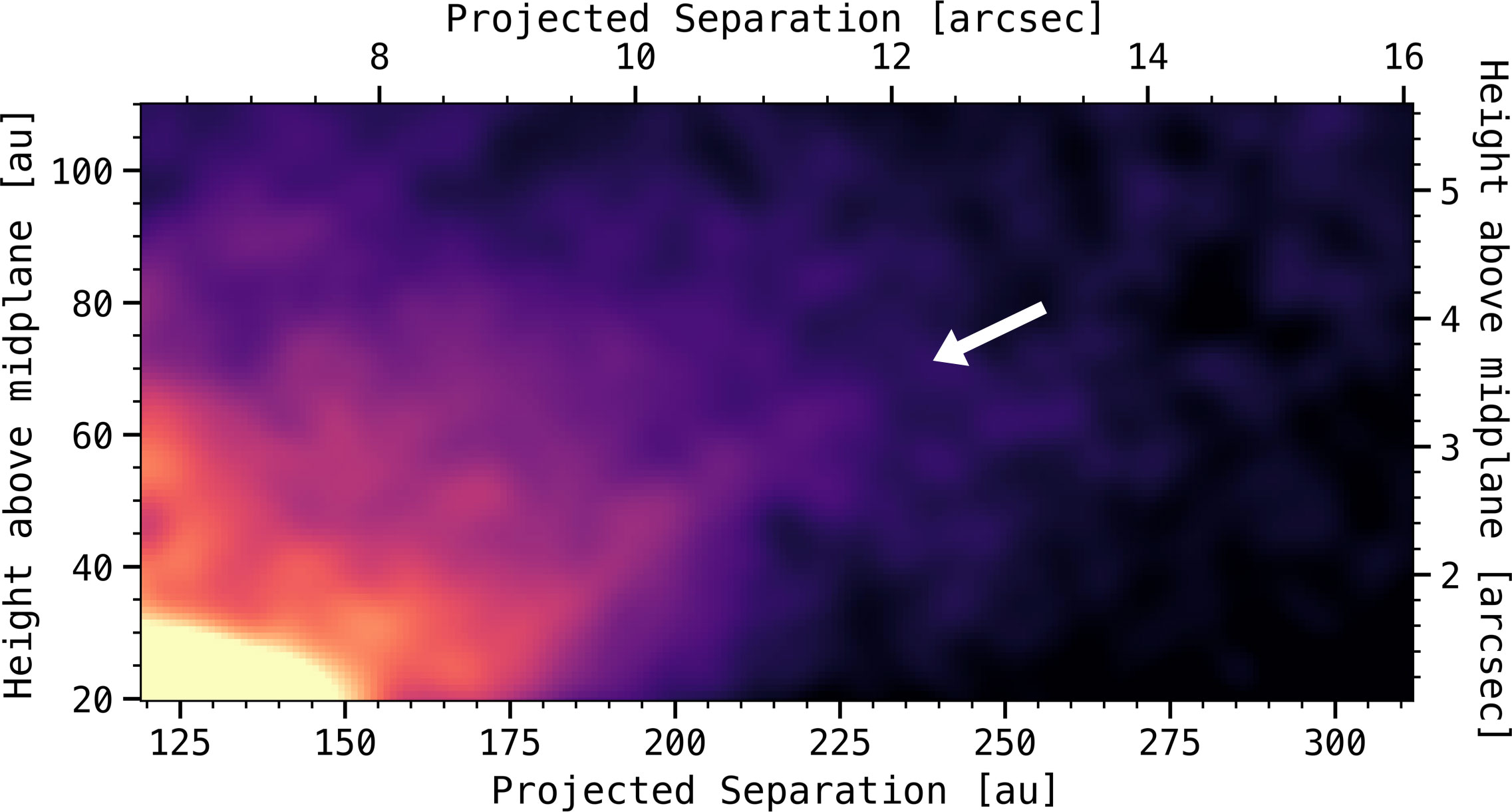
Using Hubble in a new observing configuration, the team also identified a previously unseen warp in the dust halo surrounding Beta Pictoris. The distortion may result from the gravitational influence of Beta Pictoris b, one of three known planets in the system and a gas giant approximately 10 times Jupiter’s mass.
“This gives us another line of evidence into how giant planets influence comets through their immense gravitational force,” Avsar said. “It’s a testament of how much these massive planets really influence their surrounding dust and icy bodies out to hundreds of astronomical units.”
Similar gravitational interactions likely occurred during the early history of our solar system. When the Kuiper Belt was about 20 million years old, it may have contained hundreds of Pluto-sized objects packed into a much denser region than exists today. Over time, the gravitational influence of the giant planets altered the orbits of many of these bodies, scattering some into different regions or ejecting them from the solar system entirely.
The Beta Pictoris observations provide a way to investigate comparable processes in a much younger planetary system, where collisions and gravitational disturbances are still shaping the distribution of material around its star.
Reference: “Deep HST/STIS Coronagraphic Imaging of the β Pictoris Debris Disk: On the Scattered Light Component of the Cat’s Tail” by Arin M. Avsar, Kevin Wagner, Dániel Apai, Isabel Rebollido, Antranik A. Sefilian, Marshall D. Perrin, Christopher C. Stark, Gabriel Weible and András Gáspár, 7 October 2026, The Astrophysical Journal Letters.
DOI: 10.3847/2041-8213/aeac4a
Never miss a breakthrough: Join the SciTechDaily newsletter.
Follow us on Google and Google News.