
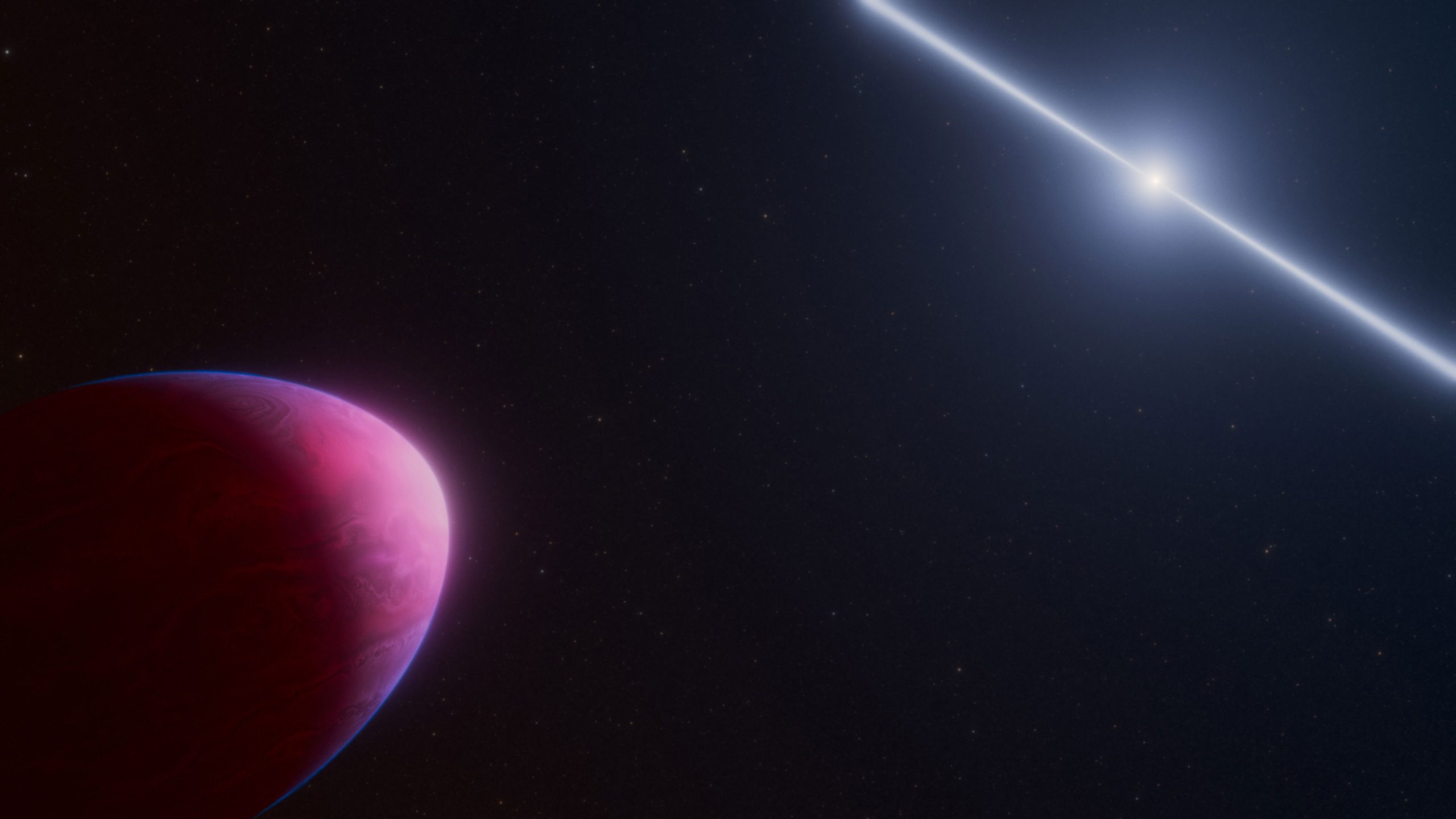
Astronomers have discovered a carbon-rich exoplanet with a bizarre atmosphere and shape, orbiting a neutron star under extreme conditions that challenge current models of planetary formation.
Scientists working with NASA’s James Webb Space Telescope have identified a previously unknown kind of exoplanet, one whose unusual atmosphere challenges our understanding of how this type of planet forms.
The strange world has a stretched, lemon-like shape and may even contain diamonds at its center, placing it somewhere between what scientists typically consider a planet and a star.
Known as PSR J2322-2650b, the object is wrapped in an atmosphere dominated by helium and carbon, a combination never before observed on an exoplanet. Although it is roughly as massive as Jupiter, its skies are filled with soot-like carbon clouds, and under intense pressure deep inside the planet, that carbon could crystallize into diamonds. The planet circles a rapidly rotating neutron star.
Exactly how such an object formed remains a mystery.
“The planet orbits a star that’s completely bizarre — the mass of the Sun, but the size of a city,” explained the University of Chicago’s Michael Zhang, the principal investigator on this study, which is accepted for publication in The Astrophysical Journal Letters. “This is a new type of planet atmosphere that nobody has ever seen before.”
“This was an absolute surprise,” said team member Peter Gao of the Carnegie Earth and Planets Laboratory in Washington, D.C. “I remember after we got the data down, our collective reaction was ‘What the heck is this?’”
A bizarre pair
The new planet, PSR J2322-2650b, is orbiting a rapidly spinning neutron star, also known as a pulsar.
This star emits beams of electromagnetic radiation from its magnetic poles at regular intervals just milliseconds apart. But the star is emitting mostly gamma rays and other high-energy particles, which are invisible to the Webb telescope’s infrared vision.
This means scientists can study the planet in intricate detail across its whole orbit—normally an extremely difficult task, because stars usually far outshine their planets.
“This system is unique because we are able to view the planet illuminated by its host star, but not see the host star at all,” explained Maya Beleznay, a graduate student at Stanford University who worked on modelling the shape of the planet and the geometry of its orbit. “So we get a really pristine spectrum. And we can better study this system in more detail than normal exoplanets.”
This animation shows an exotic exoplanet orbiting a distant pulsar, or rapidly rotating neutron star with radio pulses. The planet, which orbits about 1 million miles away from the pulsar, is stretched into a lemon shape by the pulsar’s strong gravitational tides. Credit: NASA, ESA, CSA, Ralf Crawford (STScI)
Taking stock of the planet, the team was surprised.
“Instead of finding the normal molecules we expect to see on an exoplanet—like water, methane, and carbon dioxide—we saw molecular carbon, specifically C3 and C2,” said Zhang.
At the core of the planet, subjected to intense pressure, it’s possible this carbon could be squeezed into diamonds.
But to the scientists, the larger question is how such a planet could have formed at all.
“It’s very hard to imagine how you get this extremely carbon-enriched composition,” said Zhang. “It seems to rule out every known formation mechanism.”
‘A puzzle to go after’
PSR J2322-2650b is extraordinary close to its star, just 1 million miles away. In contrast, the Earth’s distance from the Sun is about 100 million miles.
Because of its extremely tight orbit, the exoplanet’s entire year—the time it takes to go around its star—is just 7.8 hours.
Applying models to the planet’s brightness variations over its orbit, the team finds that immense gravitational forces from the much heavier pulsar are pulling the Jupiter-mass planet into a lemon shape.
Together, the star and exoplanet may be considered a “black widow” system. Black widows are a rare type of system where a rapidly spinning pulsar is paired with a small, low-mass companion. In the past, material from the companion would have streamed onto the pulsar, causing it to spin faster over time, which powers a strong wind. That wind and radiation then bombard and evaporate the smaller and less massive star.
Like the spider for which it is named, the pulsar slowly consumes its unfortunate partner.
But in this case, the tiny companion is officially considered an exoplanet by the International Astronomical Union, not a star.
“Did this thing form like a normal planet? No, because the composition is entirely different,” said Zhang. “Did it form by stripping the outside of a star, like ‘normal’ black widow systems are formed? Probably not, because nuclear physics does not make pure carbon.”
Team member Roger Romani, of Stanford and the Kavli Institute for Particle Astrophysics and Cosmology Institute, is one of the world’s preeminent experts on black widow systems. He proposes one evocative phenomenon that could occur in the unique atmosphere.
“As the companion cools down, the mixture of carbon and oxygen in the interior starts to crystallize,” Romani theorized. “Pure carbon crystals float to the top and get mixed into the helium, and that’s what we see. But then something has to happen to keep the oxygen and nitrogen away. And that’s where there’s controversy.”
“But it’s nice to not know everything,” said Romani. “I’m looking forward to learning more about the weirdness of this atmosphere. It’s great to have a puzzle to go after.”
With its infrared vision and exquisite sensitivity, this is a discovery only the Webb telescope could make. Its perch a million miles from Earth and its huge sunshield keeps the instruments very cold, which is necessary for conducting these observations.
“On the Earth, lots of things are hot, and that heat really interferes with the observations because it’s another source of photons that you have to deal with,” explained Zhang. “It’s absolutely not feasible from the ground.”
Reference: “A Carbon-rich Atmosphere on a Windy Pulsar Planet” by Michael Zhang, Maya Beleznay, Timothy D. Brandt, Roger W. Romani, Peter Gao, Hayley Beltz, Matthew Bailes, Matthew C. Nixon, Jacob L. Bean, Thaddeus D. Komacek, Brandon P. Coy, Guangwei Fu, Rafael Luque, Daniel J. Reardon, Emma Carli, Ryan M. Shannon, Jonathan J. Fortney, Anjali A. A. Piette, M. Coleman Miller and Jean-Michel Desert, 16 December 2025, The Astrophysical Journal Letters.
DOI: 10.3847/2041-8213/ae157c
Other UChicago scientists on the study included Prof. Jacob Bean, graduate student Brandon Park Coy and Rafael Luque, who was then a postdoctoral researcher at UChicago and is now with the Instituto de Astrofísica de Andalucía in Spain.
Funding: NASA, Heising-Simons Foundation.
Never miss a breakthrough: Join the SciTechDaily newsletter.
Follow us on Google and Google News.