
Close Menu
    Facebook X (Twitter) Instagram
    SciTechDaily
    • Biology
    • Chemistry
    • Earth
    • Health
    • Physics
    • Science
    • Space
    • Technology
    Facebook X (Twitter) Pinterest YouTube RSS
    SciTechDaily
    Home»Space»Science Made Simple: What Are Neutron Stars?
    Space

    Science Made Simple: What Are Neutron Stars?

    By U.S. Department of EnergyDecember 31, 20211 Comment4 Mins Read
    Facebook Twitter Pinterest Telegram LinkedIn WhatsApp Email Reddit
    Share
    Facebook Twitter LinkedIn Pinterest Telegram Email Reddit
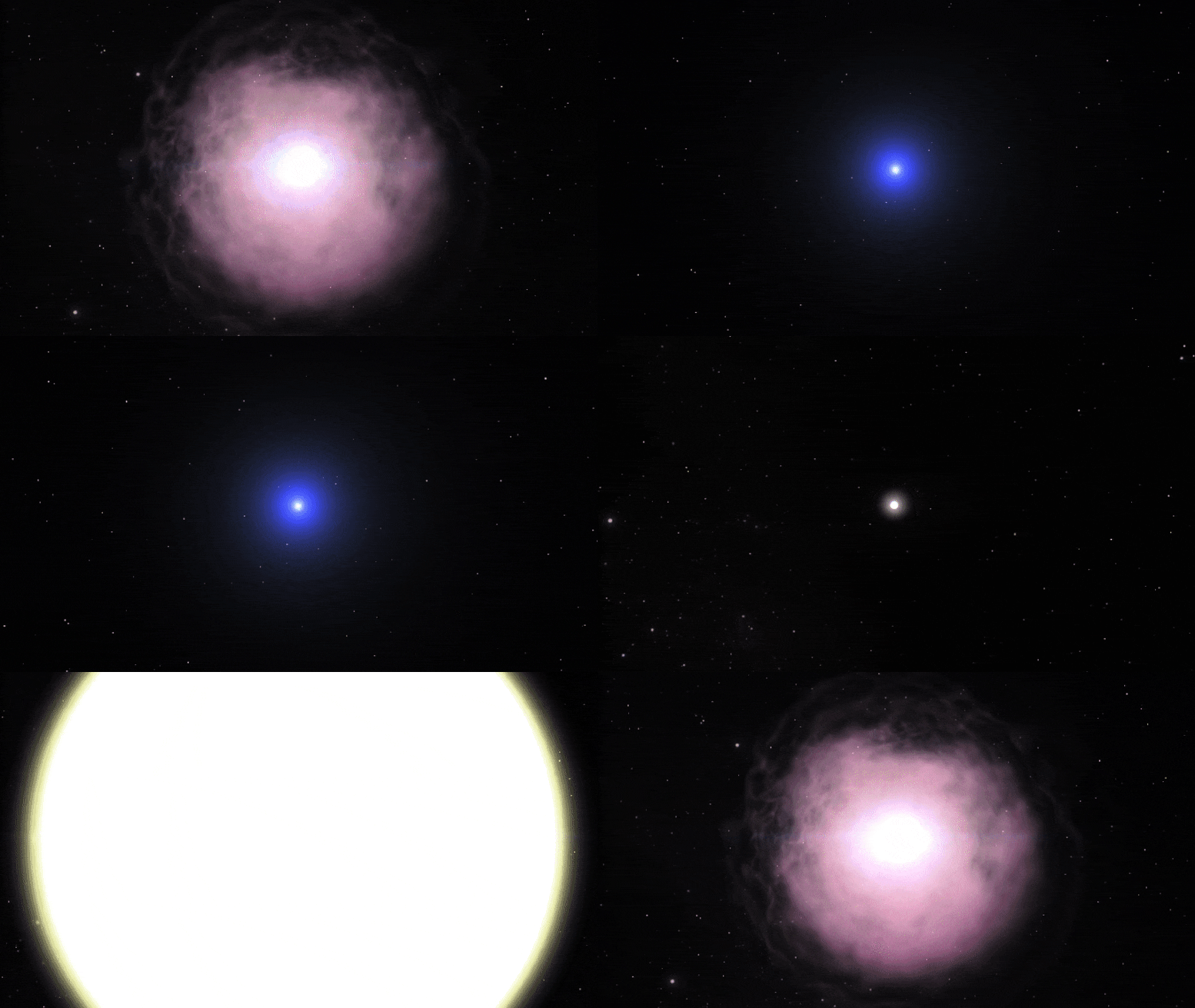
    Neutron Star Animations
    A neutron star begins its life as a star between about 7 and 20 times the mass of the sun. When this type of star runs out of fuel, it collapses under its own weight, crushing its core and triggering a supernova explosion. What remains is an ultra-dense sphere only about the size of a city across, but with up to twice the mass of the sun squeezed inside. Credit: NASA’s Goddard Space Flight Center Conceptual Image Lab

    What Are Neutron Stars?

    A giant star faces several possible fates when it dies in a supernova. That star can either be completely destroyed, become a black hole, or become a neutron star. The outcome depends on the dying star’s mass and other factors, all of which shape what happens when stars explode in a supernova.

    Neutron stars are among the densest objects in the cosmos. They average only about 12 miles (19 kilometers) in diameter but are denser than our sun, which is more than 72,000 times bigger than a neutron star. Neutron stars got their name because their cores have such powerful gravity that most positively charged protons and negatively charged electrons in the interior of these stars combine into uncharged neutrons.

    Two Dense Neutron Stars Colliding
    This simulation shows two dense neutron stars colliding. The collision has formed a black hole orbited by a whirlpool of magnetized gas. Some matter emerges in energetic jets and winds that will make heavy elements and flashes of light. Credit: Image courtesy of A. Tchekhovskoy, R. Fernandez, D. Kasen

    Neutron stars produce no new heat. However, they are incredibly hot when they form and cool slowly. The neutron stars we can observe average about 1.8 million degrees Fahrenheit (1 million degrees Celsius), compared to about 9,900 degrees Fahrenheit (5,500 degrees Celsius) for the Sun.

    Neutron stars have an important role in the universe. Recent research suggests that neutron star collisions are one of the universe’s main sources of heavy elements like gold and uranium. The process of creating new atomic nuclei from pre-existing protons and neutrons, whether it occurs during a neutron star collision, a supernova, the burning of stars, or the Big Bang, is called nucleosynthesis.

    Fast Facts

    • The enormous density of a neutron star means a teaspoon of neutron star material would weigh 10 million tons. (Other estimates from NASA say a teaspoon of neutron star material would weigh about 1 billion tons or even 4 billion tons.)
    • At only about 12 miles in diameter, a neutron star would fit inside the boundaries of Chicago.
    • Neutron stars have exceptionally strong magnetic fields around them.
    • Neutron stars rotate extremely rapidly due to the conservation of angular momentum.
    • Many neutron stars are observed through periodic (or pulsed) radio waves they emit (these are called pulsars).
    • Neutron star collisions are no small affair. The event releases the equivalent of hundreds of millions of times our Sun’s energy, distorting spacetime as gravitational waves.

    DOE Office of Science: Contributions to Neutron Star Research

    The DOE Office of Science Nuclear Physics program supports research in nuclear astrophysics. This scientific discipline helps us understand neutron stars and other objects in the cosmos. Two university-based DOE Centers of Excellence—the Cyclotron Institute at Texas A&M University and the Triangle Universities Nuclear Laboratory—specialize in the study of nuclear astrophysics. DOE also funds research on the Big Bang, stars, supernovae, and neutron star mergers and their roles as sources of elements. The Nuclear Physics program at the DOE Office of Science funded research that produced supercomputer models of neutron star collisions. DOE also supports experiments at DOE’s Jefferson Lab

    that, by measuring the distribution of neutrons in nuclei, tell us about the physics of neutron stars and the properties of dense nuclear matter. Studying the properties of dense nuclear matter and neutron-rich matter is also part of the purpose of the Facility for Rare Isotope Beams and the Argonne Tandem Linac Accelerator System, both DOE Office of Science user facilities.

    Never miss a breakthrough: Join the SciTechDaily newsletter.
    Follow us on Google and Google News.

    Astronomy Astrophysics DOE Neutron Star
    Share. Facebook Twitter Pinterest LinkedIn Email Reddit

    Related Articles

    Supercomputing Tapped to Study Exotic Matter in Stars

    Highly Accurate Measurements Show Neutron Star “Skin” Is Less Than a Millionth of a Nanometer Thick

    New Clues to Remains of Star That Exploded Just Outside Our Galaxy

    Super-Earth Atmospheres Probed With Sandia National Lab’s Powerful Z Machine

    Reclusive Neutron Star May Have Been Found in Famous Supernova SN 1987A

    New Metamaterial Structures for Studying the Oldest Light in the Universe

    True Identity of Mysterious High-Energy Gamma-Ray Source Revealed

    New Measurement of the Hubble Constant – Rate of Expansion of the Universe – From Combined Observations of Neutron Stars

    Chandra Studies Extraordinary Magnetar: Fastest Spinning and Possibly the Youngest Magnetar Known

    1 Comment

    1. Skaas on January 2, 2022 2:31 am

      Fahrenheit? Really? At least have the decency to add Celsius or Kelvin if you want me to take your “science” seriously.

      Reply
    Leave A Reply Cancel Reply

    • Facebook
    • Twitter
    • Pinterest
    • YouTube

    Don't Miss a Discovery

    Subscribe for the Latest in Science & Tech!

    Trending News

    Breakthrough Bowel Cancer Trial Leaves Patients Cancer-Free for Nearly 3 Years

    Natural Compound Shows Powerful Potential Against Rheumatoid Arthritis

    100,000-Year-Old Neanderthal Fossils in Poland Reveal Unexpected Genetic Connections

    Simple “Gut Reset” May Prevent Weight Gain After Ozempic or Wegovy

    2.8 Days to Disaster: Scientists Warn Low Earth Orbit Could Suddenly Collapse

    Common Food Compound Shows Surprising Power Against Superbugs

    5 Simple Ways To Remember More and Forget Less

    The Atomic Gap That Could Cost the Semiconductor Industry Billions

    Follow SciTechDaily
    • Facebook
    • Twitter
    • YouTube
    • Pinterest
    • Newsletter
    • RSS
    SciTech News
    • Biology News
    • Chemistry News
    • Earth News
    • Health News
    • Physics News
    • Science News
    • Space News
    • Technology News
    Recent Posts
    • After 37 Years, the World’s Longest-Running Soil Warming Experiment Uncovers a Startling Climate Secret
    • NASA Satellite Captures First-Ever High-Res View of Massive Pacific Tsunami
    • ADHD Isn’t Just a Deficit: Study Reveals Powerful Hidden Strengths
    • Scientists Uncover “Astonishing” Hidden Property of Light
    • Scientists Discover Stem Cells That Could Regrow Teeth and Bone
    Copyright © 1998 - 2026 SciTechDaily. All Rights Reserved.
    • Science News
    • About
    • Contact
    • Editorial Board
    • Privacy Policy
    • Terms of Use

    Type above and press Enter to search. Press Esc to cancel.