
Close Menu
    Facebook X (Twitter) Instagram
    SciTechDaily
    • Biology
    • Chemistry
    • Earth
    • Health
    • Physics
    • Science
    • Space
    • Technology
    Facebook X (Twitter) Pinterest YouTube RSS
    SciTechDaily
    Home»Space»New Calculations Uncover a Vast Ocean Beneath Pluto’s Ice
    Space

    New Calculations Uncover a Vast Ocean Beneath Pluto’s Ice

    By Chris Woolston, Washington University in St. LouisJuly 25, 20243 Comments3 Mins Read
    Facebook Twitter Pinterest Telegram LinkedIn WhatsApp Email Reddit
    Share
    Facebook Twitter LinkedIn Pinterest Telegram Email Reddit
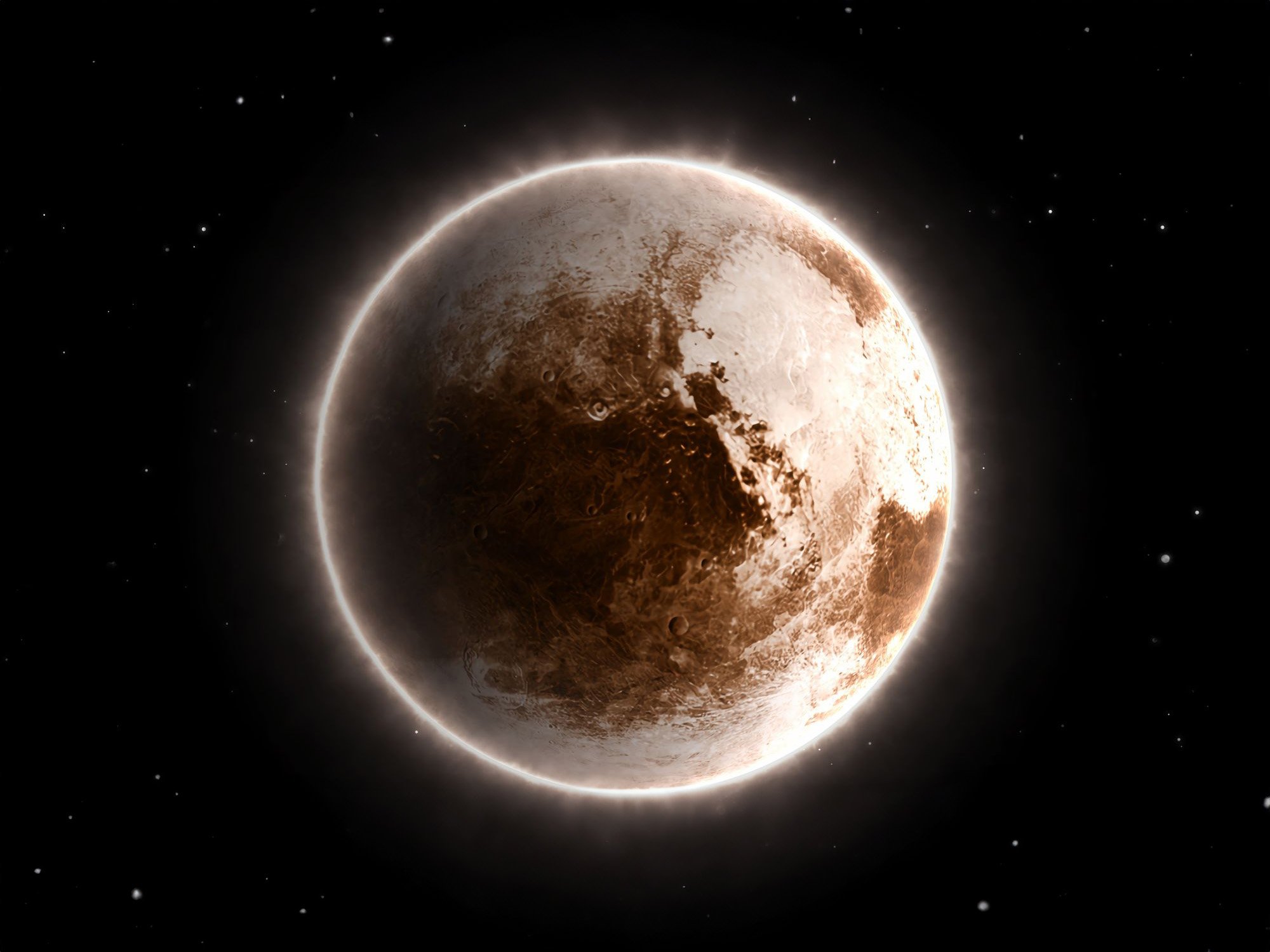
    Glowing Pluto
    Recent research has provided deeper insights into the subsurface ocean of Pluto, previously believed to be an impossibility due to the dwarf planet’s extremely low temperatures.

    Graduate student Alex Nguyen calculated the depth and density of the solar system’s most mysterious and remote body of water.

    New calculations by Alex Nguyen, a graduate student in the Department of Earth, Environmental, and Planetary Sciences, are bringing into focus the existence of a vast ocean of liquid water beneath Pluto’s icy surface.

    In a paper published in the journal Icarus, Nguyen used mathematical models and images from the New Horizons spacecraft that passed by Pluto in 2015 to take a closer look at the ocean that likely covers the planet beneath a thick shell of nitrogen, methane, and water ice.

    Patrick McGovern of the Lunar and Planetary Institute in Houston, Texas, was a co-author of the paper.

    For many decades, planetary scientists assumed that Pluto could not support an ocean. The surface temperature is about -220 C, a temperature so cold even gases like nitrogen and methane freeze solid. Water shouldn’t have a chance. “Pluto is a small body,” Nguyen said. “It should have lost almost all of its heat shortly after it was formed, so basic calculations would suggest that it’s frozen solid to its core.”

    Recent Evidence of Liquid Water

    But in recent years, prominent scientists including Professor Bill McKinnon have gathered evidence suggesting Pluto likely contains an ocean of liquid water beneath the ice. That inference came from several lines of evidence, including Pluto’s cryovolcanoes that spew ice and water vapor. Although there is still some debate, “it’s now generally accepted that Pluto has an ocean,” Nguyen said.

    The new study probes the ocean in greater detail, even if it’s far too deep below the ice for scientists to ever see. Nguyen and McGovern created mathematical models to explain the cracks and bulges in the ice covering Pluto’s Sputnik Platina Basin, the site of a meteor collision billions of years ago. Their calculations suggest the ocean in this area exists beneath a shell of water ice 40 to 80 km thick, a blanket of protection that likely keeps the inner ocean from freezing solid.

    They also calculated the likely density or salinity of the ocean based on the fractures in the ice above. They estimate Pluto’s ocean is at most about 8% denser than seawater on Earth, or roughly the same as Utah’s Great Salt Lake. If you could somehow get to Pluto’s ocean, you could effortlessly float.

    As Nguyen explained, that level of density would explain the abundance of fractures seen on the surface. If the ocean was significantly less dense, the ice shell would collapse, creating many more fractures than actually observed. If the ocean was much denser, there would be fewer fractures. “We estimated a sort of Goldilocks zone where the density and shell thickness is just right,” he said.

    Space agencies have no plans to return to Pluto any time soon, so many of its mysteries will remain for future generations of researchers. Whether it’s called a planet, a planetoid, or merely one of many objects in the outer reaches of the solar system, it’s worth studying, Nguyen said. “From my perspective, it’s a planet.”

    Reference: “The role of Pluto’s ocean’s salinity in supporting nitrogen ice loads within the Sputnik Planitia basin” by P.J. McGovern and A.L. Nguyen, 28 January 2024, Icarus.
    DOI: 10.1016/j.icarus.2024.115968

    Never miss a breakthrough: Join the SciTechDaily newsletter.
    Follow us on Google and Google News.

    Astrobiology Planets Pluto Popular Washington University in St. Louis
    Share. Facebook Twitter Pinterest LinkedIn Email Reddit

    Related Articles

    Tread Lightly: Strange “Eggshell Planets” Possible Around Other Stars

    Opposite World: Pluto’s Ice Caps Made of Methane, Turns Earth’s Process Upside Down

    Some Planets May Be Better for Life Than Earth: Researchers Identify 24 Superhabitable Exoplanets

    If It Wasn’t for Jupiter, Venus Might Be Habitable Today

    Astronomers Find Possible Signs of Life on Venus

    Unexpected Findings Result in New Origin Theory for Earth’s Water

    Evidence Pluto Started Out With Liquid Oceans That Have Been Slowly Freezing Over Time

    Stanford: Promising Signs for Past Martian Life at Jezero Crater, Mars

    Pluto’s Icy Heart Heart Beats Daily, Pumping Nitrogen Winds Around the Dwarf Planet

    3 Comments

    1. Ken on July 27, 2024 5:07 pm

      It’s a planet.

      Reply
    2. Bill in Seminole on July 27, 2024 5:57 pm

      Alex Nguyen said, “From my perspective, it’s a planet.” Darn right, it was a planet when I was a kid, it’s a planet now, and it forever will be.

      Reply
    3. Max on July 29, 2024 8:06 pm

      Yeah, but just try to convince certain members of the IAU of that. They have spent years trying to deny the obvious.

      Reply
    Leave A Reply Cancel Reply

    • Facebook
    • Twitter
    • Pinterest
    • YouTube

    Don't Miss a Discovery

    Subscribe for the Latest in Science & Tech!

    Trending News

    Millions Take These IBS Drugs, But a New Study Finds Serious Risks

    Scientists Unlock Hidden Secrets of 2,300-Year-Old Mummies Using Cutting-Edge CT Scanner

    Bread Might Be Making You Gain Weight Even Without Eating More Calories

    Scientists Discover Massive Magma Reservoir Beneath Tuscany

    Europe’s Most Active Volcano Just Got Stranger – Here’s Why Scientists Are Rethinking It

    Alzheimer’s Symptoms May Start Outside the Brain, Study Finds

    Millions Take This Popular Supplement – Scientists Discover a Concerning Link to Heart Failure

    The Universe Is Expanding Too Fast and Scientists Can’t Explain Why

    Follow SciTechDaily
    • Facebook
    • Twitter
    • YouTube
    • Pinterest
    • Newsletter
    • RSS
    SciTech News
    • Biology News
    • Chemistry News
    • Earth News
    • Health News
    • Physics News
    • Science News
    • Space News
    • Technology News
    Recent Posts
    • Doctors Surprised by the Power of a Simple Drug Against Colon Cancer
    • Why Popular Diabetes Drugs Like Ozempic Don’t Work for Everyone: The “Genetic Glitch”
    • Scientists Create Improved Insulin Cells That Reverse Diabetes in Mice
    • Scientists Stunned After Finding Plant Thought Extinct for 60 Years
    • A Common Diabetes Drug May Hold the Key to Stopping HIV From Coming Back
    Copyright © 1998 - 2026 SciTechDaily. All Rights Reserved.
    • Science News
    • About
    • Contact
    • Editorial Board
    • Privacy Policy
    • Terms of Use

    Type above and press Enter to search. Press Esc to cancel.