
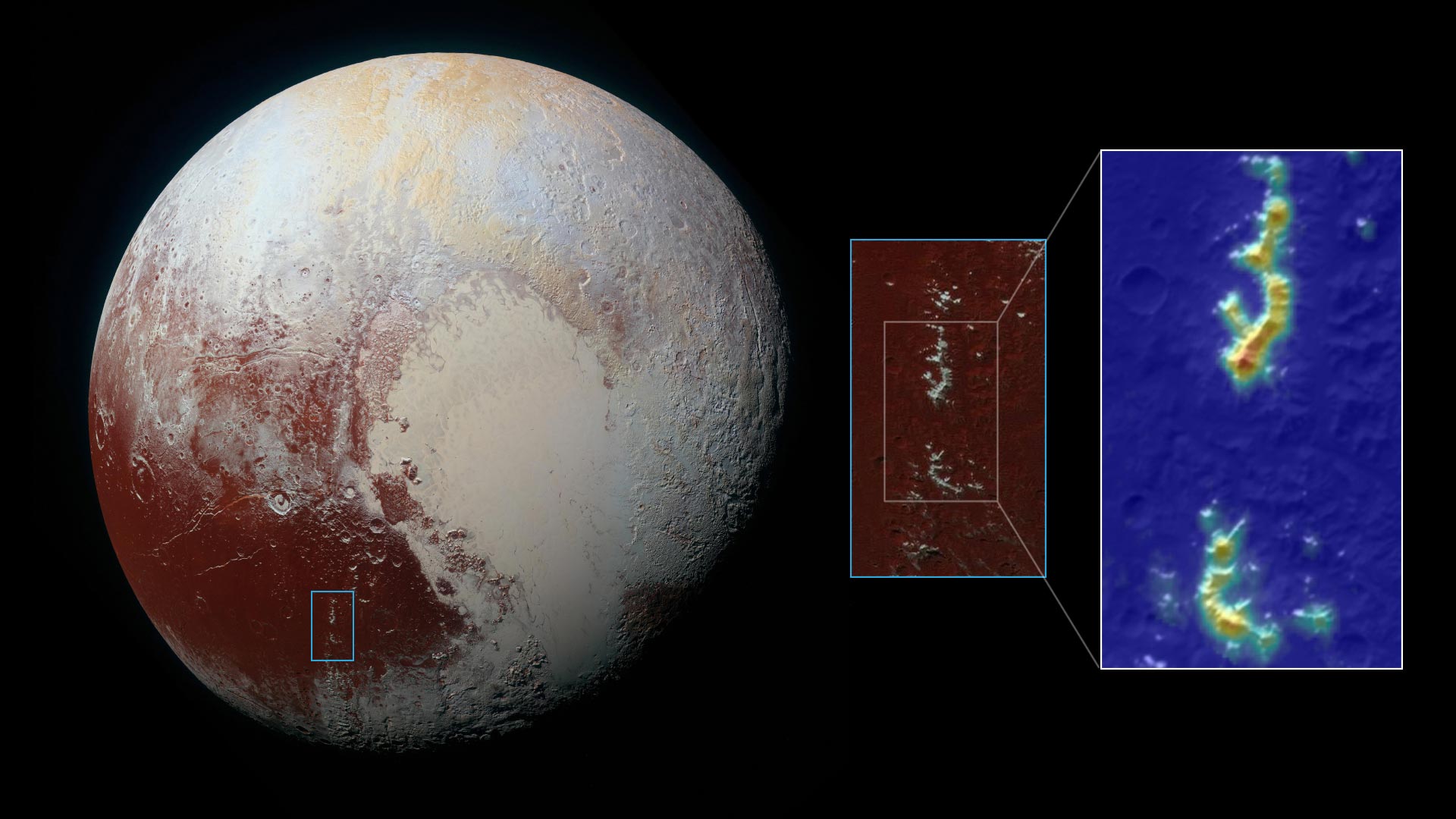
The mountains discovered on Pluto during the New Horizons spacecraft’s flyby of the dwarf planet in 2015 are covered by a blanket of methane ice, creating bright deposits strikingly like the snow-capped mountain chains found on Earth.
New research conducted by an international team of scientists, including researchers at NASA’s Ames Research Center in California’s Silicon Valley, analyzed New Horizons data from Pluto’s atmosphere and surface, using numerical simulations of Pluto’s climate to reveal that these ice caps are created through an entirely different process than they are on Earth.
“It is particularly remarkable to see that two very similar landscapes on Earth and Pluto can be created by two very dissimilar processes,” said Tanguy Bertrand, a postdoctoral researcher at Ames and lead author on the paper detailing these results, which was published in Nature Communications. “Though theoretically, objects like Neptune’s moon Triton could have a similar process, nowhere else in our solar system has ice-capped mountains like this besides Earth.”
On our planet, atmospheric temperatures decrease with altitude, mostly because of the cooling induced by the expansion of the air in upward motions. The cool atmosphere in turn cools temperatures at the surface. When a moist wind approaches a mountain on Earth, its water vapor cools and condenses, forming clouds and then the snow seen on mountain tops. But on Pluto, the opposite occurs. The dwarf planet’s atmosphere actually gets warmer as altitude increases because the methane gas that’s more concentrated higher up absorbs solar radiation. However, the atmosphere is too thin to impact the surface temperatures, which remain constant. And unlike Earth’s upward winds, on Pluto, winds that travel down mountain slopes dominate.

To understand how the same landscape could be produced with different materials and under different conditions, the researchers developed a 3D model of Pluto’s climate at the Laboratoire de Météorologie in Paris, France, simulating the atmosphere and surface over time. They found that Pluto’s atmosphere has more gaseous methane at its warmer, higher altitudes, allowing for that gas to saturate, condense, and then freeze directly on the mountain peaks without any clouds forming. At lower altitudes, there’s no methane frost because there’s less of this gaseous methane, making it impossible for condensation to occur.
This process not only creates the methane ice caps on Pluto’s mountains, but also similar features on its crater rims as well. The mysterious bladed terrain that can be found in the Tartarus Dorsa region around Pluto’s equator is also explained by this cycle.
“Pluto really is one of the best natural laboratories we have to explore the physical and dynamic processes involved when compounds that regularly transition between solid and gas states interact with a planetary surface,” said Bertrand. “The New Horizons flyby revealed astonishing glacial landscapes we continue to learn from.”
Reference: “Equatorial mountains on Pluto are covered by methane frosts resulting from a unique atmospheric process” by Tanguy Bertrand, François Forget, Bernard Schmitt, Oliver L. White and William M. Grundy, 13 October 2020, Nature Communications.
DOI: 10.1038/s41467-020-18845-3
Never miss a breakthrough: Join the SciTechDaily newsletter.
Follow us on Google and Google News.
4 Comments
I think that Pluto holds great hope for mankind for minerals
And new metals. I myself am working on several projects one for launching payloads into space and a anti gravity project my company is called D&A Concept Design anybody interested in our projects do get in contact with us .00353 0877736639
“Anti gravity”? Not literarily I suppose since that is forbidden by spin=2 gravitons and general relativity. The only way to locally diminish gravity is to find Lagrange points in space, where gravitational effects from two masses cancel out.
… where we have two bodies one can add one more and have fun with gravity.
The determinism goes buy, buy, …
… who is playing the jamb, … God, …