
Close Menu
    Facebook X (Twitter) Instagram
    SciTechDaily
    • Biology
    • Chemistry
    • Earth
    • Health
    • Physics
    • Science
    • Space
    • Technology
    Facebook X (Twitter) Pinterest YouTube RSS
    SciTechDaily
    Home»Space»New Horizons Reveals ‘Snakeskin’ Pluto Image and More
    Space

    New Horizons Reveals ‘Snakeskin’ Pluto Image and More

    By NASASeptember 25, 2015No Comments6 Mins Read
    Facebook Twitter Pinterest Telegram LinkedIn WhatsApp Email Reddit
    Share
    Facebook Twitter LinkedIn Pinterest Telegram Email Reddit
    New Pluto Image from New Horizons
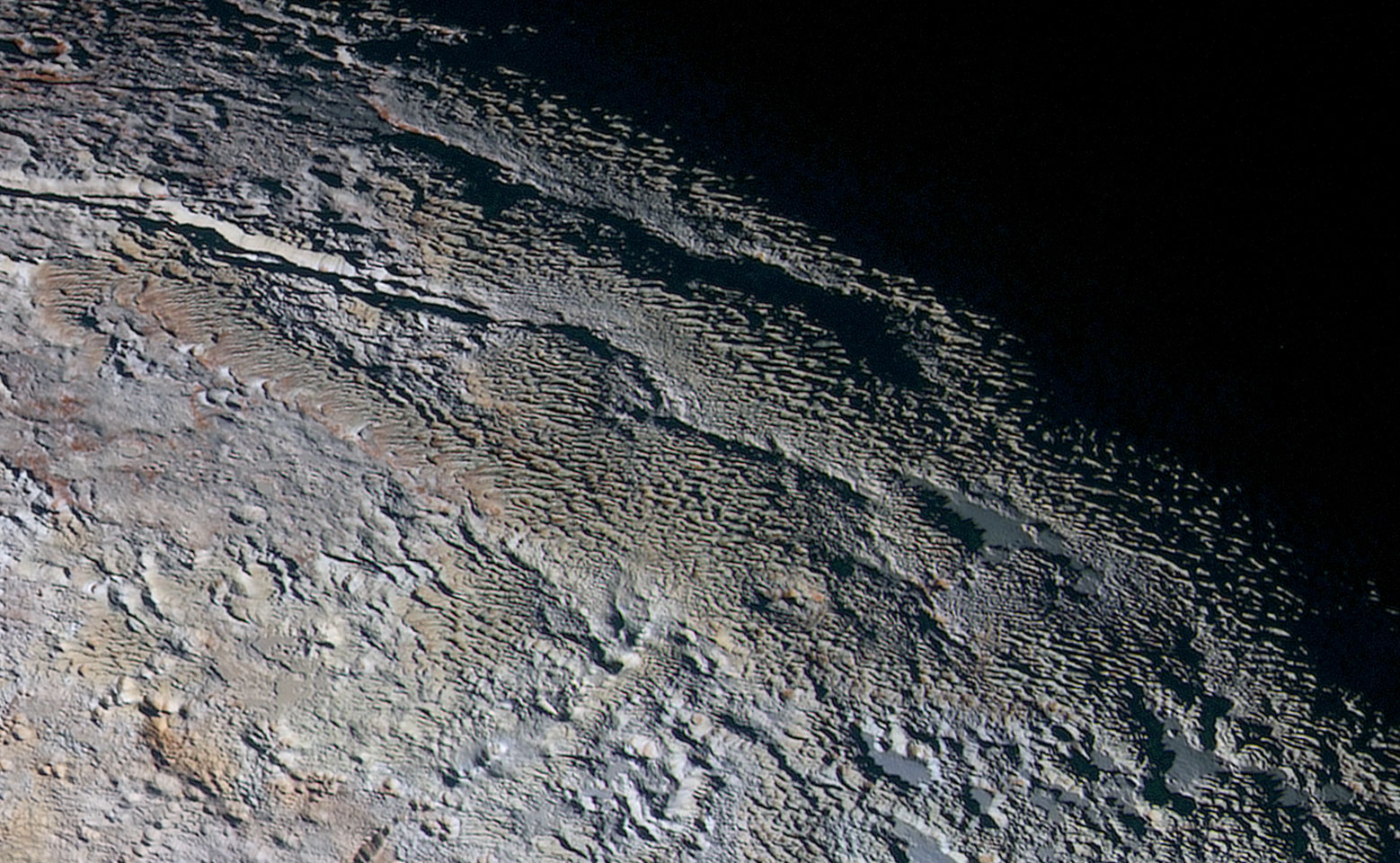
    In this extended color image of Pluto taken by NASA’s New Horizons spacecraft, rounded and bizarrely textured mountains, informally named the Tartarus Dorsa, rise up along Pluto’s day-night terminator and show intricate but puzzling patterns of blue-gray ridges and reddish material in between. This view, roughly 330 miles (530 kilometers) across, combines blue, red and infrared images taken by the Ralph/Multispectral Visual Imaging Camera (MVIC) on July 14, 2015, and resolves details and colors on scales as small as 0.8 miles (1.3 kilometers). Credit: NASA/JHUAPL/SWRI

    NASA’s New Horizons Spacecraft continues to deliver data to astronomers, revealing new images and much more about the dwarf planet Pluto.

    The newest high-resolution images of Pluto from NASA’s New Horizons are both dazzling and mystifying, revealing a multitude of previously unseen topographic and compositional details. The image above —showing an area near the line that separates day from night —captures a vast rippling landscape of strange, aligned linear ridges that has astonished New Horizons team members.

    “It’s a unique and perplexing landscape stretching over hundreds of miles,” said William McKinnon, New Horizons Geology, Geophysics and Imaging (GGI) team deputy lead from Washington University in St. Louis. “It looks more like tree bark or dragon scales than geology. This will really take time to figure out; maybe it’s some combination of internal tectonic forces and ice sublimation driven by Pluto’s faint sunlight.”

    Cylindrical Projection Map of Pluto
    This cylindrical projection map of Pluto, in enhanced, extended color, is the most detailed color map of Pluto ever made. It uses recently returned color imagery from the New Horizons Ralph camera, which is draped onto a base map of images from NASA’s spacecraft’s Long Range Reconnaissance Imager (LORRI). The map can be zoomed in to reveal exquisite detail with high scientific value. Color variations have been enhanced to bring out subtle differences. Colors used in this map are the blue, red, and near-infrared filter channels of the Ralph instrument. Credit: NASA/JHUAPL/SWRI

    The “snakeskin” image of Pluto’s surface is just one tantalizing piece of data New Horizons sent back in recent days. The spacecraft also captured the highest-resolution color view yet of Pluto, as well as detailed spectral maps and other high-resolution images.

    The new “extended color” view of Pluto – taken by New Horizons’ wide-angle Ralph/Multispectral Visual Imaging Camera (MVIC) on July 14 and downlinked to Earth on September 19 – shows the extraordinarily rich color palette of Pluto.
    High Resolution Images of Pluto Taken by NASA’s New Horizons Spacecraft
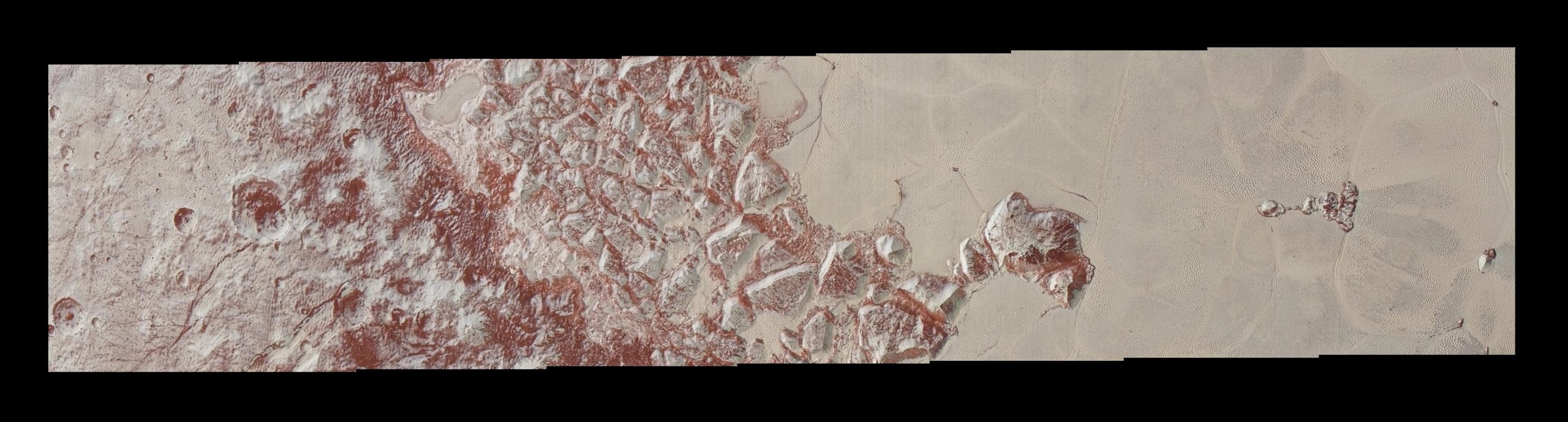
    High-resolution images of Pluto taken by NASA’s New Horizons spacecraft just before closest approach on July 14, 2015, reveal features as small as 270 yards (250 meters) across, from craters to faulted mountain blocks, to the textured surface of the vast basin informally called Sputnik Planum. Enhanced color has been added from the global color image. This image is about 330 miles (530 kilometers) across. For optimal viewing, zoom in on the image on a larger screen. Credit: NASA/JHUAPL/SWRI

    “We used MVIC’s infrared channel to extend our spectral view of Pluto,” said John Spencer, a GGI deputy lead from Southwest Research Institute (SwRI) in Boulder, Colorado. “Pluto’s surface colors were enhanced in this view to reveal subtle details in a rainbow of pale blues, yellows, oranges, and deep reds. Many landforms have their own distinct colors, telling a wonderfully complex geological and climatological story that we have only just begun to decode.”

    Additionally, a high-resolution swath across Pluto taken by New Horizons’ narrow-angle Long Range Reconnaissance Imager (LORRI) on July 14, and downlinked on September 20, homes in on details of Pluto’s geology. These images – the highest-resolution yet available of Pluto – reveal features that resemble dunes, the older shoreline of a shrinking glacial ice lake, and fractured, angular water ice mountains with sheer cliffs. Color details have been added using MVIC’s global map shown above.
    NASA’s New Horizons Spacecraft Mapped Composition Across Pluto’s Surface
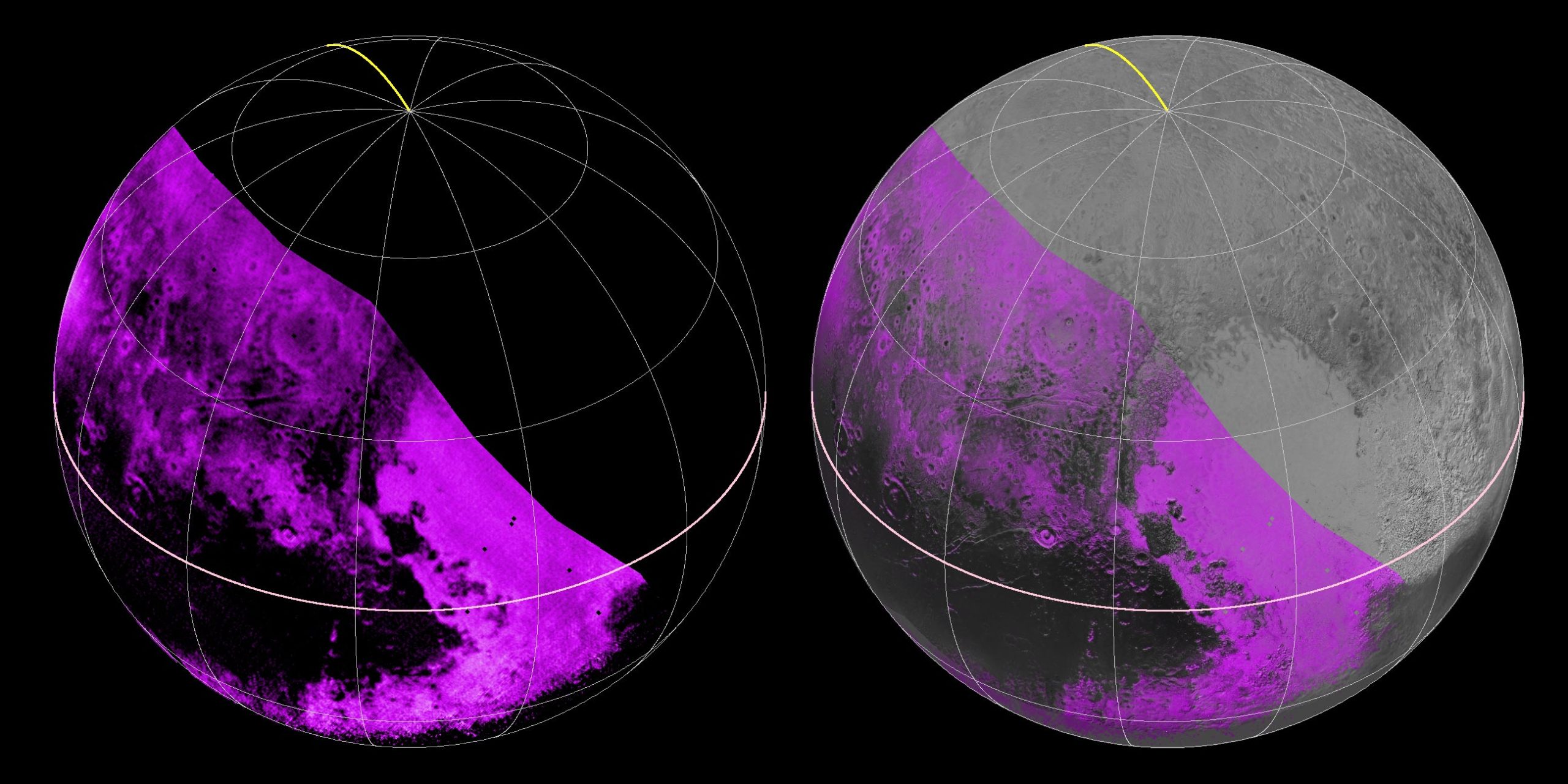
    The Ralph/LEISA infrared spectrometer on NASA’s New Horizons spacecraft mapped compositions across Pluto’s surface as it flew by on July 14. On the left, a map of methane ice abundance shows striking regional differences, with stronger methane absorption indicated by the brighter purple colors here, and lower abundances shown in black. Data have only been received so far for the left half of Pluto’s disk. At right, the methane map is merged with higher-resolution images from the spacecraft’s Long Range Reconnaissance Imager (LORRI). Credit: NASA/JHUAPL/SWRI

    This closer look at the smooth, bright surface of the informally named Sputnik Planum shows that it is actually pockmarked by dense patterns of pits, low ridges and scalloped terrain. Dunes of bright volatile ice particles are a possible explanation, mission scientists say, but the ices of Sputnik may be especially susceptible to sublimation and formation of such corrugated ground.

    Beyond the new images, new compositional information comes from a just-obtained map of methane ice across part of Pluto’s surface that reveals striking contrasts: Sputnik Planum has abundant methane, while the region informally named Cthulhu Regio shows none, aside from a few isolated ridges and crater rims. Mountains along the west flank of Sputnik lack methane as well.

    The distribution of methane across the surface is anything but simple, with higher concentrations on bright plains and crater rims, but usually none in the centers of craters or darker regions. Outside of Sputnik Planum, methane ice appears to favor brighter areas, but scientists aren’t sure if that’s because methane is more likely to condense there or that its condensation brightens those regions.

    “It’s like the classic chicken-or-egg problem,” said Will Grundy, New Horizons surface composition team lead from Lowell Observatory in Flagstaff, Arizona. “We’re unsure why this is so, but the cool thing is that New Horizons has the ability to make exquisite compositional maps across the surface of Pluto, and that’ll be crucial to resolving how enigmatic Pluto works.”

    “With these just-downlinked images and maps, we’ve turned a new page in the study of Pluto beginning to reveal the planet at high resolution in both color and composition,” added New Horizons Principal Investigator Alan Stern, of SwRI. “I wish Pluto’s discoverer Clyde Tombaugh had lived to see this day.”

    Never miss a breakthrough: Join the SciTechDaily newsletter.
    Follow us on Google and Google News.

    Astronomy Geology NASA New Horizons Planetary Science Pluto Popular
    Share. Facebook Twitter Pinterest LinkedIn Email Reddit

    Related Articles

    New Horizons Reveals Charon’s Colorful and Violent History

    NASA Reveals New Pluto Images from New Horizons Spacecraft

    Data from NASA’s New Horizons Hints at Underground Ocean on Pluto

    New Horizons Reveals Flowing Ices, Exotic Surface Chemistry, Mountains, and Haze on Pluto

    New Horizons Reveals a Dense Region of Atmospheric Ions Behind Pluto

    New Horizons Discovers Frozen Plains on Pluto

    NASA’s New Horizons Spacecraft Reaches Historic Encounter with Pluto

    New Horizons Reveals Signs of Pluto’s Geology

    Dwarf Planet Pluto: The ‘Other’ Red Planet

    Leave A Reply Cancel Reply

    • Facebook
    • Twitter
    • Pinterest
    • YouTube

    Don't Miss a Discovery

    Subscribe for the Latest in Science & Tech!

    Trending News

    Popular Sugar-Free Sweetener Linked to Liver Disease, Study Warns

    What Is Hantavirus? The Deadly Disease Raising Alarm Worldwide

    Scientists Just Discovered How the Universe Builds Monster Black Holes

    Scientists Unveil New Treatment Strategy That Could Outsmart Cancer

    A Simple Vitamin May Hold the Key to Treating Rare Genetic Diseases

    Scientists Think the Real Fountain of Youth May Be Hiding in Your Gut

    Ravens Don’t Follow Wolves, They Predict Them

    This Common Knee Surgery May Be Doing More Harm Than Good

    Follow SciTechDaily
    • Facebook
    • Twitter
    • YouTube
    • Pinterest
    • Newsletter
    • RSS
    SciTech News
    • Biology News
    • Chemistry News
    • Earth News
    • Health News
    • Physics News
    • Science News
    • Space News
    • Technology News
    Recent Posts
    • Why Are So Many New Fathers Dying? Scientists Say the U.S. Has a Dangerous Blind Spot
    • Scientists Identify Simple Supplement That Greatly Reduces Alzheimer’s Damage
    • You May Have a Dangerous Type of Cholesterol Even if Your Tests Look Normal
    • Study Reveals Dangerous Flaw in AI Symptom Checkers
    • New MRI Breakthrough Captures Stunningly Clear Images of the Eye and Brain
    Copyright © 1998 - 2026 SciTechDaily. All Rights Reserved.
    • Science News
    • About
    • Contact
    • Editorial Board
    • Privacy Policy
    • Terms of Use

    Type above and press Enter to search. Press Esc to cancel.