
Close Menu
    Facebook X (Twitter) Instagram
    SciTechDaily
    • Biology
    • Chemistry
    • Earth
    • Health
    • Physics
    • Science
    • Space
    • Technology
    Facebook X (Twitter) Pinterest YouTube RSS
    SciTechDaily
    Home»Space»New Horizons Discovers Frozen Plains on Pluto
    Space

    New Horizons Discovers Frozen Plains on Pluto

    By Dwayne Brown / Laurie Cantillo, NASAJuly 18, 2015No Comments5 Mins Read
    Facebook Twitter Pinterest Telegram LinkedIn WhatsApp Email Reddit
    Share
    Facebook Twitter LinkedIn Pinterest Telegram Email Reddit
    NASA’s New Horizons Discovers Frozen Plains
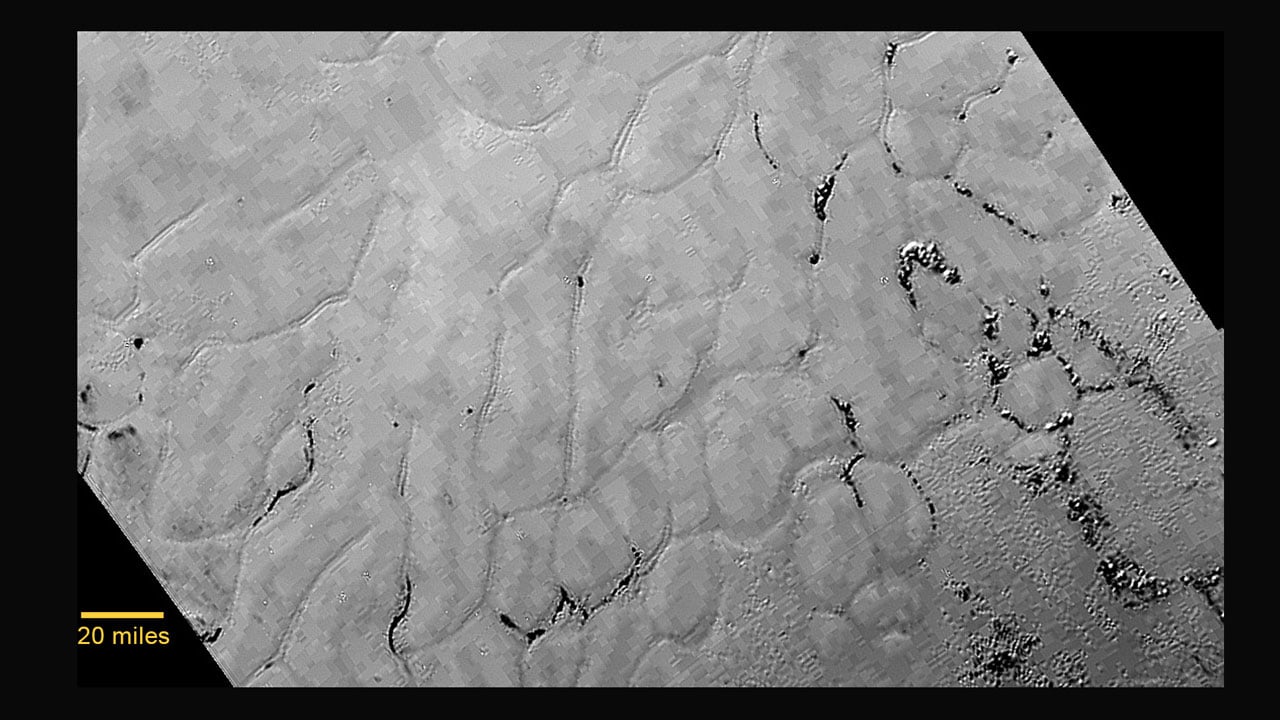
    In the center left of Pluto’s vast heart-shaped feature – informally named “Tombaugh Regio” – lies a vast, craterless plain that appears to be no more than 100 million years old, and is possibly still being shaped by geologic processes. This frozen region is north of Pluto’s icy mountains and has been informally named Sputnik Planum (Sputnik Plain), after Earth’s first artificial satellite. The surface appears to be divided into irregularly shaped segments that are ringed by narrow troughs. Features that appear to be groups of mounds and fields of small pits are also visible. This image was acquired by the Long Range Reconnaissance Imager (LORRI) on July 14 from a distance of 48,000 miles (77,000 kilometers). Features as small as one-half mile (1 kilometer) across are visible. The blocky appearance of some features is due to the compression of the image. Credit: NASA/JHUAPL/SWRI

    The latest data from NASA’s New Horizons Spacecraft shows a close-up image of a craterless plain on Pluto that appears to be no more than 100 million years old, and is possibly still being shaped by geologic processes.

    This frozen region is north of Pluto’s icy mountains, in the center-left of the heart feature, informally named “Tombaugh Regio” (Tombaugh Region) after Clyde Tombaugh, who discovered Pluto in 1930.

    “This terrain is not easy to explain,” said Jeff Moore, leader of the New Horizons Geology, Geophysics, and Imaging Team (GGI) at NASA’s Ames Research Center in Moffett Field, California. “The discovery of vast, craterless, very young plains on Pluto exceeds all pre-flyby expectations.”

    This fascinating icy plains region — resembling frozen mud cracks on Earth — has been informally named “Sputnik Planum” (Sputnik Plain) after the Earth’s first artificial satellite. It has a broken surface of irregularly shaped segments, roughly 12 miles (20 kilometers) across, bordered by what appear to be shallow troughs. Some of these troughs have darker material within them, while others are traced by clumps of hills that appear to rise above the surrounding terrain. Elsewhere, the surface appears to be etched by fields of small pits that may have formed by a process called sublimation, in which ice turns directly from solid to gas, just as dry ice does on Earth.

    Scientists have two working theories as to how these segments were formed. The irregular shapes may be the result of the contraction of surface materials, similar to what happens when mud dries. Alternatively, they may be a product of convection, similar to wax rising in a lava lamp. On Pluto, convection would occur within a surface layer of frozen carbon monoxide, methane, and nitrogen, driven by the scant warmth of Pluto’s interior.

    Pluto’s icy plains also display dark streaks that are a few miles long. These streaks appear to be aligned in the same direction and may have been produced by winds blowing across the frozen surface.

    The Tuesday “heart of the heart” image was taken when New Horizons was 48,000 miles (77,000 kilometers) from Pluto, and shows features as small as one-half mile (1 kilometer) across. Mission scientists will learn more about these mysterious terrains from higher-resolution and stereo images that New Horizons will pull from its digital recorders and send back to Earth during the next year.
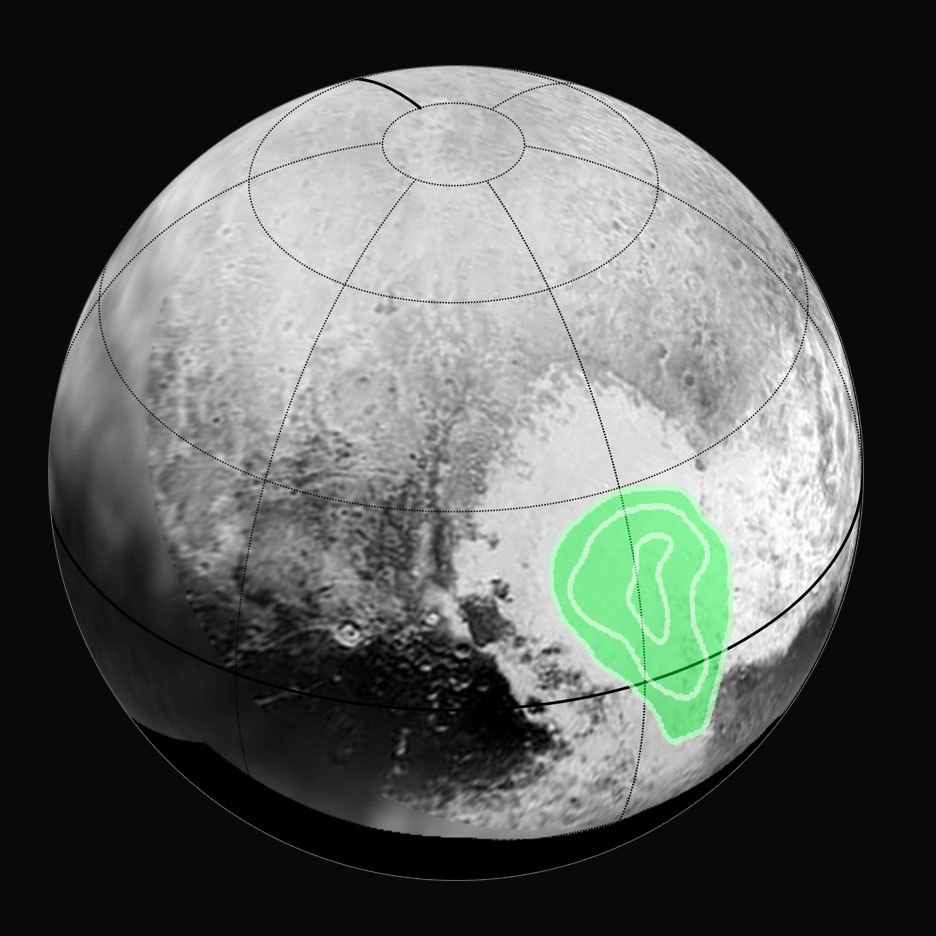
    Frozen Carbon Monoxide in Pluto’s 'Heart'
    Peering closely at the “heart of Pluto,” in the western half of what mission scientists have informally named Tombaugh Regio (Tombaugh Region), New Horizons’ Ralph instrument revealed evidence of carbon monoxide ice. The contours indicate that the concentration of frozen carbon monoxide increases towards the center of the “bull’s eye.” These data were acquired by the spacecraft on July 14 and transmitted to Earth on July 16. Credit: NASA/JHUAPL/SWRI

    The New Horizons Atmospheres team observed Pluto’s atmosphere as far as 1,000 miles (1,600 kilometers) above the surface, demonstrating that Pluto’s nitrogen-rich atmosphere is quite extended. This is the first observation of Pluto’s atmosphere at altitudes higher than 170 miles above the surface (270 kilometers).

    The New Horizons Particles and Plasma team has discovered a region of cold, dense ionized gas tens of thousands of miles beyond Pluto — the planet’s atmosphere being stripped away by the solar wind and lost to space.

    “This is just a first tantalizing look at Pluto’s plasma environment,” said New Horizons co-investigator Fran Bagenal, University of Colorado, Boulder.

    “With the flyby in the rearview mirror, a decade-long journey to Pluto is over –but, the science payoff is only beginning,” said Jim Green, director of Planetary Science at NASA Headquarters in Washington. “Data from New Horizons will continue to fuel discovery for years to come.”

    Alan Stern, New Horizons principal investigator from the Southwest Research Institute (SwRI), Boulder, Colorado, added, “We’ve only scratched the surface of our Pluto exploration, but it already seems clear to me that in the initial reconnaissance of the solar system, the best was saved for last.”

    Never miss a breakthrough: Join the SciTechDaily newsletter.
    Follow us on Google and Google News.

    Astronomy Geology NASA New Horizons Planetary Science Pluto
    Share. Facebook Twitter Pinterest LinkedIn Email Reddit

    Related Articles

    New Findings Help Shape Our Understanding of Pluto and Its Moons

    New Horizons Reveals Charon’s Colorful and Violent History

    New Horizons Reveals ‘Snakeskin’ Pluto Image and More

    The Latest New Horizons Images of Dwarf Planet Pluto

    Dwarf Planet Pluto: The ‘Other’ Red Planet

    New Horizons Spacecraft Reveals Series of Spots on Pluto That Fascinate

    New Horizons Spacecraft Awakens for Encounter with Pluto System

    New ScienceCast Video Previews What New Horizons May See on Pluto

    New ScienceCast Video – Countdown to Pluto

    Leave A Reply Cancel Reply

    • Facebook
    • Twitter
    • Pinterest
    • YouTube

    Don't Miss a Discovery

    Subscribe for the Latest in Science & Tech!

    Trending News

    Artificial Sweeteners May Harm Future Generations, Study Suggests

    Splashdown! NASA Artemis II Returns From Record-Breaking Moon Mission

    What If Consciousness Exists Beyond Your Brain

    Scientists Finally Crack the 100-Million-Year Evolutionary Mystery of Squid and Cuttlefish

    Beyond “Safe Levels”: Study Challenges What We Know About Pesticides and Cancer

    Researchers Have Found a Dietary Compound That Increases Longevity

    Scientists Baffled by Bizarre “Living Fossil” From 275 Million Years Ago

    Your IQ at 23 Could Predict Your Wealth at 27, Study Finds

    Follow SciTechDaily
    • Facebook
    • Twitter
    • YouTube
    • Pinterest
    • Newsletter
    • RSS
    SciTech News
    • Biology News
    • Chemistry News
    • Earth News
    • Health News
    • Physics News
    • Science News
    • Space News
    • Technology News
    Recent Posts
    • What if Dark Matter Has Two Forms? Bold New Hypothesis Could Explain a Cosmic Mystery
    • Researchers Expose Hidden Chemistry of “Ore-Forming” Elements in Biology
    • Geologists Reveal the Americas Collided Earlier Than We Thought
    • 20x Difference: Study Reveals True Source of Airborne Microplastics
    • Scientists Uncover Hidden Force Powering Yellowstone’s Supervolcano
    Copyright © 1998 - 2026 SciTechDaily. All Rights Reserved.
    • Science News
    • About
    • Contact
    • Editorial Board
    • Privacy Policy
    • Terms of Use

    Type above and press Enter to search. Press Esc to cancel.