
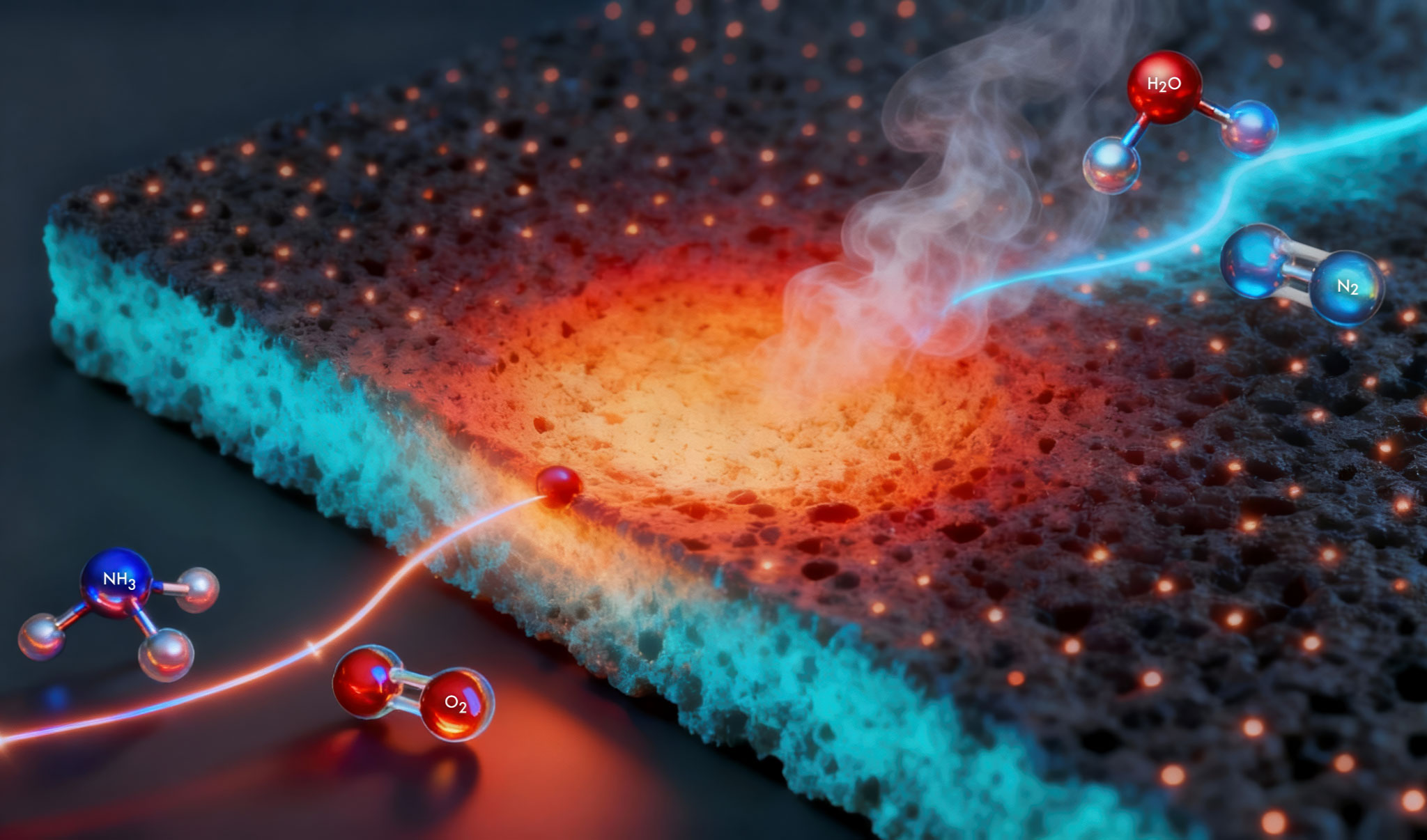
A newly engineered catalyst overcomes key obstacles that have long limited ammonia as a clean fuel for heavy industry.
A newly developed single-atom platinum catalyst can ignite ammonia at about 200°C (392°F) and sustain stable combustion at 1,100°C (2,012°F) while producing very little NOx. The breakthrough could provide carbon-free, high-grade heat for industries such as steel, cement, and chemical manufacturing.
Ammonia has long been considered a promising clean fuel for energy-intensive industries. It can be produced using air, water, and renewable electricity, stored in liquid form, and transported through existing industrial infrastructure.
The challenge is that ammonia is difficult to ignite, burns slowly, and can release large amounts of nitrogen oxides (NOx) at high temperatures. Those limitations have made it difficult for heavy industries, which depend on reliable high-temperature heat, to move away from fossil fuels.
Researchers from the College of Design and Engineering (CDE) have now demonstrated that atomic-scale engineering may solve these problems. In a study published in Joule, a team led by Professor Yan Ning from the Department of Chemical and Biomolecular Engineering and Assistant Professor He Qian from the Department of Materials Science and Engineering created a catalyst that starts ammonia combustion just above 200°C (392°F) and maintains clean burning at 1,100°C (2,012°F).

The process converts ammonia completely into nitrogen and water while generating only trace levels of NOx. The findings suggest ammonia could eventually provide industrial heat without carbon dioxide emissions or harmful exhaust gases.
Why Ammonia Has Struggled as an Industrial Fuel
Industrial furnaces and reactors require powerful, controllable heat that can be produced on demand. Ammonia could theoretically provide this without carbon emissions, but practical use has been difficult. Ammonia burns cleanly only within a narrow range of fuel and air mixtures. Its “light-off” temperature, the point where combustion begins easily, is also relatively high, and the flame can become unstable. Raising the temperature to stabilize combustion often increases NOx emissions.
“Heavy industry needs high-quality heat, not just a clean exhaust,” says Asst Prof He. “We set out to kill two birds with one stone: make ammonia easier to ignite and keep NOx low when you run it hot.”
The researchers used a method called high-temperature catalytic ammonia combustion, which relies on a surface catalyst to help ammonia react more efficiently with oxygen. The main difficulty was identifying a material capable of initiating combustion at lower temperatures while also surviving the extreme heat required for industrial applications.
Single-Atom Platinum Catalyst Enables Low-Temperature Ignition
The team developed a material that spreads individual platinum atoms across a durable alumina support reinforced with zirconia. Each platinum atom acts as a separate reaction site. This structure prevents the platinum from clustering under intense heat and helps preserve the catalyst’s stability at temperatures above 1,000°C (1,832°F).

Laboratory testing showed the catalyst could ignite ammonia at roughly 215°C (419°F), much lower than the typical 500°C (932°F) or higher usually required. It also maintained stable combustion at 1,100°C (2,012°F). All ammonia molecules were fully converted, leaving no unburned fuel and producing almost no NOx. Researchers also found that the catalyst became more effective after initial use and stayed stable during repeated high-temperature testing cycles.
At lower temperatures, the isolated platinum atoms help break apart ammonia molecules and recombine them with oxygen to produce nitrogen and water, which is the cleanest possible combustion outcome. At higher temperatures, the catalyst’s structure directs the reaction away from NOx production. Imaging studies confirmed that the platinum atoms remained evenly dispersed and active even after 80 hours of operation, demonstrating the material’s thermal durability.
Atomic-Scale Design Reduces NOx Emissions
“What matters here is the design logic,” says Prof Yan. “Pairing a heat-stable support with isolated metal atoms enables us to achieve both early ignition and resilience at extreme temperatures. The system naturally favors the formation of nitrogen over nitrogen oxides.”
Asst Prof He adds: “Industries could retrofit their systems with minimal changes, gaining the benefits of clean heat without having to rebuild their plants from scratch.”
The researchers are now working to move the technology closer to industrial use. With support from the NUS Centre for Hydrogen Innovations, the team is preparing pilot-scale trials at facilities designed for safe ammonia handling. They plan to evaluate the catalyst in industrial burners, gas turbines, and high-temperature reactors under real operating conditions.
“Ammonia has always held promise as a low-carbon fuel, but making it truly usable required solving a long-standing chemistry problem,” says Du Yankun, first author of the paper. “Our catalyst shows that it is possible to unlock ammonia’s energy cleanly and reliably. That brings us one step closer to carbon-free industrial heat.”
Reference: “Single-atom catalysts enabled catalytic ammonia combustion at 1,100°C” by Yankun Du, Bingqing Yao, Liang Xu, Shangchen Lu, Chaokai Xu, Peijie Han, Sheng Dai, Sikai Wang, Shibo Xi, Boon Siong Neo, Ning Yan and Qian He, 3 July 2025, Joule.
DOI: 10.1016/j.joule.2025.102030
Never miss a breakthrough: Join the SciTechDaily newsletter.
Follow us on Google and Google News.
1 Comment
thanks for this