
Japanese scientists have discovered a compound, ethylammonium lead iodide, which can store and release ammonia safely and efficiently. This finding holds potential for ammonia’s role as a carbon-free hydrogen carrier, contributing to the transition towards a decarbonized society.
Researchers at the RIKEN Center for Emergent Matter Science (CEMS) in Japan have discovered a compound that uses a chemical reaction to store ammonia, potentially offering a safer and easier way to store this important chemical. This discovery, published in the Journal of the American Chemical Society on July 10, makes it possible not only to safely and conveniently store ammonia, but also the important hydrogen is carries. This finding should help lead the way to a decarbonized society with a practical hydrogen economy.
For society to make the switch from carbon-based to hydrogen-based energy, we need a safe way to store and transport hydrogen, which by itself is highly combustible. One way to do this is to store it as part of another molecule and extract it as needed. Ammonia, chemically written as NH3, makes a good hydrogen carrier because three hydrogen atoms are packed into each molecule, with almost 20% of ammonia being hydrogen by weight.
A Perovskite-Based Storage Solution
The problem, however, is that ammonia is a highly corrosive gas, making it difficult to store and use. Currently, ammonia is generally stored by liquefying it at temperatures well below freezing in pressure-resistant containers. Porous compounds can also store ammonia at room temperature and pressure, but storage capacity is low, and the ammonia cannot always be retrieved easily. The new study reports the discovery of a perovskite, a material with a distinctive repetitive crystal structure, which can easily store ammonia and also allows easy and complete retrieval at relatively low temperatures.
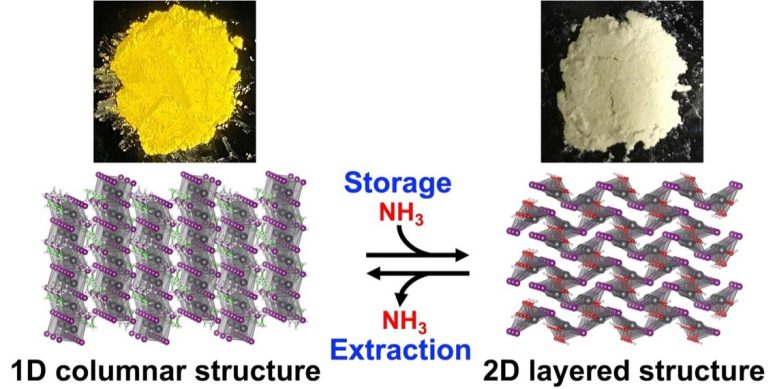
The research team led by Masuki Kawamoto at RIKEN CEMS focused on the perovskite ethylammonium lead iodide (EAPbI3), chemically written as CH3CH2NH3PbI3. They found that its one-dimensional columnar structure undergoes a chemical reaction with ammonia at room temperature and pressure, and dynamically transforms into a two-dimensional layered structure called lead iodide hydroxide, or Pb(OH)I. As a result of this process, ammonia is stored within the layered structure through chemical conversion. Thus, EAPbI3 can safely store corrosive ammonia gas as a nitrogen compound in a process that is much cheaper than liquification at -33°C (-27.4°F) in pressurized containers. Even more importantly, the process to retrieve the stored ammonia is just as simple.
Releasing Ammonia: A Simple and Efficient Process
“To our surprise, ammonia stored in ethylammonium lead iodide could be easily extracted by heating it gently,” says Kawamoto. The stored nitrogen compound undergoes a reverse reaction at 50°C (122°F) under vacuum and returns to ammonia. This temperature is much lower than the 150°C (302°F) or more that is needed to extract ammonia from porous compounds, making EAPbI3 an excellent medium for handling corrosive gases in a simple and cost-effective process. Additionally, after returning to the one-dimensional columnar structure, the perovskite can be reused, allowing ammonia to be repeatedly stored and extracted. An added bonus was that the normally yellow compound became white after the reaction. According to Kawamoto, “the compound’s ability to change color when storing ammonia means that color-based ammonia sensors can be developed to determine the amount of ammonia stored.”
The new storage method has several uses. In the short term, the researchers have developed a safe method for storing ammonia, which already has multiple uses in society, from fertilizer to pharmaceuticals to textiles. “In the long-term,” says to co-author Yoshihiro Ito of RIKEN CEMS, “we hope that this simple and efficient method can be a part of the solution for achieving a decarbonized society through the use of ammonia as carbon-free hydrogen carrier.”
This research will help achieve the 2016 Sustainable Development Goals (SDGs) set forth by the United Nations, especially Goal 7: Affordable and clean energy and Goal 13: Climate action.
Reference: “Chemical storage of ammonia through dynamic structural transformation of a hybrid perovskite compound” by Jyorthana Rajappa Muralidhar, Krishnachary Salikolimi, Kiyohiro Adachi, Daisuke Hashizume, Koichi Kodama, Takuji Hirose, Yoshihiro Ito and Masuki Kawamoto, 10 July 2023, Journal of the American Chemical Society.
DOI: 10.1021/jacs.3c04181
Never miss a breakthrough: Join the SciTechDaily newsletter.
Follow us on Google and Google News.
1 Comment
The next step is a substitute for lead. Maybe then it will be safe.