
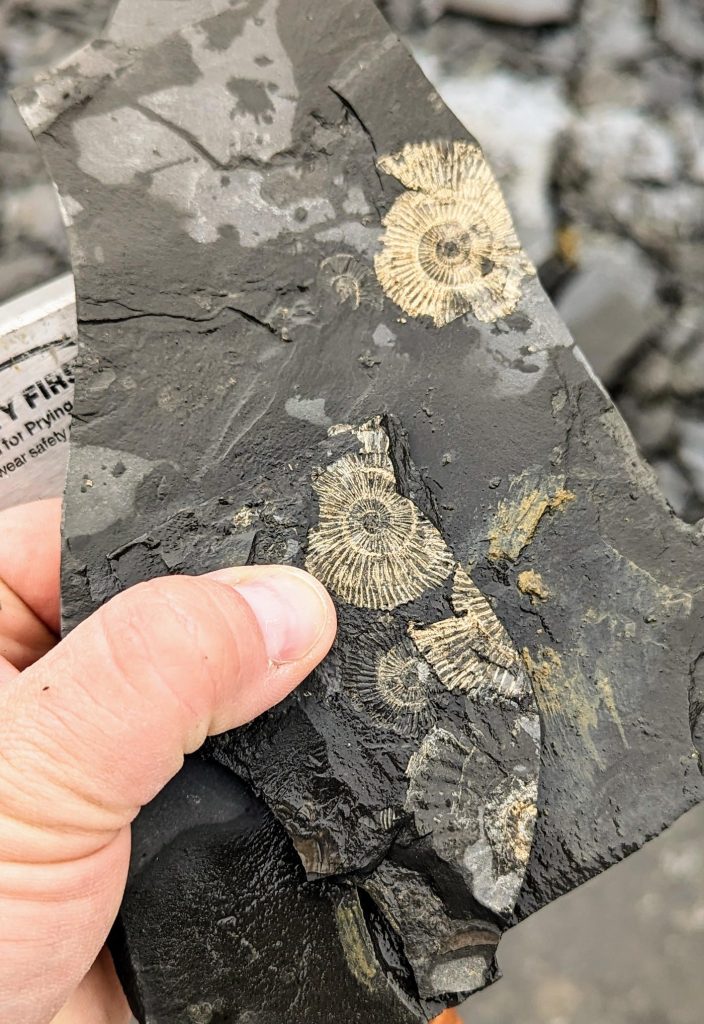
New research debunks the belief that Posidonia shale fossils owe their golden sheen to pyrite. Instead, phosphate minerals, formed by oxygenation events, played a key role in their preservation, challenging theories that link fossilization strictly to anoxic conditions.
All that glitters is not gold, or even fool’s gold in the case of fossils.
New research carried out by scientists at The University of Texas at Austin and their collaborators has revealed a new truth about the fossils from Germany’s Posidonia shale. They debunked the long-standing belief that their shimmer stemmed from pyrite, popularly known as fool’s gold. The source of their golden gleam actually lies in a blend of minerals, which offers clues about the environment where these fossils came into existence.
The discovery is important for understanding how the fossils — which are among the world’s best-preserved specimens of sea life from the Early Jurassic — came to form in the first place, and the role that oxygen in the environment had in their formation.
Golden Fossils Without Fool’s Gold
“When you go to the quarries, golden ammonites peek out from black shale slabs,” said study co-author Rowan Martindale, an associate professor at the UT Jackson School of Geosciences. “But surprisingly, we struggled to find pyrite in the fossils. Even the fossils that looked golden, are preserved as phosphate minerals with yellow calcite. This dramatically changes our view of this famous fossil deposit.”
The research was published in Earth Science Reviews. Drew Muscente, a former assistant professor at Cornell College and former Jackson School postdoctoral researcher, led the study.
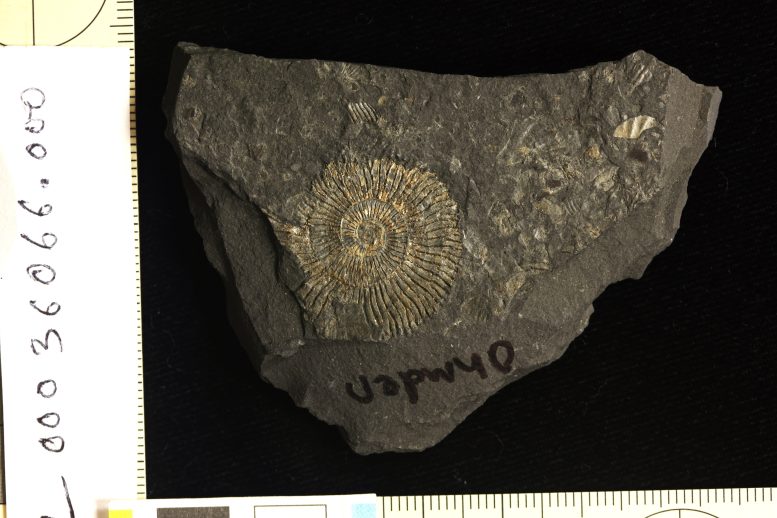
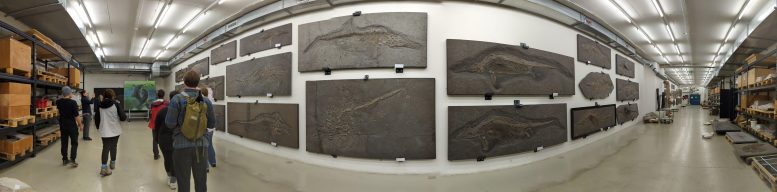
The fossils of the Posidonia Shale date back to 183 million years ago, and include rare soft-bodied specimens such as ichthyosaur embryos, squids with ink-sacs, and lobsters. To learn more about the fossilization conditions that led to such exquisite preservation, the researchers put dozens of samples under scanning electron microscopes to study their chemical composition.
“I couldn’t wait to get them in my microscope and help tell their preservational story,” said co-author Jim Schiffbauer, an associate professor at the University of Missouri Department of Geological Sciences, who handled some of the larger samples.
The Unexpected Role of Phosphate in Fossil Formation
The researchers found that in every instance, the fossils were primarily made up of phosphate minerals even though the surrounding black shale rock was dotted with microscopic clusters of pyrite crystals, called framboids.
“I spent days looking for the framboids on the fossil,” said co-author Sinjini Sinha, a doctoral student at the Jackson School. “For some of the specimens, I counted 800 framboids on the matrix while there was maybe three or four on the fossils.”
The Role of Oxygen in Fossilization
The fact that pyrite and phosphate are found in different places on the specimens is important because it reveals key details about the fossilization environment. Pyrite forms in anoxic (without oxygen) environments, but phosphate minerals need oxygen. The research suggests that although an anoxic seafloor sets the stage for fossilization — keeping decay and predators at bay — it took a pulse of oxygen to drive the chemical reactions needed for fossilization.
These findings complement earlier research carried out by the team on the geochemical conditions of sites known for their caches of exceptionally preserved fossils, called konservat-lagerstätten. However, the results of these studies contradict long-standing theories about the conditions needed for exceptional fossil preservation in the Posidonia.
“It’s been thought for a long time that the anoxia causes the exceptional preservation, but it doesn’t directly help,” said Sinha. “It helps with making the environment conducive to faster fossilization, which leads to the preservation, but it’s oxygenation that’s enhancing preservation.”
It turns out, the oxygenation — and the phosphate and accompanying minerals — also enhanced the fossil’s shine.
Reference: “What role does anoxia play in exceptional fossil preservation? Lessons from the taphonomy of the Posidonia Shale (Germany)” by A.D. Muscente, Olivia Vinnes, Sinjini Sinha, James D. Schiffbauer, Erin E. Maxwell, Günter Schweigert and Rowan C. Martindale, 23 January 2023, Earth-Science Reviews.
DOI: 10.1016/j.earscirev.2023.104323
The research was funded by Cornell College and the National Science Foundation. The Posidonia fossil specimens used in this study are now part of the collections at the Jackson School’s Non-Vertebrate Paleontology Laboratory.
Never miss a breakthrough: Join the SciTechDaily newsletter.
Follow us on Google and Google News.
1 Comment
This composition explains why these beauties do not quickly tarnish as true pyrite/marcasite replaced specimens do.