
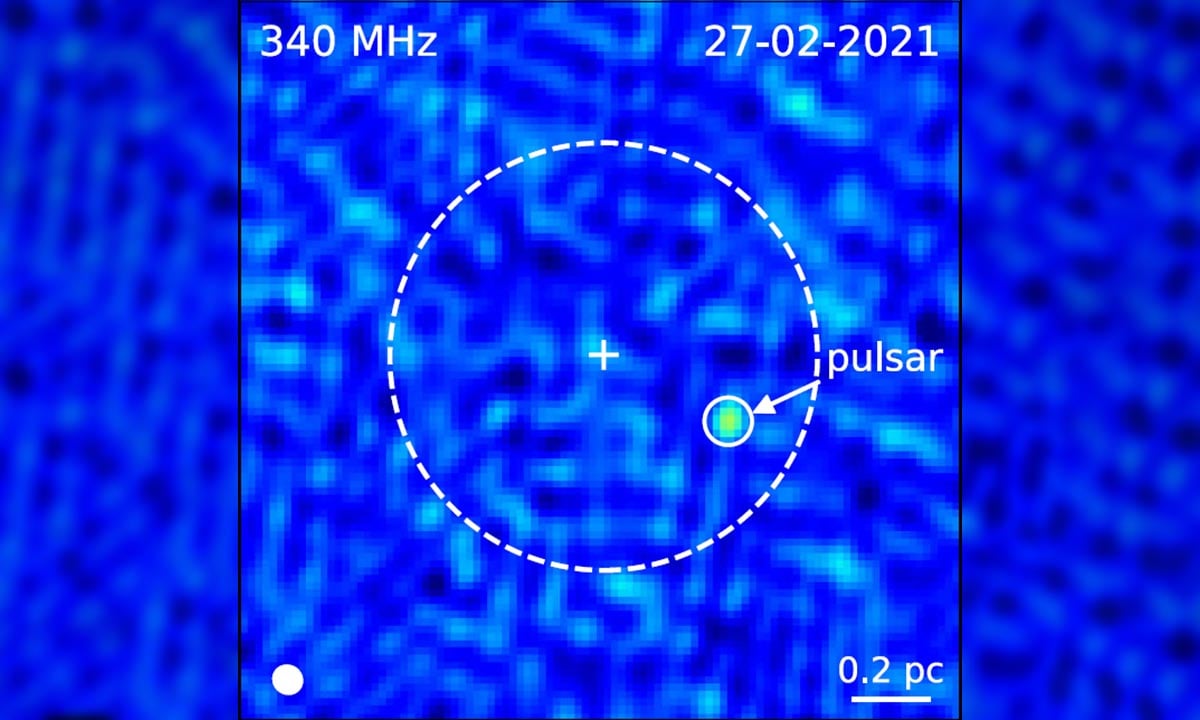
A U.S. Naval Research Laboratory intern discovered a millisecond pulsar in the Glimpse-CO1 cluster using the Very Large Array, highlighting pulsars’ role as celestial timekeepers and their potential in space navigation. The research, involving collaboration with national observatories, underscores the critical contributions of student interns in cutting-edge scientific discoveries.
U.S. Naval Research Laboratory (NRL) Remote Sensing Division intern, Amaris McCarver, along with a team of astronomers, discovered the first millisecond pulsar in the stellar cluster Glimpse-CO1 and recently published findings in the Astrophysical Journal.
Pulsars are natural laboratories for studying the behavior of matter under extreme gravitational and magnetic fields — conditions difficult or impossible to replicate on Earth.
They also function as natural timekeepers. Precise timing of the observed pulses from an array of pulsars offers a means to detect gravitational waves propagating through our galaxy from the merging supermassive black holes that result from galaxy collisions. Some pulsars are observed to have an accuracy and stability comparable to our most precise atomic clocks. These pulsars hold the potential to establish a “celestial GPS” system for satellite navigation in space.
Breakthrough in Pulsar Research
McCarver’s team used images from the Karl G. Jansky Very Large Array (VLA) Low-band Ionosphere and Transient Experiment (VLITE) to search for new pulsars in 97 stellar clusters.
“It was exciting so early in my career to see a speculative project work out so successfully,” said McCarver. Her new approach of using VLITE images coupled with images from several radio surveys at different frequencies identified multiple candidate pulsars, with the strongest candidate residing in a system known as GLIMPSE-C01.
“This type of scientific discovery is only possible thanks to the collaboration between NRL and the National Radio Astronomy Observatory that enabled this continual dual-frequency capability on the VLA,” said Tracy E. Clarke, Ph.D., NRL Remote Sensing Division astronomer. “This research highlights how we can use measures of radio brightness at different frequencies to find new pulsars efficiently, and that available sky surveys combined with the mountain of VLITE data mean those measurements are essentially always available. This opens the door to a new era of searches for highly dispersed and highly accelerated pulsars.”
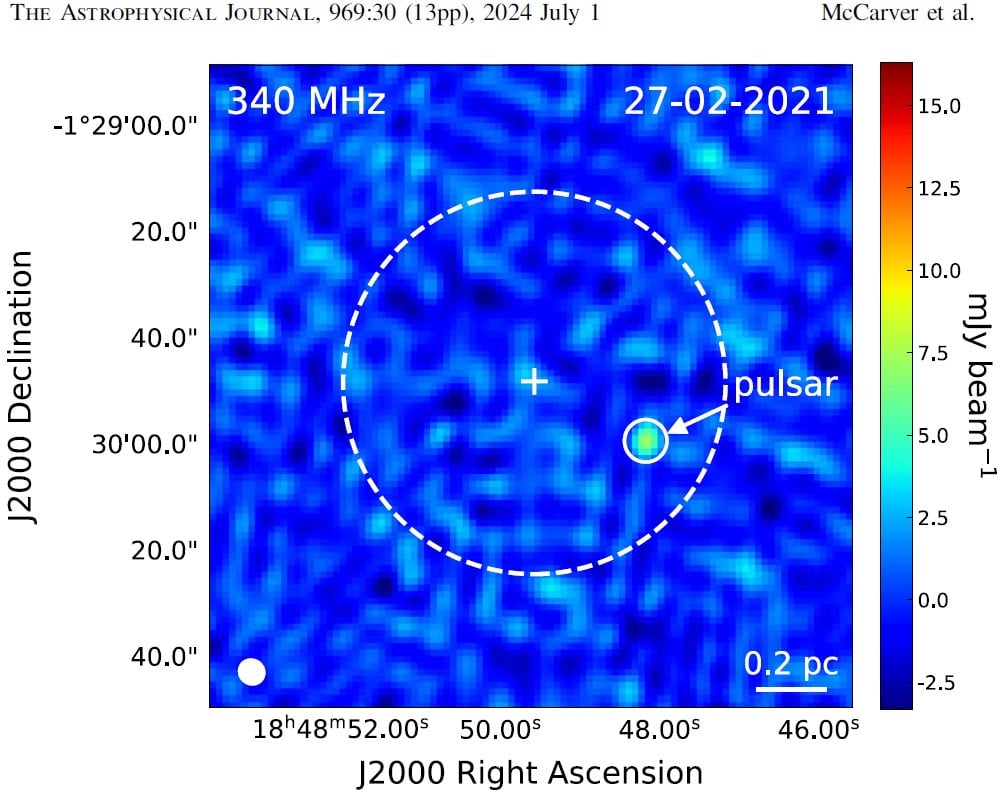
Identifying a Millisecond Pulsar
The presence of a millisecond pulsar, designated GLIMPSE-C01A, was confirmed through re-processing of archival data from the Robert C. Byrd Green Bank Telescope. Millisecond pulsars, such as GLIMPSE-C01A, are born in supernova explosions and are spun up by consuming material from a companion star.
“Millisecond pulsars, or MSP, offer a promising method for autonomously navigating spacecraft from low Earth orbit to interstellar space, independent of ground contact and GPS availability,” said Emil Polisensky, Ph.D., an NRL Remote Sensing Division astronomer. “The confirmation of a new MSP identified by Amaris highlights the exciting potential for discovery with NRL’s VLITE data and the key role student interns play in cutting edge research.”
Future Aspirations and Institutional Support
McCarver received the Robert S. Hyer Research Award from the Texas Section of the American Physical Society (APS). The award for ‘Excellence in Research’ was presented to her during the October Texas APS meeting for her summer research on millisecond pulsars which was undertaken as part of the Naval Research Enterprise Internship Program (NREIP).
McCarver was one of 16 summer of 2023 interns in the Radio, Infrared, Optical Sensors Branch at NRL DC who participated in internships through the Science Engineering Apprenticeship Program and NREIP, Historically Black College and University/Minority Institution High Performance Computing Internship Program, and the U.S. Naval Academy Midshipmen Internship Program. She will graduate with a degree in Physics and Astronomy and plans to pursue her graduate education in astronomy.
NRL’s Research Agenda
The NRL Remote Sensing Division conducts a program of basic research, science, and applications aimed at the development of new concepts for sensors and imaging systems for objects and targets on the Earth, in the near-Earth environment, and in deep space. The research, both theoretical and experimental, deals with discovering and understanding the basic physical principles and mechanisms that give rise to target and background emission, and to absorption and emission by the intervening medium.
The research includes theory, laboratory, and field experiments leading to ground-based, airborne, or space systems for use in such areas as remote sensing, astrometry, astrophysics, surveillance, non-acoustic anti-submarine warfare, and improved meteorological support systems for the operational Navy.
Reference: “A VLITE Search for Millisecond Pulsars in Globular Clusters: Discovery of a Pulsar in GLIMPSE-C01” by Amaris V. McCarver, Thomas J. Maccarone, Scott M. Ransom, Tracy E. Clarke, Simona Giacintucci, Wendy M. Peters, Emil Polisensky, Kristina Nyland, Tasha Gautam, Paulo C. C. Freire and Blagoy Rangelov, 27 June 2024, The Astrophysical Journal.
DOI: 10.3847/1538-4357/ad4461
Never miss a breakthrough: Join the SciTechDaily newsletter.
Follow us on Google and Google News.