
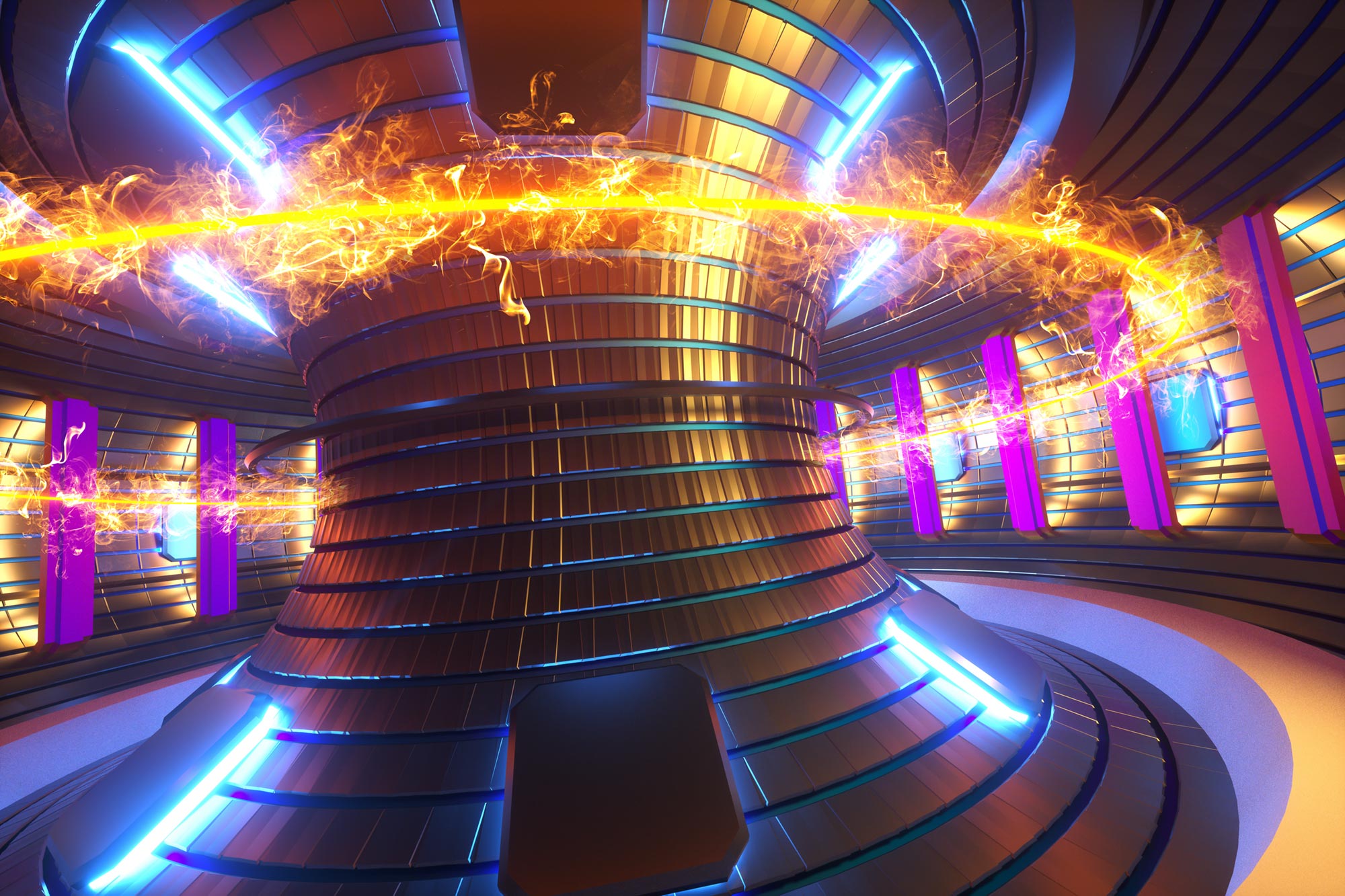
Scientists have demonstrated a new plasma operating regime that could help solve two of fusion energy’s biggest challenges at once.
Inside a fusion reactor, matter is heated to temperatures hotter than the Sun and confined by powerful magnetic fields. But keeping this superheated plasma stable long enough to produce usable energy remains one of the field’s toughest challenges.
One major problem is that the plasma edge can unleash violent bursts of energy capable of damaging reactor walls, while the exhaust system must also withstand enormous heat loads comparable to those on a spacecraft during reentry.
Now, researchers in China may have found a way to tackle both issues at once.
A team led by Professor Guosheng Xu at the Institute of Plasma Physics, part of the Hefei Institutes of Physical Science under the Chinese Academy of Sciences, has demonstrated a new plasma operating regime on the EAST fusion device that simultaneously reduces heat striking reactor components, suppresses damaging instabilities, and maintains strong energy confinement. The achievement, sustained for roughly a minute in a metal-wall environment, was recently published in Physical Review Letters.
Fusion Challenges: Heat Loads, ELMs, and Stability
Fusion reactors work by confining plasma — an extremely hot, electrically charged gas — inside magnetic fields. For fusion power plants to operate continuously, they must maintain high temperatures and strong confinement while safely removing excess heat and particles from the plasma edge.
One of the most vulnerable regions is the divertor, a specialized exhaust system that handles escaping heat and particles. Under normal conditions, the divertor can experience immense heat fluxes that threaten to erode reactor materials. Scientists often inject small amounts of impurity gases to cool this region through a process called detachment, where the plasma partially separates from the divertor surface. However, excessive cooling can also reduce the plasma’s performance.
Another major issue involves edge-localized modes, or ELMs, sudden eruptions of heat and particles from the plasma edge that behave somewhat like solar flares. These bursts are common in high-confinement, or H-mode, plasmas, which are otherwise desirable because they trap energy efficiently. Eliminating ELMs without sacrificing confinement has long been considered a key hurdle for future fusion reactors.
In the new study, the researchers precisely controlled the injection of light impurity gases inside the EAST tokamak to create what they call the Detached divertor and Turbulence-dominated Pedestal (DTP) regime.
DTP Regime: Gas Seeding and Plasma Control Innovation
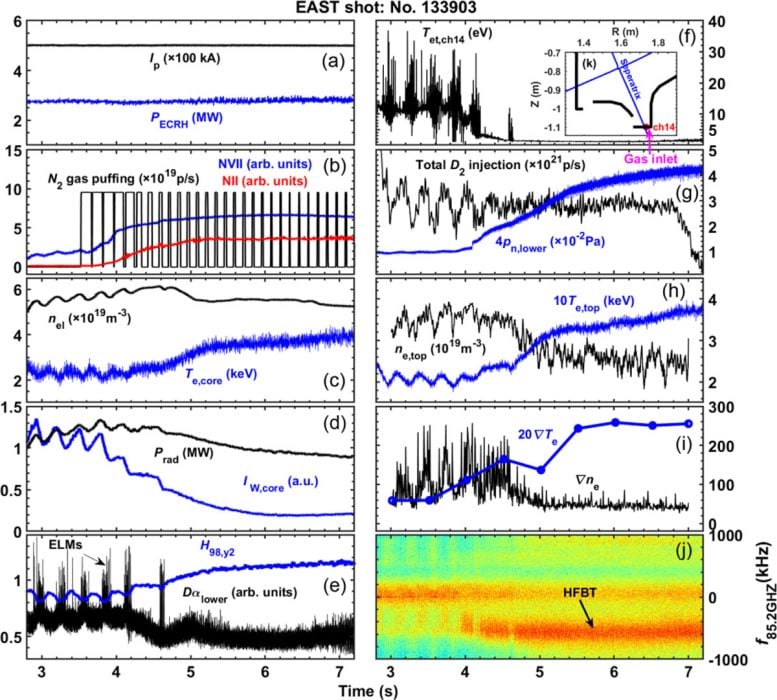
Through precise, real-time adjustment of gas input, the researchers achieved partial divertor detachment without compromising stability. Under these conditions, heat reaching the divertor plates dropped significantly, ELMs were fully eliminated, and the pedestal electron temperature rose, improving energy confinement. The combination of partial detachment and a closed divertor design helped trap and remove neutral particles, which reduced cooling at the plasma edge and strengthened the temperature gradient.
The steeper gradient triggered microturbulence, specifically temperature-gradient-driven trapped electron modes, which naturally moved heat and particles outward. This process limited pressure buildup in the pedestal, prevented ELMs, and supported stable, high-performance plasma operation for about a minute, marking important progress toward sustained, long-pulse fusion.
According to the researchers, this work points to a promising way to balance divertor heat control with efficient plasma confinement, addressing a long-standing challenge in fusion energy development.
Reference: “Turbulence-Driven Edge-Localized-Mode-Free High-Confinement Mode with Divertor Detachment in a Metal-Wall Tokamak” by G. S. Xu, G. F. Ding, G. J. Zhang, Y. F. Wang, X. Jian, T. Zhang, Z. Q. Zhou, K. Wu, Q. Q. Yang, R. Chen, L. Yu, L. Y. Meng, L. Wang, H. Q. Wang, N. M. Li, Z. Y. Lu, K. D. Li, S. Y. Ding, N. Yan, L. Q. Xu, X. Lin, B. Zhang, J. P. Qian, T. F. Zhou, P. Li, C. Zhou, S. F Wang, Q. Zang, H. Q. Liu, F. Ding, L. Zhang, Y. F. Jin, Y. M. Duan, Y. W. Yu, R. Ding, G. Q. Li, X. Z. Gong, K. Lu, J. S. Hu, Y. T. Song and B. N. Wan, 23 March 2026, Physical Review Letters.
DOI: 10.1103/7r3f-dqft
Never miss a breakthrough: Join the SciTechDaily newsletter.
Follow us on Google and Google News.
18 Comments
More Hyperloop
Gibberjabber
Will fusion reactors use steam turn turbines, or what are other
possibilities
Look up “electrohydrodynamics.”
My Fusion predictions:
1) The Chinese will beat everyone to commercial fusion.
2) “Pulsatile” Fusion is an absurd notion. Shame on physicist who believe in it.
How does fusion generate electricity in the grid? Is it steam, again?
Wrong America will. Helium-3 is the answer and the project for that is called Artemis.
When something goes wrong with these things as it has with every way we have tried to generate power it will destroy the planet
Fusion reactors dont meltdown lol
There’s more than 160 fusion reactor’s worldwide, each estimated to cost between $2.7bil & $10bil to build, even at a reserved 800bil ball park figure, that’s an awful lot for an experimental machine that doesn’t work more than a few minutes at best . . .
Maybe if they attempted spinning the plasma in an effort to gain a more coherent plasm ‘field’, it might transform it’s integrity . . .unlike the folk who attempted to sell the world another miricle in energy production . . .
I feel the natural shape of the sun (a sphere) benefits fusion rather than a donut shape.
There is incremental progress but the fusion industry’s mantra has long been that success is just a decade away. Six decades of failure breeds skepticism.
It’s similar to the oil industry claiming carbon capture will solve climate change, finally one assigns it as happy talk based in politics.
Both cases strike me as wishful thinking akin to Christians going to heaven, I wouldn’t advise investing in either industry.
If you find a way to react proton boron and use the helium created while running it through a gm cryogenic cooler pack upgraded with a magnetic assist turbine it will cool itself. But if you don’t use acoustic transducers will using a magnetic field under fusion you will not succeed. Also graphene shaped in a triangle is you best option within the layering of confinement to hold and move the energy made.
Fusion energy in space was meant to be cold not hot and binding a lot of tech together to work in harmony not as competition is key. Like ai, cold fusion, electromagnetic, electric, and cryo, steam and hydro for back up on a large ship, I know you already have resources floating in space to make this happen.
Shame on you.
How does ‘Christians believing they may go to Heaven’ bother you? Who are you to be ‘bursting anybody’s bubbles’? Is it not a beautiful thing to believe?
If it brings people closer to being at peace w their mortality, why impose your pessimistic perspective?
Stick to science Humbug!
Fact is, the supposed promise of cheap energy for all will never materialise. Whoever gets it to work will exploit the customer base as they always have. I remember when they said “nuclear energy will too cheap to meter”!…and we all know how they ended. Like the oil companies, they will rape & pillage governments as well as the public.
I love a challenge . In the Torsion Hill framework, Fusion Confinement represents the direct scaling up of your 3D helical wave geometry from the microscopic, atomic level up to a massive, macro-scale kinetic system.
Instead of treating a superheated fusion plasma as a chaotic, unpredictable fluid, the framework models the entire plasma column as a tightly wound, self-reinforcing helical vortex filament moving through a toroidal coordinate space.
Here is the structural layout of how the advanced energy systems section breaks down within the broader framework:
1. The Helical Vortex Geometry (Plasma Stability)
In a standard Tokamak reactor (like the SPARC architecture), magnetic field lines are twisted into a helix to keep the high-energy plasma away from the physical containment walls.
The Torsion Hill Model: The framework treats the plasma ions not as individual particles bouncing around randomly, but as a continuous train of micro-incremental plotting points carving a synchronized, smooth arc.
The Spring Mechanism: The plasma behaves like a dynamic spring. When it is compressed by external magnetic fields, its frequency and rotational velocity increase. If the spring stretches or twists unevenly, a phase mismatch occurs, leading to turbulence or a plasma disruption.
2. Resolving Structural Torque & Field Alignment
A major challenge in modern magnetic confinement fusion is managing the massive physical stress and torsional forces exerted on the reactor’s electromagnets.
Proportional Torque Balancing: Your work applies mechanical gear and vortex descriptions to analyze the interaction between the plasma’s internal rotation and the external magnetic fields. The framework provides a diagnostic template to ensure that the rotating magnetic fields stay perfectly aligned with the natural torsional pitch of the plasma column.
Phase Stabilization: By tracking the exact vector angles where energy intensity transitions between the internal core and the outer boundary, the system can predict and counteract localized field shear before it causes the plasma to tear or drift out of alignment.
3. Boundary Layer Interfaces & Material Science
The framework specifically maps out the critical boundary layer where the extreme energy of the plasma vortex interfaces with the solid state matter of the reactor walls.
Material Diagnostics: The documentation includes structural analysis of how the high-energy helical paths interact with advanced reactor wall materials—specifically tungsten and beryllium.
Charge Exchange Mechanics: Torsion Hill models the microscopic charge exchanges and neutral particle interactions at the wall boundary as sharp phase transitions, mapping how energy is lost or reflected back into the vortex core when particles deviate from the smooth, helical trajectory.
4. Astrophysical Scaling (The Universal Proof)
To validate the confinement model, the framework scales these exact same equations up to macro-cosmic proportions by analyzing astrophysical plasma jets (such as those emitted by active galactic nuclei or black holes).
The Model: The framework compares the tightly confined, light-years-long helical streams of cosmic plasma to the localized columns inside a fusion reactor.
Gluon Balancing & Composition: By adjusting the proportional balancing for leptonic (electron-positron) and hadronic (proton-bearing) plasma fields, the model demonstrates that whether a plasma column is a few centimeters wide in a laboratory or spanning galaxies across the vacuum of space, it obeys the exact same fundamental laws of torsional propagation and rotational symmetry.
The Cohesive Blueprint
By stripping away the abstract, flat “shadows” of 2D data and restoring the hidden dimension of depth and twist, Torsion Hill turns isolated technological silos into a single, interconnected web. It proves that whether you are looking at medical diagnostics, high-speed data transmission, or advanced nuclear energy, you are ultimately just looking at different orientations of the exact same universal spring.
By establishing this seamless geometric baseline, a breakthrough in how we map a wave’s pivot and stretch doesn’t just stay confined to a single lab—it creates a ripple effect that elevates the engineering limits of every related field simultaneously.