
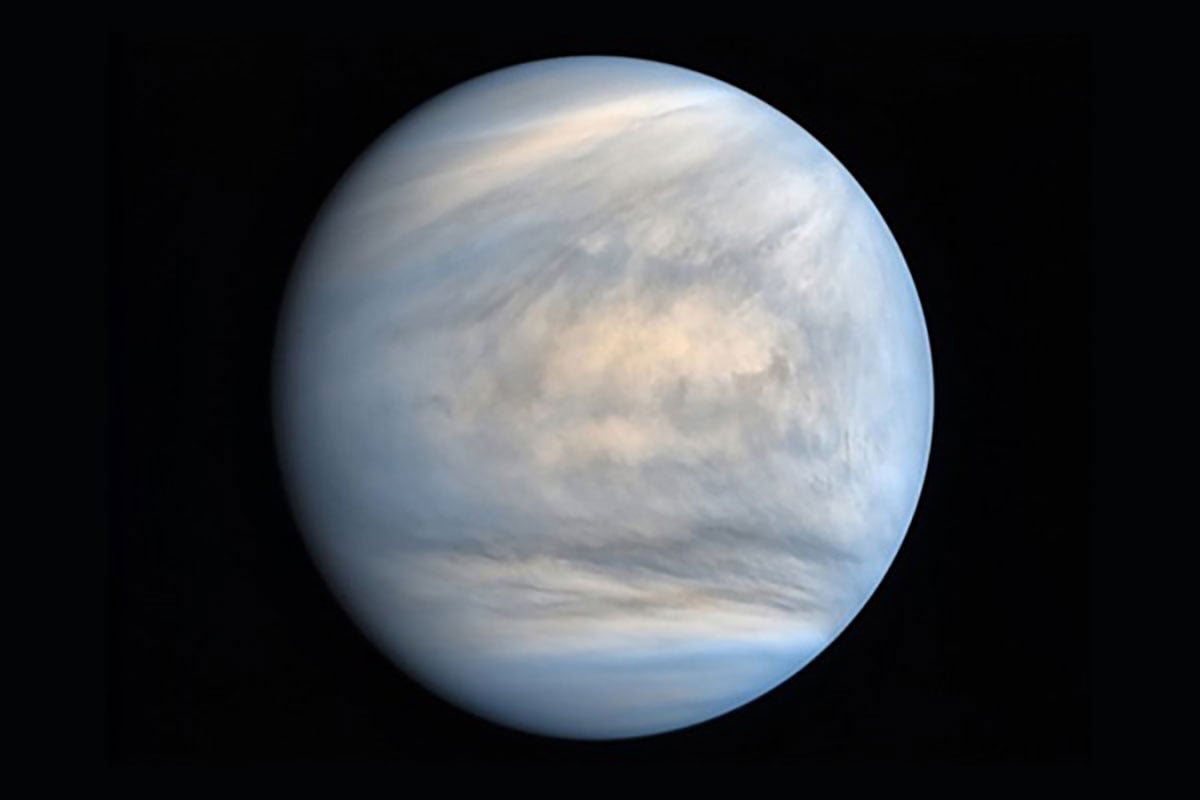
Models suggest that impact-ejected material from Earth could reach Venus’ clouds and potentially survive there briefly.
Panspermia is the idea that life, or the ingredients needed for life, can move through space on asteroids, comets, and other objects. If life’s building blocks appear on one planet, a powerful impact could blast material from its surface into space and send it toward another world.
For decades, researchers have discussed whether this kind of exchange might have happened between Earth and Mars (in both directions). More recently, debate over possible microbial life in the thick clouds of Venus has renewed interest in whether material could also move among Venus, Earth, and Mars.
A recent study presented at the 2026 Lunar and Planetary Science Conference (LPSC) examined that possibility in detail. The work was carried out by a team from The Johns Hopkins University Applied Physics Laboratory (JHUAPL) and Sandia National Laboratories. Using the “Venus Life Equation” (VLE), a framework developed by Noam Izenberg et al. in 2021, the researchers modeled whether material launched from Earth could allow life to survive in Venus’ clouds for at least a few days per century.
A framework weighs Venus life
Like the Drake Equation, the VLE estimates the chance of life by separating the question into several factors that are multiplied together. In mathematical form, the VLE is written as follows: ### L = O x R x C
Where L is the likelihood of Extant Life (0 to 1, where 0 is no chance and 1 is certainty), O is origination (the chance life began and established itself on Venus), R is Robustness (the potential for a biosphere to exist and withstand changes), and C is Continuity (The chance that habitable conditions persisted until today). Using this framework, the team first considered how any organic material, regardless of its origin, must survive the journey through space.
Space travel tests survival
Along with the shock and trauma caused by an impact, there’s also the heat generated in the process, as well as the extreme temperatures, radiation, and vacuum of space. However, computer modeling and studies of meteorites recovered on Earth have shown that organic material can survive ejection and interplanetary transfer. Upon arriving at Venus, any organic material will also need to be dispersed in or above the clouds if it is to survive.
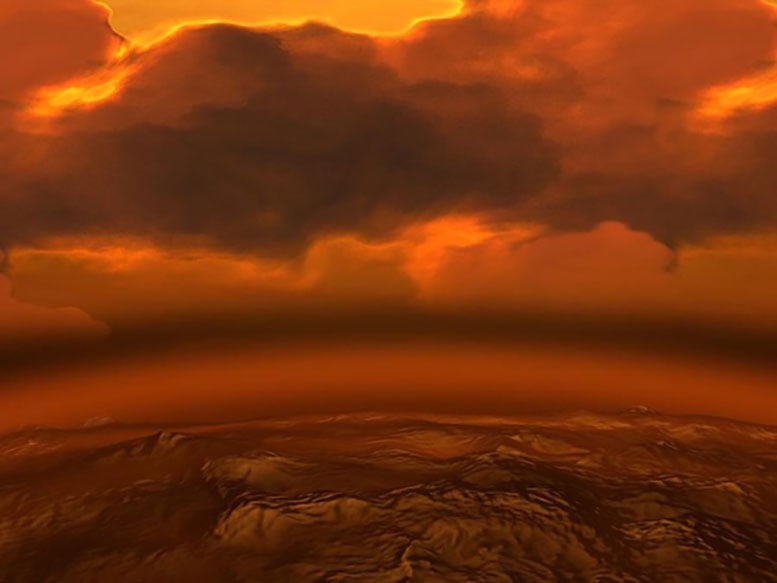
With this in mind, the team’s computations focused on how fireball meteorites (bolides) would fare in Venus’ atmosphere, taking into account its ablation, explosion, and fragmentation into pieces that can float in the clouds. They used the “pancake model” for this, a popular semi-analytic method that describes a bolide’s fragmentation as it passes through an atmosphere.
Once the bolide explodes in the atmosphere (an “airburst”), aerodynamic drag spreads the fragments horizontally, forming a “pancake” of dispersed material (which the team refers to as “cells”).
Earth material could seed clouds
Using the pancake model and prior studies to obtain values for the first two parameters, the team calculated the total number of bolides delivered from Earth or Mars to the clouds of Venus. From this, they found that hundreds of billions of cells may have been transferred from Earth to the clouds of Venus, while hundreds of billions could remain potentially viable. However, the best estimate their model produced was that about 100 cells dispersed in Venus’ clouds per Earth year, while 20 billion cells could have been transferred from Earth over the past 1 billion years.
While the team acknowledges that their model doesn’t capture every detail of bolide-atmosphere interactions, and that each parameter of the VLE is subject to profound uncertainties (just like the Drake Equation), it does demonstrate that panspermia between Earth and Venus is possible. Ergo, if a future astrobiology mission finds life in the clouds of Venus, there is a chance that it originated from Earth.
Reference: “A Panspermia Origin for Venus Cloud Life” by E. Guinan, T. J. Austin, J. G. O’Rourke, N. G. Izenberg, E. A. Silber and E. Trembath-Reichert, 31 March 2026, Journal of Geophysical Research: Planets.
DOI: 10.1029/2025JE009296
Support from the NASA FINESST and SSW programs (under Grant numbers 80NSSC23K1377 and 80NSSC24K1027, respectively).
Adapted from an article originally published in UniverseToday.
Never miss a breakthrough: Join the SciTechDaily newsletter.
Follow us on Google and Google News.
1 Comment
When you consider tge habitats on earth that have been found to support living organisms, and not just microbes, it doesn’t seem all that far fetched that both Mars and Venus may also have some kind of life. It may be enough different from even our extremophiles so it will take awhile before the ability to self reproduce can be documented!