
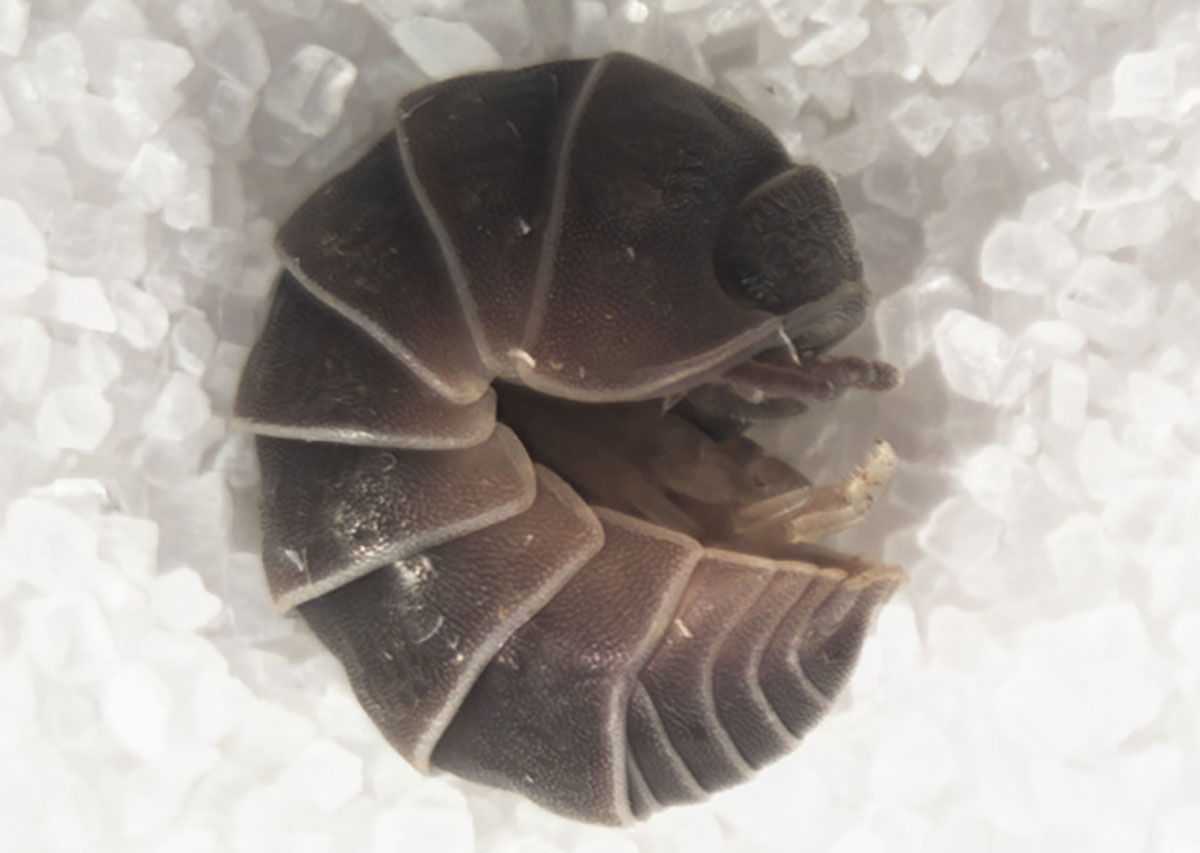
Artificial streetlights can lure isopods into massive circular processions that may leave them vulnerable to predators.
Researchers have made a world-first observation of thousands of Israeli isopods leaving their normally solitary shelters and moving together in huge synchronized “death spirals” caused by artificial streetlights.
By testing different light arrangements, the team found that vertical beams of white light can unintentionally override the natural behavior of these crustaceans, pulling them into a circular march that is striking to watch but may put them at risk. The finding reveals another hidden consequence of light pollution for small animals that live close to the ground.
A new study led by PhD student Idan Sheizaf, under the guidance of Prof. Ariel Chipman from The Hebrew University of Jerusalem, has described a behavior never previously documented: thousands of land-dwelling isopods moving together in large circular processions. The behavior appears to result from artificial light at night.
Published in Ecology and Evolution, the study examines how these small terrestrial relatives of crabs and shrimp, also known as “woodlice” or “pill bugs”, leave their usual sheltered habitats and gather in swirling “mills” that can contain more than 5,000 individuals.
A Chance Discovery in the Golan Heights
The unusual behavior first reached the researchers through amateur naturalist Eviatar Itzkovich, who noticed the moving circles on summer nights in the Golan Heights. The study focused on Armadillo sordidus, a species that, like most isopods, usually stays beneath stones or in moist debris to avoid drying out.
Woodlice are known to cluster together to retain moisture, but coordinated movement on this scale has almost never been recorded. Before this research, very little was known about A. sordidus. The study also broadened the species’ known range. Previously, it had been recorded only in southern Syria and the Golan Heights, but this work marks the first description of the species in the Jezreel Valley.
Testing the “Light Trap”
To identify what was causing the behavior, the team tested several possible environmental triggers, including magnetic fields and different kinds of light.
- Magnetism: Because the Golan Heights has unusual magnetic properties, the team placed strong magnets near the isopods to test whether their movement would change. The isopods did not respond and continued their circular motion.
- Ultraviolet Light: UV flashlights attracted only a small share of the population and did not trigger circular movement.
- White Light: This proved to be the “smoking gun”. When a white lamp was positioned perpendicular to the ground, it reliably triggered the large circular procession.
The researchers found that the shape of the light mattered most. A vertical beam creates a circular “boundary” of illumination on the ground. The isopods are drawn toward the light and start moving along this bright edge. Once enough individuals gather, their separate movements merge into a collective swirl that can sustain itself.
Reflecting on the discovery, Idan Sheizaf noted: “While collective movement is common in the animal kingdom, seeing it in this form in isopods was entirely unexpected. It appears that the geometry of our modern world—specifically the circular pools of light created by streetlights, is interacting with the natural instincts of these creatures to create a mesmerizing, yet potentially harmful, emergent phenomenon.”
The Toll of Artificial Light
Although the behavior is visually striking, it may be a human-created “trap”. The researchers found that the groups were mostly female, and many were carrying eggs, which suggests the processions are not a mating behavior. Instead, the movement appears to reflect a disruption of natural instincts caused by artificial light at night (ALAN).
These “isopod mills” could carry serious costs. In one observation, a centipede preyed on the distracted animals inside the moving mass. By pulling isopods out of protected shelters and keeping them moving in exposed loops, light pollution may make them easier targets for predators and force them to spend energy they need for survival.
The study shows how even small human changes to the environment, such as adding a streetlight, can profoundly alter long-established behavior in some of the smallest animals around us.
Reference: “A Novel Light-Induced Collective Circular Movement in Armadillo sordidus Isopods” by Idan Sheizaf, Eviatar Itzkovich and Ariel D. Chipman, 13 April 2026, Ecology and Evolution.
DOI: 10.1002/ece3.73487
I.S. is supported by a Swiss National Science Foundation (SNSF) Sinergia award (grant number 198691).
Never miss a breakthrough: Join the SciTechDaily newsletter.
Follow us on Google and Google News.
1 Comment
📖 = human version. We do not like having to lie about God for your inability to grasp the concept without cliff notes.