
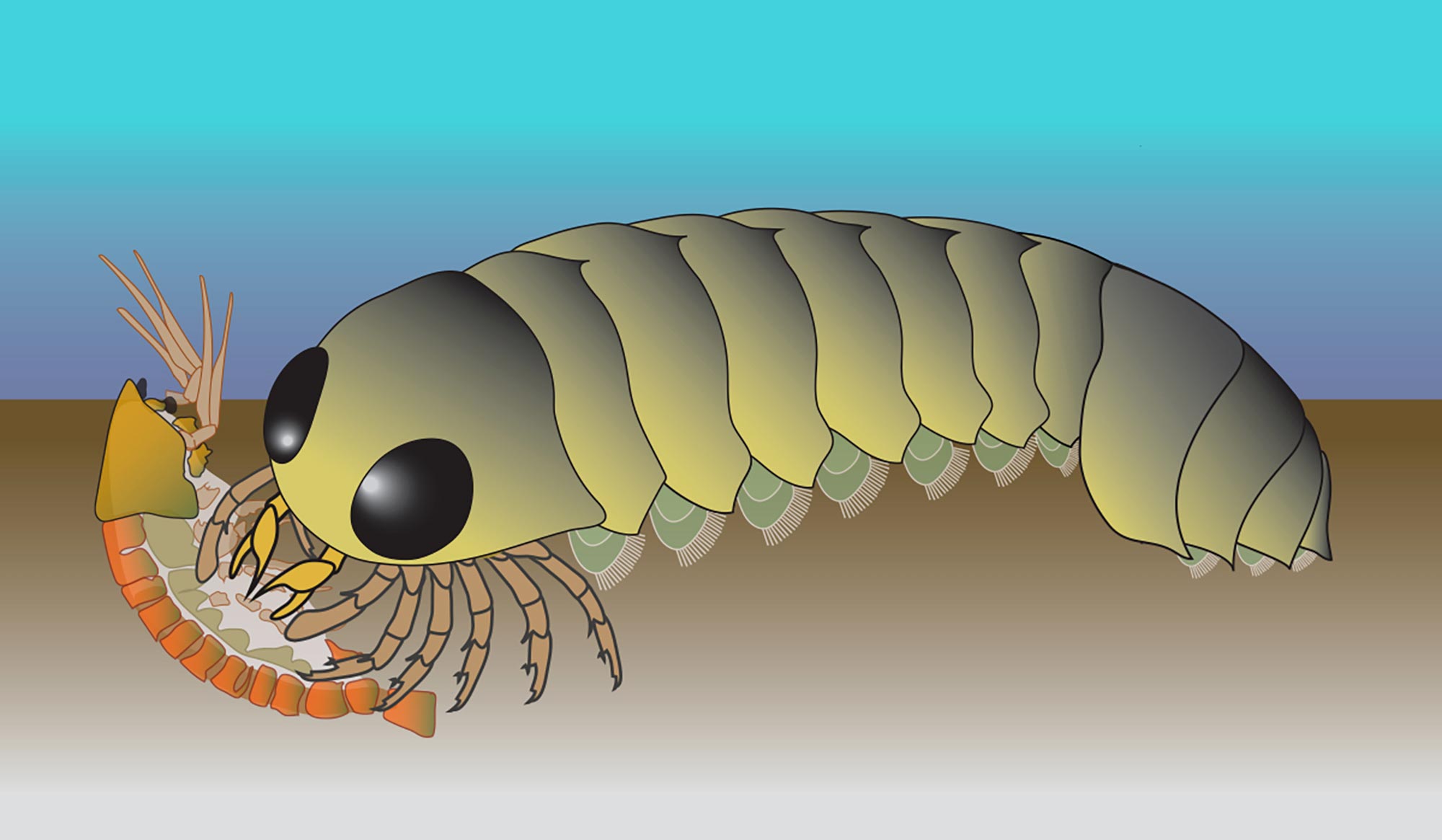
An exquisitely preserved fossil from half a billion years ago has turned our understanding of spider evolution upside down.
Scientists studying the fossilized brain of Mollisonia symmetrica, a marine creature from the Cambrian period, have found striking similarities to modern spider neuroanatomy, suggesting that arachnids may have first evolved in the ocean, not on land, as was long believed.
Ancient Origins of Arachnids
A remarkably well-preserved fossil from 500 million years ago may rewrite what scientists thought they knew about the origins of spiders and their relatives. New research suggests that arachnids — a group that includes spiders, scorpions, and similar arthropods — may have first evolved in the ocean, not on land as previously believed. This challenges the long-standing assumption that arachnid diversity only took off after their ancestors became land-dwellers.
Spiders and scorpions have been around for roughly 400 million years and have changed very little over time. As part of the broader arachnid group, they have become the planet’s most dominant arthropod predators. Fossil evidence had led scientists to believe that arachnids evolved and diversified only in terrestrial environments.
Surprising Brain Structure Discovery
In a study published in Current Biology, researchers from the United States and United Kingdom, led by Nicholas Strausfeld of the University of Arizona, closely examined the fossilized brain and nervous system of an extinct species called Mollisonia symmetrica. This animal lived during the Cambrian period (between 540 and 485 million years ago) and was previously considered an early chelicerate — a group that includes the ancestors of modern horseshoe crabs.
However, the research team made an unexpected discovery. The structure of Mollisonia’s brain was not arranged like that of a horseshoe crab, as they had anticipated. Instead, it matched the neural layout found in today’s spiders and related arachnids, suggesting a closer evolutionary link than once thought.
Mollisonia’s Curious Resemblance
“It is still vigorously debated where and when arachnids first appeared, and what kind of chelicerates were their ancestors,” said Strausfeld, a Regents Professor in the U of A Department of Neuroscience, “and whether these were marine or semi-aquatic like horseshoe crabs.”
Mollisonia outwardly resembles some other early chelicerates from the lower and mid-Cambrian in that its body was composed of two parts: a broad rounded “carapace” in the front and a sturdy segmented trunk ending in a broad, tail-like structure. Some scientists have referred to the organization of a carapace in front, followed by a segmented trunk as similar to the body plan of a scorpion. But nobody had claimed that Mollisonia was anything more exotic than a basal chelicerate, even more primitive than the ancestor of the horseshoe crab, for example.
Neural Evidence Links to Spiders
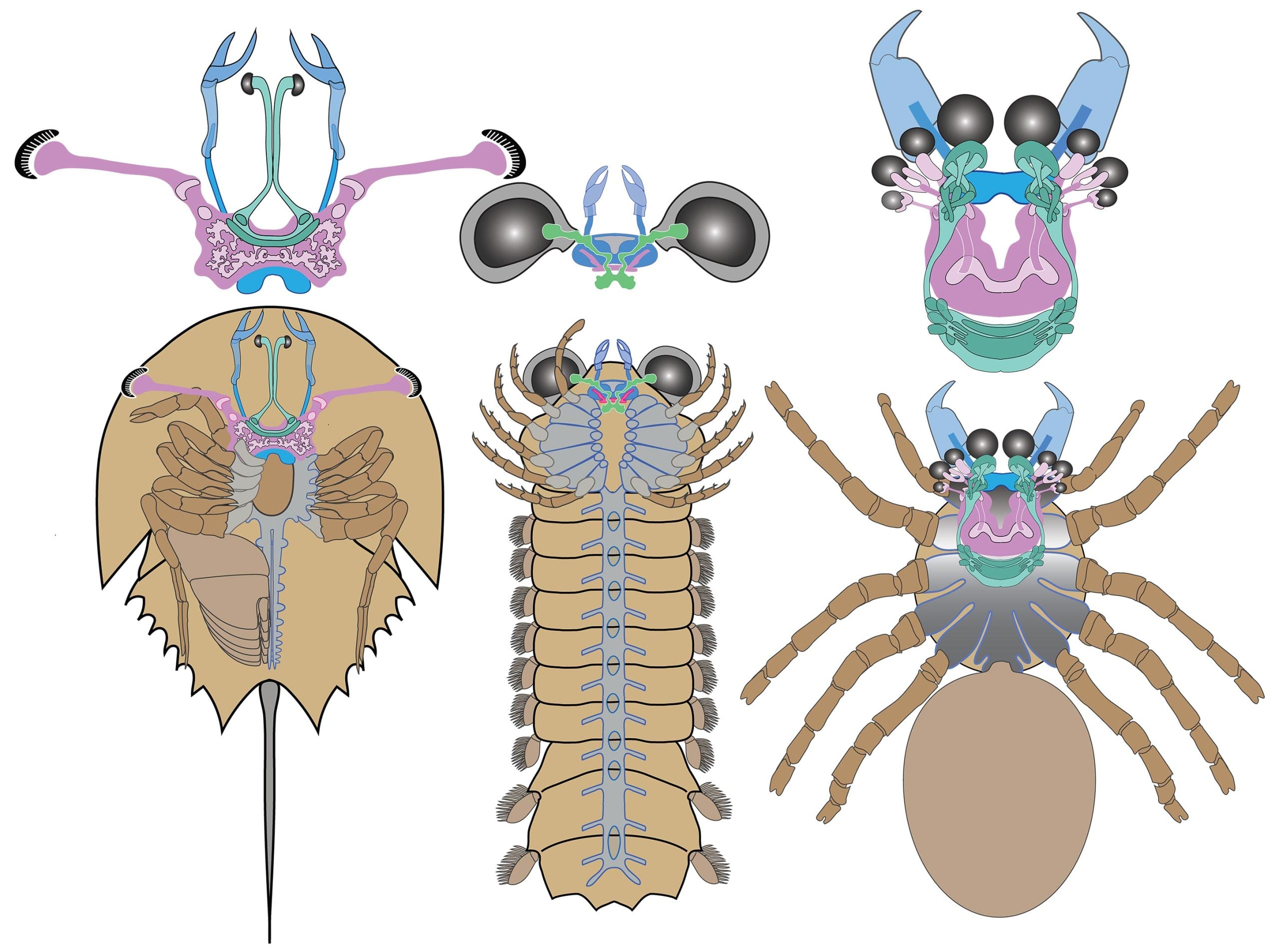
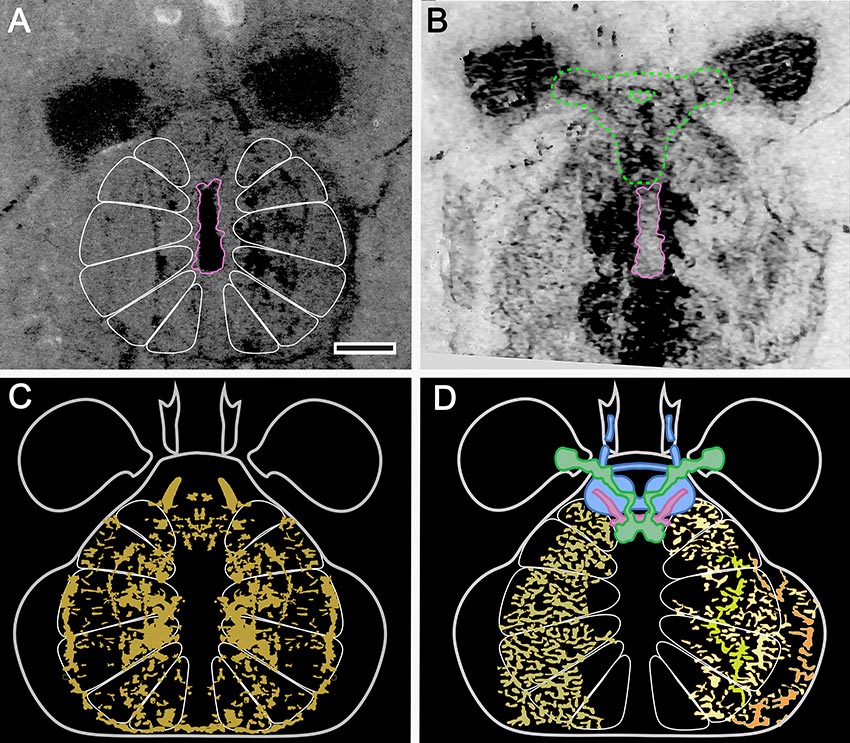
What Strausfeld and his colleagues found, indicating Mollisonia’s status as an arachnid, is its fossilized brain and nervous system. As in spiders and other present-day arachnids, the anterior part of Mollisonia’s body (called the prosoma) contains a radiating pattern of segmental ganglia that control the movements of five pairs of segmental appendages. In addition to those arachnid-like features, Mollisonia also revealed an unsegmented brain extending short nerves to a pair of pincer-like “claws,” reminiscent of the fangs of spiders and other arachnids.
But the decisive feature demonstrating arachnid identity is the unique organization of the mollisoniid brain, which is the reverse of the front-to-back arrangement found in present-day crustaceans, insects and centipedes, and even horseshoe crabs, such as the genus Limulus.
Evolutionary Shortcut to Dexterity
“It’s as if the Limulus-type brain seen in Cambrian fossils, or the brains of ancestral and present-day crustaceans and insects, have been flipped backwards, which is what we see in modern spiders,” he said.
According to co-author Frank Hirth from King’s College London, the latter finding may be a crucial evolutionary development, because studies of existing spider brains suggest that this back-to-front arrangement provides shortcuts from neuronal control centers to underlying circuits that coordinate a spider’s (or its relative’s) amazing repertoire of movements. This arrangement likely confers stealth in hunting, rapidity in pursuit, and in the case of spiders, an exquisite dexterity for the spinning of webs to entrap prey.
A Major Evolutionary Leap
“This is a major step in evolution, which appears to be exclusive to arachnids,” Hirth said. “Yet already in Mollisonia, we identified brain domains that correspond to living species with which we can predict the underlying genetic makeup that is common to all arthropods.”
“The arachnid brain is unlike any other brain on this planet,” Strausfeld added, “and it suggests that its organization has something to do with computational speed and the control of motor actions.”
The first creatures to come onto land were probably millipede-like arthropods and probably some ancestral, insect-like creatures, an evolutionary branch of crustaceans, according to Strausfeld.
“We might imagine that a Mollisonia-like arachnid also became adapted to terrestrial life making early insects and millipedes their daily diet,” he said, adding that the first arachnids on land may have contributed to the evolution of a critical defense mechanism: insect wings, hence flight and escape.
Spiders May Have Shaped Insect Flight
“Being able to fly gives you a serious advantage when you’re being pursued by a spider,” Strausfeld said. “Yet, despite their aerial mobility, insects are still caught in their millions in exquisite silken webs spun by spiders.”
For the study, Strausfeld spent time at the Museum of Comparative Zoology at Harvard University, where the Mollisonia specimen is housed, taking scores of photographs under various directions of illumination, light intensities, and polarization light, and magnifications.
Data-Driven Phylogenetic Placement
To rule out the possibility that the congruence between Mollisonia’s brain and that of spiders was the result of parallel evolution – in other words, coincidence rather than derived by a common lineage – co-author David Andrew, a former graduate student in the Strausfeld laboratory who is now at Lycoming College in Pennsylvania, performed a statistical analysis comparing 115 neuronal and related anatomical traits across arthropods, both extinct and living. The results placed Mollisonia as a sister group of modern arachnids, lending further weight to the idea that Mollisonia’s lineage gave rise to the clade that today includes spiders, scorpions, sun spiders, vinegarroons, and whip scorpions, amongst many others.
A Legacy Etched in Fossil Brains
Unfortunately, other Mollisonia-like arthropods are not preserved in a way that allows for a detailed analysis of their nervous system. But if they shared the same unique kind of brain, the authors suggest, their descendants might have established diverging terrestrial lineages that today account for the various branches of the arachnid tree of life.
Reference: “Cambrian origin of the arachnid brain” by Nicholas J. Strausfeld, David R. Andrew and Frank Hirth, 22 July 2025, Current Biology.
DOI: 10.1016/j.cub.2025.06.063
Never miss a breakthrough: Join the SciTechDaily newsletter.
Follow us on Google and Google News.