
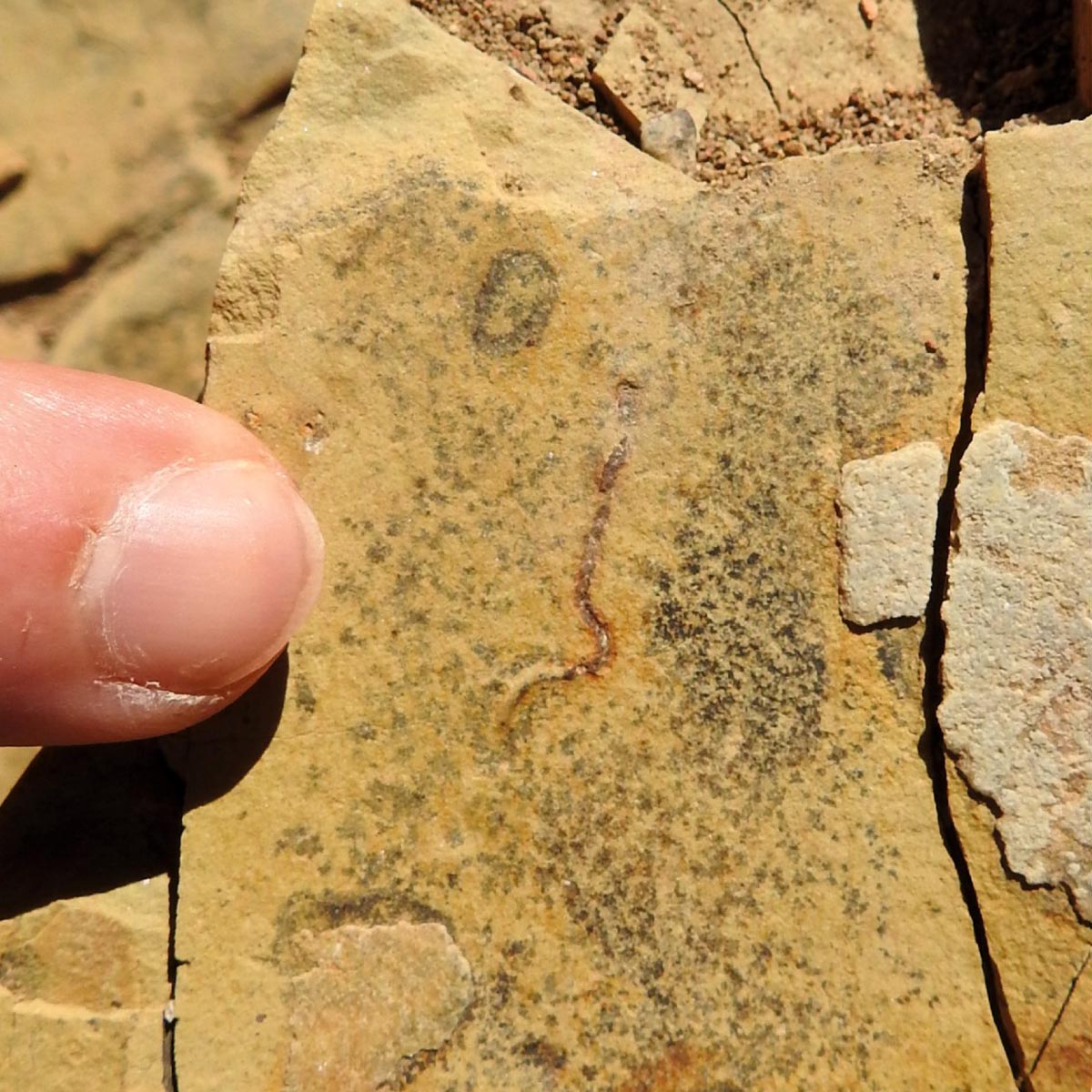
Scientists discovered that some of Earth’s supposed earliest animal fossils were actually giant ancient microbes.
Ancient microfossils discovered in Brazil are changing scientists’ understanding of early life on Earth. Structures once believed to be traces left behind by tiny marine animals have now been identified as fossilized communities of microscopic bacteria and algae instead.
The discovery suggests that during the Ediacaran period, around 540 million years ago, Earth’s oceans may not yet have contained enough oxygen to support certain small invertebrates previously thought to exist at that time. The findings were published in the journal Gondwana Research.
“Using microtomography and spectroscopy techniques, we observed that the microfossils have cellular structures – sometimes with preserved organic material – consistent with bacteria or algae that existed during that period. These aren’t traces of animals that may have passed through the area,” says Bruno Becker-Kerber, lead author of the study.
Becker-Kerber conducted the work during his postdoctoral research at the Institute of Geosciences at the University of São Paulo (USP) and at the Brazilian Center for Research in Energy and Materials (CNPEM), supported by a FAPESP fellowship. He is currently continuing postdoctoral research at Harvard University in the United States.
Ancient Fossils Challenge Early Animal Evidence
Researchers had previously interpreted the fossil marks as signs of wormlike organisms or other tiny seafloor animals. If true, the fossils would have represented some of the oldest known examples of meiofauna, tiny invertebrates measuring less than one millimeter long.
According to Becker-Kerber, the new findings point in a very different direction.
The Ediacaran period came just before the Cambrian explosion, a major stage in Earth’s history when rising oxygen levels helped fuel the rapid diversification of complex animals. Meiofauna are well documented in Cambrian fossils, but the new study suggests they may not have existed in these older environments after all.
The research is part of the “Rio de la Plata Craton and Western Gondwana” project, coordinated by Miguel Angelo Stipp Basei of IGc-USP and funded by FAPESP. Lucas Warren of São Paulo State University (IGCE-UNESP) in Rio Claro also contributed to the study with support from FAPESP.
The fossils reexamined in the study came from Corumbá, while additional specimens were collected from rock outcrops in Bonito in the Serra da Bodoquena region. Both locations are in Mato Grosso do Sul within the Tamengo geological formation.
Scientists say the rocks formed in a shallow marine environment along a continental shelf during the final stages of the supercontinent Gondwana’s formation, before it later separated into landmasses that became South America and Africa.
In a separate study, the same research group identified what may be the oldest known lichen fossil, also discovered in Mato Grosso do Sul and younger than the bacteria and algae described in this research.
Advanced Tomography Revealed Hidden Cellular Structures
To study the fossils in detail, researchers used the MOGNO beamline at Sirius, CNPEM’s particle accelerator facility in Campinas. The equipment allowed scientists to examine fossils ranging from only a few micrometers to several millimeters in size.
The samples underwent both microtomography and nanotomography, producing images at scales as small as micrometers (one-thousandth of a millimeter) and nanometers (one-billionth of a meter).
“When you have a large sample and want to image a structure inside it, the resolution obtained is often insufficient. The MOGNO beamline is one of the few in the world that performs so-called zoom tomography, in which we focus on something inside the sample and analyze it at the nanoscale without destroying the sample,” says Becker-Kerber.
He noted that earlier research interpreting the structures as animal traces did not have access to this imaging technology.
Researchers also used Raman spectroscopy to analyze the fossils’ chemical composition. The method revealed organic compounds in fossil cell walls, strengthening the idea that the structures are preserved microbial remains rather than trails left behind by animals moving through sediment.
Giant Ancient Microbes in Prehistoric Seas
Some specimens also contained pyrite, a mineral composed of iron and sulfur. Based on the fossils’ shape and composition, scientists believe some may represent sulfur-oxidizing bacteria, organisms that rely on sulfur as part of their metabolism.
“This group of bacteria is surprising. Some of the largest ever recorded belong precisely to this category. Unlike the common image we have of microscopic bacteria, certain species can reach diameters larger than a strand of hair and are visible to the naked eye,” says Becker-Kerber.
Although the fossils do not preserve features detailed enough for exact species identification, researchers observed preserved cells, divisions in cell walls, and traces of organic material at multiple collection sites. Scientists say these characteristics would not be expected if the structures were merely marks left behind by passing animals.
The fossils also fall into three different size groups, suggesting several species may have existed together in microbial communities. The larger forms resemble green or red algae, while the smaller ones may include algae, cyanobacteria, or sulfur-oxidizing bacteria.
“There are concave and convex partitions, coiled filaments, cells without sediment but containing organic matter. This evidence is much closer to bacteria or algae than to mere marks of disturbance caused by animals,” the researcher concludes.
The findings offer scientists a clearer picture of Earth’s environment before the Cambrian explosion and may help researchers better understand the conditions that eventually allowed complex animal life to flourish.
Reference: “Proposed Ediacaran meiofaunal burrows from Brazil are pyritized algal/microbial consortia” by Bruno Becker-Kerber, Nathaly Lopes Archilha, Andrew Knoll, Miguel Angelo Stipp Basei, Lucas Verissimo Warren, Lucas Del Mouro, Gilmar Kerber, Sharif Ahmed and Javier Ortega-Hernández, 11 February 2026, Gondwana Research.
DOI: 10.1016/j.gr.2026.01.011
Never miss a breakthrough: Join the SciTechDaily newsletter.
Follow us on Google and Google News.
1 Comment
Im curious so the dinosaurs were here first then the cavemen and homosepians , or during ice age , so when they got here did they died off or what?