

Researchers have reexamined the skull musculature of coelacanths, a lineage of fish dating back 400 million years, and discovered that many anatomical structures had been previously misidentified.
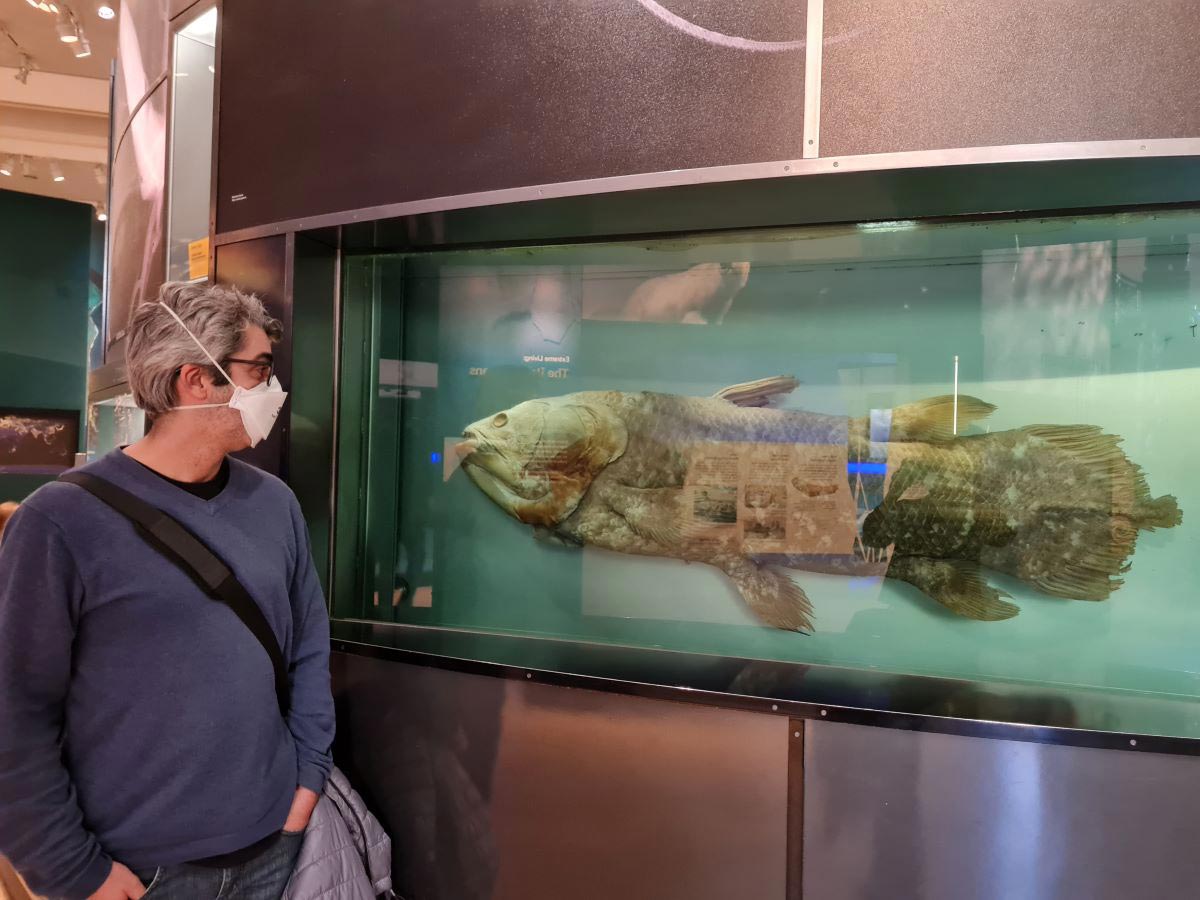
The coelacanth, often called a “living fossil,” has remained anatomically similar for over 65 million years. While it is one of the most extensively examined fish in scientific history, it still holds secrets that could significantly reshape our knowledge of vertebrate evolution. A new study published in Science Advances by researchers from the University of São Paulo (USP) in Brazil and the Smithsonian Institution in the United States brings fresh insights into this ancient species.
By closely analyzing the skull muscles of the African coelacanth (Latimeria chalumnae), the team found that just 13% of the previously reported evolutionary muscle developments for major vertebrate groups were accurate. In contrast, they identified nine previously unrecognized changes linked to key developments in how these animals eat and breathe.
“Ultimately, it’s even more similar to cartilaginous fish [sharks, rays, and chimaeras] and tetrapods [birds, mammals, amphibians, and reptiles] than previously thought. And even more distinct from ray-finned fish, which make up about half of living vertebrates,” says Aléssio Datovo, a professor at the Museum of Zoology (MZ) at USP supported by FAPESP, who led the study.
One of the most significant corrections involved the misidentification of certain soft-tissue structures. Features once believed to be muscles that expanded the buccopharyngeal cavity, the area connecting the mouth to the throat, turned out to be ligaments instead. Unlike muscles, ligaments cannot contract, meaning earlier assumptions about the coelacanth’s feeding and breathing mechanisms were likely incorrect.
Ray-finned fish (actinopterygii) and lobe-finned fish (sarcopterygii) diverged from a common ancestor approximately 420 million years ago. The sarcopterygii include fish such as coelacanths and lungfish, as well as all other tetrapods, because they evolved from an aquatic ancestor. These include mammals, birds, reptiles, and amphibians.
In ray-finned fish, such as aquarium carp, it is easy to see how the mouth moves to suck in food. This ability gave actinopterygii a significant evolutionary advantage; today, they comprise about half of all living vertebrates.
This is a fundamental difference from other fish, such as coelacanths and sharks, which primarily feed by biting their prey.
“In previous studies, it was assumed that this set of muscles that would give greater suction capacity was also present in coelacanths and, therefore, would have evolved in the common ancestor of bony vertebrates, which we now show isn’t true. This only appeared at least 30 million years later, in the common ancestor of living ray-finned fish,” points out Datovo.
Behind the scenes
Coelacanths are extremely rare fish that live about 300 meters below the surface of the water and spend their days in underwater caves.
One reason they have changed so little since the extinction of the dinosaurs is that they have few predators and live in a relatively protected environment. This has resulted in slow changes to their genome, as shown by a 2013 study published in the journal Nature.
Coelacanths were first known only from fossils from about 400 million years ago. It was not until 1938 that a living animal was discovered, much to the astonishment of scientists. In 1999, another species (Latimeria chalumnae) was discovered in Asian waters.
Due to the rarity of specimens in museums, researchers from USP and the Smithsonian Institution’s National Museum of Natural History had to persevere to find an institution willing to lend animals for dissection.
The Field Museum in Chicago and the Virginia Institute of Marine Science, both in the United States, finally agreed to lend one specimen each. According to Datovo, G. David Johnson, co-author of the article, deserves credit for obtaining the loan.
Johnson, born in 1945, was “probably the greatest fish anatomist of his time,” according to Datovo. He died in November 2024 after a domestic accident while the study was under review.
Contribution
“Contrary to what it may seem, dissecting a specimen does not mean destroying it as long as it’s done properly,” says Datovo.
The researcher, who has been conducting this type of study for over 20 years, spent six months separating all the muscles and skull bones of the coelacanth. These structures are now preserved and can be studied individually by other scientists, eliminating the need to dissect a new animal.
Seeing each muscle and nerve firsthand allowed the authors to identify what was actually in the coelacanth’s head with certainty, point out previously undescribed structures, and correct errors that had been repeated in the scientific literature for over 70 years.
“There were many contradictions in the literature. When we finally got to examine the specimens, we detected more errors than we’d imagined. For example, 11 structures described as muscles were actually ligaments or other types of connective tissue. This has a drastic consequence for the functioning of the mouth and breathing, because muscles perform movement, while ligaments only transmit it,” he explains.
Due to the position of coelacanths in the vertebrate tree of life, the discovery impacts our understanding of cranial evolution in all other large vertebrate groups.
With this information, the researcher used three-dimensional microtomography images of the skulls of other groups of fish, both extinct and living. These images are made available by other researchers who study fish anatomy when they perform 3D scans.
From images of the skull bones of other fish from completely extinct lineages, Datovo and Johnson were able to infer where the muscles found in coelacanths would fit, elucidating the evolution of these muscles in the first jawed vertebrates. In future work, Datovo intends to analyze similarities with the muscles of tetrapods, such as amphibians and reptiles.
Reference: “Coelacanths illuminate deep-time evolution of cranial musculature in jawed vertebrates” by Aléssio Datovo and G. David Johnson, 30 April 2025, Science Advances.
DOI: 10.1126/sciadv.adt1576
Funding: São Paulo Research Foundation
Never miss a breakthrough: Join the SciTechDaily newsletter.
Follow us on Google and Google News.