
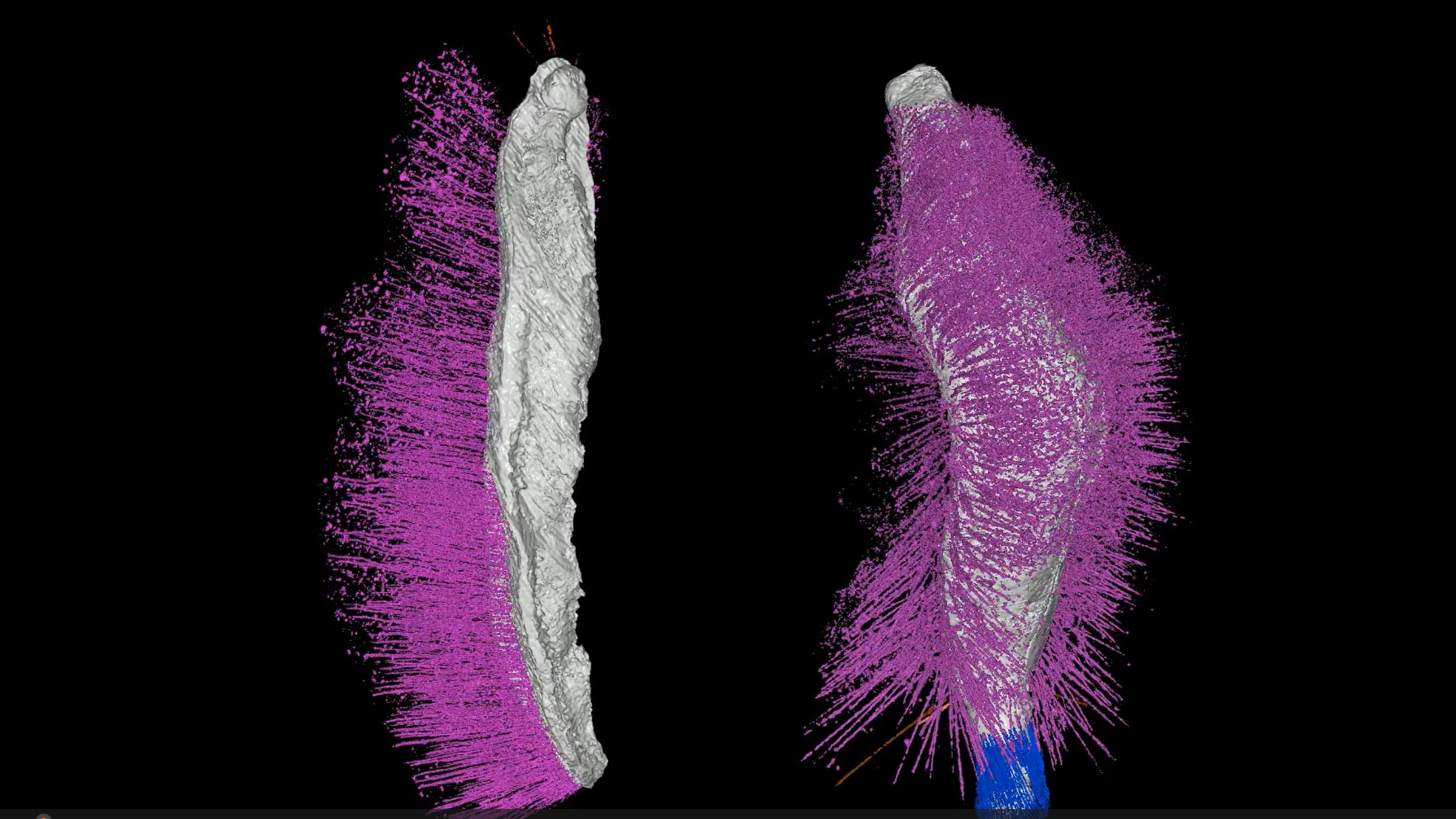
The discovery of two ancient fossils shows early mollusks were more complex and diverse than previously thought.
Researchers have discovered two fossils, named Punk and Emo, that reveal ancient mollusks were more complex and adaptable than previously believed.
Mollusks are among the most diverse animal groups on Earth, and the analysis of these rare 430-million-year-old fossils is challenging long-standing theories about their early evolution.
Unearthed in Herefordshire, the fossils date back to the Silurian period and provide new insights into the mollusks’ complex evolutionary history and how they moved.
The discovery challenges the longstanding view that early mollusks from the group known as Aculifera – which include chitons and worm-like mollusks – were basic and primitive.
Instead, the ‘rebellious’ fossils – whose scientific names are Punk ferox and Emo vorticaudum – show that early molluscs possessed some unique features and were, in fact, quite complex and adaptable in their forms and habitats.
Researchers drew these conclusions by recreating the fossils in 3D using advanced imaging techniques, including X-ray scanning. They found that Emo and Punk displayed a wider variety of forms and movement strategies than researchers knew existed in this group of early mollusks.
Fossils were exceptionally preserved
The study, published in Nature, was led by Dr Mark Sutton, from the Department of Earth Science and Engineering at Imperial College London, working with collaborators at the University of Leicester, the University of Oxford, the Senckenberg Research Institute, and Natural History Museum Frankfurt, and Yale University. Dr Sutton said:
“Molluscs are one of the largest and most diverse animal groups on Earth. However, early Aculiferan mollusks are much less well-known than some of their relatives. We have limited information about this group, and for a very long time, we assumed they were rather basic, simple, and primitive.
“Retrieving fossils that are so exceptionally well preserved and reveal details of the soft tissues is extremely rare. We have been able to create ‘virtual fossils’ – 3D digital models – providing us with a gold mine of information and helping us understand that the branch of molluscan evolution containing Emo and Punk was much more evolutionarily rich and diverse than we thought; as much as other mollusk groups.”
Unique features and unusual ways of moving
The team used two different methods to get a clear picture of the fossils both inside and out. First, they used X-ray scanning to get a detailed look at the internal structures without causing any external damage. They then carefully ground the fossils down in very thin layers, taking photos at each step to create a 3D image of the external features.
Researchers found both fossils had smooth undersides, suggesting that they lived on the sea floor, and they both possessed some unique features and unconventional movement strategies.
The Emo fossil is preserved in a folded posture, suggesting that it moved like an inchworm, using its spines to grip and push forward. Meanwhile, how Punk was able to move remains unclear to researchers, but they found it had a ridge-like foot, unlike any existing mollusk today.
“The names Punk and Emo were actually our initial pet names for these ancient mollusks, inspired by some of their unique features and individuality. Punk in particular, with its spiky appearance, clearly resembles a rebellious punk rocker – and we thought Emo complemented it well,” said Dr Sutton.
While Punk resembles worm-like mollusks with long spines, it also has a broad foot and gills like chitons. Emo, similarly worm-like with a long body and spines, also features shells and a compressed body similar to chitons.
This mix of features helps researchers better understand the mollusk evolutionary tree – pointing to a story that involves more complexity and diversity than previously thought.
Reference: “New Silurian aculiferan fossils reveal complex early history of Mollusca” by Mark D. Sutton, Julia D. Sigwart, Derek E. G. Briggs, Pierre Gueriau, Andrew King, David J. Siveter and Derek J. Siveter, 8 January 2025, Nature.
DOI: 10.1038/s41586-024-08312-0
Never miss a breakthrough: Join the SciTechDaily newsletter.
Follow us on Google and Google News.