
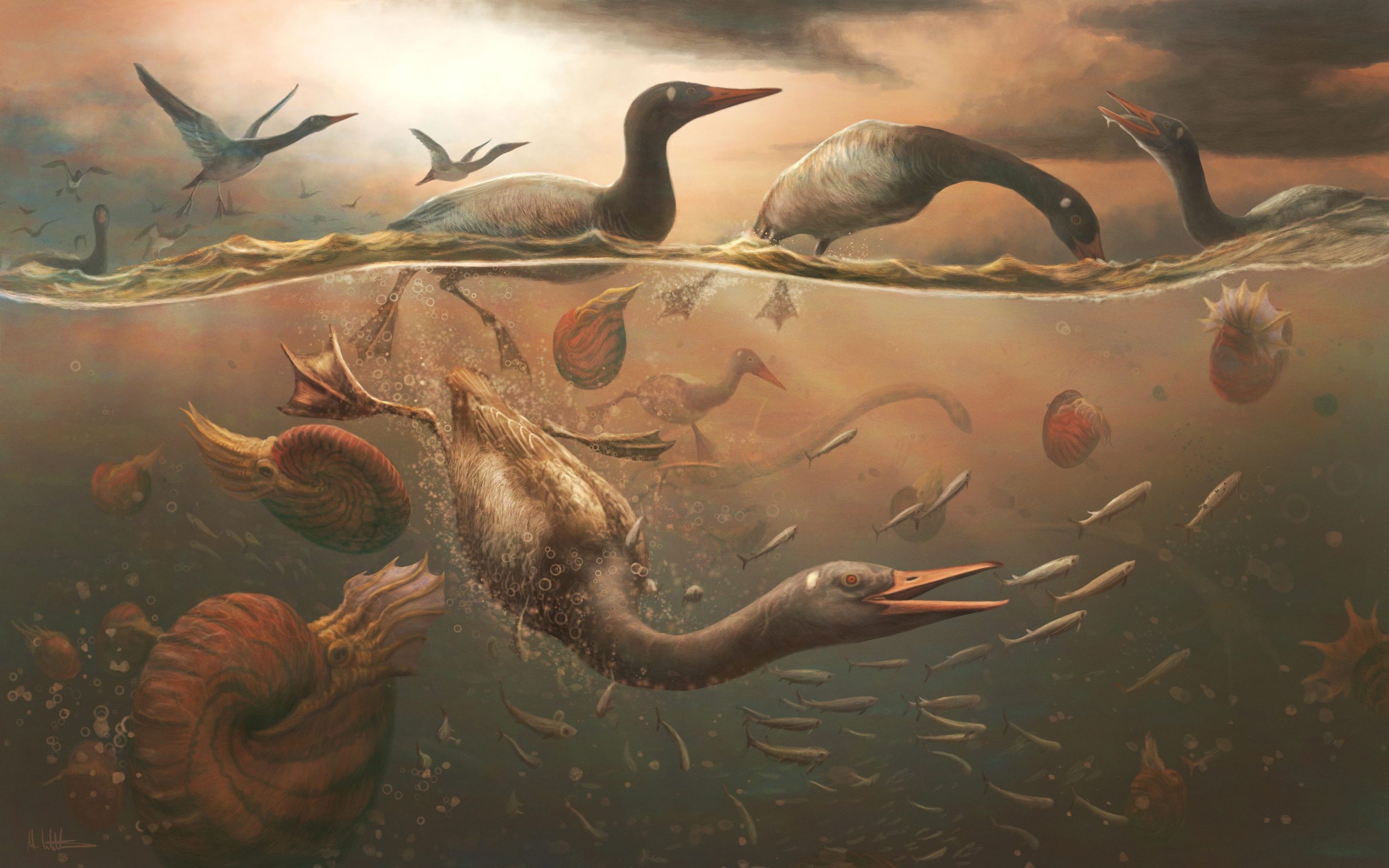
New clues explore the age-old question: Does a duck always look like a duck and quack like a duck?
Sixty-six million years ago, at the end of the Cretaceous Period, an asteroid impact near the Yucatán Peninsula in Mexico triggered the extinction of all known non-avian dinosaurs. Yet, for the early ancestors of today’s waterfowl, surviving that mass extinction event was like… water off a duck’s back.
Location played a crucial role, and Antarctica may have served as a refuge, its remoteness shielding it from the upheaval occurring elsewhere on the planet. Fossil evidence suggests a temperate climate with lush vegetation, potentially providing an incubator for the earliest members of the group that now includes ducks and geese.
A paper published in the journal Nature describes an important new fossil of the oldest known modern bird, an early relative of ducks and geese that lived in Antarctica at around the same time Tyrannosaurus rex dominated North America. The study was led by Dr. Christopher Torres, a National Science Foundation (NSF) Postdoctoral Fellow at Ohio University’s Heritage College of Osteopathic Medicine.
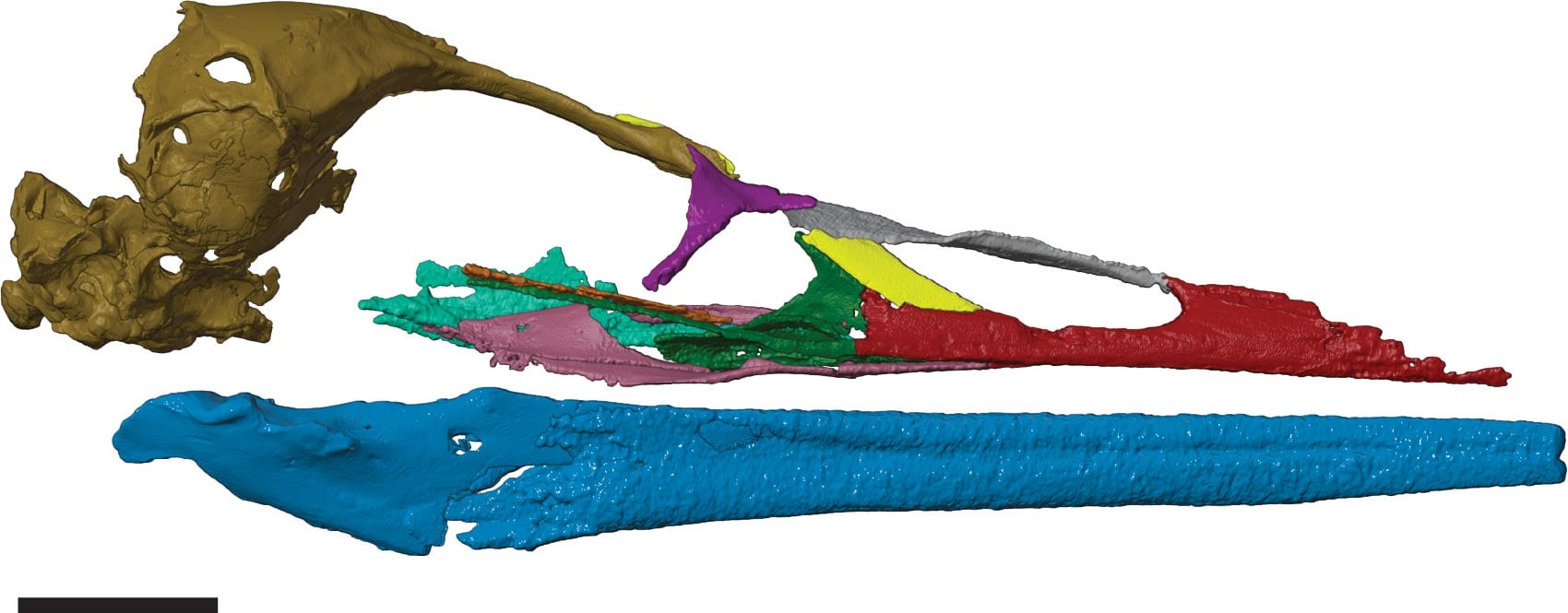
The fossil, a nearly complete, 69-million-year-old skull, belongs to an extinct bird named Vegavis iaai, and was collected during a 2011 expedition by the Antarctic Peninsula Paleontology Project. The new skull exhibits a long, pointed beak and a brain shape unique among all known birds previously discovered from the Mesozoic Era, when non-avian dinosaurs and a bizarre collection of early birds ruled the globe. Instead, these features place Vegavis in the group that includes all modern birds, representing the earliest evidence of a now widespread and successful evolutionary radiation across the planet.
A Controversial Bird in the Evolutionary Tree
“Few birds are as likely to start as many arguments among paleontologists as Vegavis,” says lead author Dr. Torres, now a professor at University of the Pacific. “This new fossil is going to help resolve a lot of those arguments. Chief among them: where is Vegavis perched in the bird tree of life?”
Vegavis was first reported 20 years ago by study co-author Dr. Julia Clarke of The University of Texas at Austin and several colleagues. At that time, it was proposed as an early member of modern (also known as crown) birds that was evolutionarily nested within waterfowl. But modern birds are exceptionally rare before the end-Cretaceous extinction, and more recent studies have cast doubt on the evolutionary position of Vegavis. The new specimen described in this study has something that all previous fossils of this bird have lacked: a nearly complete skull.

This new skull helps lay that skepticism to rest, preserving several traits like the shape of the brain and beak bones that are consistent with modern birds, specifically waterfowl. Unlike most waterfowl today, the skull preserves traces of powerful jaw muscles useful for overcoming water resistance while diving to snap up fish.
These skull features are consistent with clues from elsewhere in the skeleton, suggesting that Vegavis used its feet for underwater propulsion during pursuit of fish and other prey – a feeding strategy unlike that of modern waterfowl and more like that of some other birds such as grebes and loons.
Antarctica’s Role in Early Bird Evolution
“This fossil underscores that Antarctica has much to tell us about the earliest stages of modern bird evolution,” says Dr. Patrick O’Connor, co-author on the study, professor at Ohio University, and director of Earth and Space Sciences at Denver Museum of Nature & Science.
Birds known from elsewhere on the planet at around the same time are barely recognizable by modern bird standards. Moreover, most of the handful of sites that even preserve delicate bird fossils yield specimens that are so incomplete as to only give hints to their identity, as was the situation with Vegavis until now.

“And those few places with any substantial fossil record of Late Cretaceous birds, like Madagascar and Argentina, reveal an aviary of bizarre, now-extinct species with teeth and long bony tails, only distantly related to modern birds. Something very different seems to have been happening in the far reaches of the Southern Hemisphere, specifically in Antarctica,” noted Dr. O’Connor.
How the Antarctic landmass helped shape modern ecosystems in deep time is a topic of active research by scientists from around the world. Indeed, according to study co-author Dr. Matthew Lamanna of Carnegie Museum of Natural History, “Antarctica is in many ways the final frontier for humanity’s understanding of life during the Age of Dinosaurs.”
Advancing Science Through Research and Education
Dr. Torres was supported at Ohio University for three years by the NSF Postdoctoral Fellowship Program, working on a project examining the relationship between bird diversification and resilience to extinction through the combined lenses of ecology, brain anatomy, and other life-history traits. He is now in his first year as an Assistant Professor in the Department of Biological Sciences at the University of the Pacific in Stockton, California.
“This discovery exemplifies the power of scientific research and the crucial role our institution plays in advancing knowledge about Earth’s deep history,” Ohio University President Lori Stewart Gonzalez said. “This research not only enhances our understanding of early bird evolution but also highlights the invaluable contributions of OHIO graduate students and postdoctoral researchers who are at the forefront of these expeditions. It is through these global, expeditionary efforts—whether in the field or in the lab—that we can truly grasp the dynamic changes our planet has undergone over millions of years. This study is a prime example of real-world experiential learning that connects STEM education with hands-on, transformative research, preparing the next generation of scientists to tackle the challenges of the future.”
“Large-scale projects like this one, involving students and postdoctoral researchers, prepare the scientists of tomorrow to collaborate, advance science, and tackle the biggest questions facing our planet,” added Dr. O’Connor.
Reference: “Cretaceous Antarctic bird skull elucidates early avian ecological diversity” by Christopher R. Torres, Julia A. Clarke, Joseph R. Groenke, Matthew C. Lamanna, Ross D. E. MacPhee, Grace M. Musser, Eric M. Roberts and Patrick M. O’Connor, 5 February 2025, Nature.
DOI: 10.1038/s41586-024-08390-0
Other co-authors of the study include Joseph Groenke (Ohio University), Ross MacPhee (American Museum of Natural History), Grace Musser (The University of Texas at Austin and Smithsonian National Museum of Natural History), and Eric Roberts (Colorado School of Mines). This work was funded by the NSF grants DBI-2010996 to Torres, NSF ANT-1142104 to O’Connor, NSF ANT-1141820 to Clarke, NSF ANT-1142129 to Lamanna, and NSF ANT-0636639 and NSF ANT-1142052 to MacPhee.
Never miss a breakthrough: Join the SciTechDaily newsletter.
Follow us on Google and Google News.
8 Comments
The mental gymnastics required to believe this stuff is absurd.
The story of evolution has to be rethought and retold every single time they find something new that contradicts the previous story.
Hiding and outright ignoring discoveries until what they feel is a plausible explanation and new story can be formulated.
Since much of the evolutionary record is missing, of course ideas need revision because of new findings.
At least we have advanced beyond the myths in the Old Testament and no longer get burnt at the stake as heretics for not believing in the Catholic Church’s former opinion of how things began and how the sun and stars circled the Earth..
I would like to stand this chance to be one of those people who are going to be challenged by the question that you ask in science please
69,000,000 years old. Ya, ok…. Biggest embarrassment, fraud in history of science. When will these willfully ignorant so called scientists stop.
Bird are not dinosaur the search for dinosaur is over the myth that they died is a market gimmick .gator is only surviving dinosaur the mesoeucrocodylia dinosaur the asteroid did not kill dinosaur is was better dinosaur the modern crocodilian Darwin said strong will make it .the gator is alive and its dinosaur .i am idiot I miss odontoid report on the fish eating dinosaur from surrey the baryonyx skeleton .they were many odontoid report maybe I cut the corner they is a lot to read.odontoid is part of death roll system .bird and mammal are convergent evolution has it .only dinosaur has it is sauropod .in birds it’s for flight
Work on your sentence structure. You sound like an idiot, even though It’s clear that you are not.
This coming the same day as one find having modern birds at 149 million years ago. They took a time machine after evolving from T-Rex 68 million years ago. I swear evolutionist will call any shared feature transitional.