
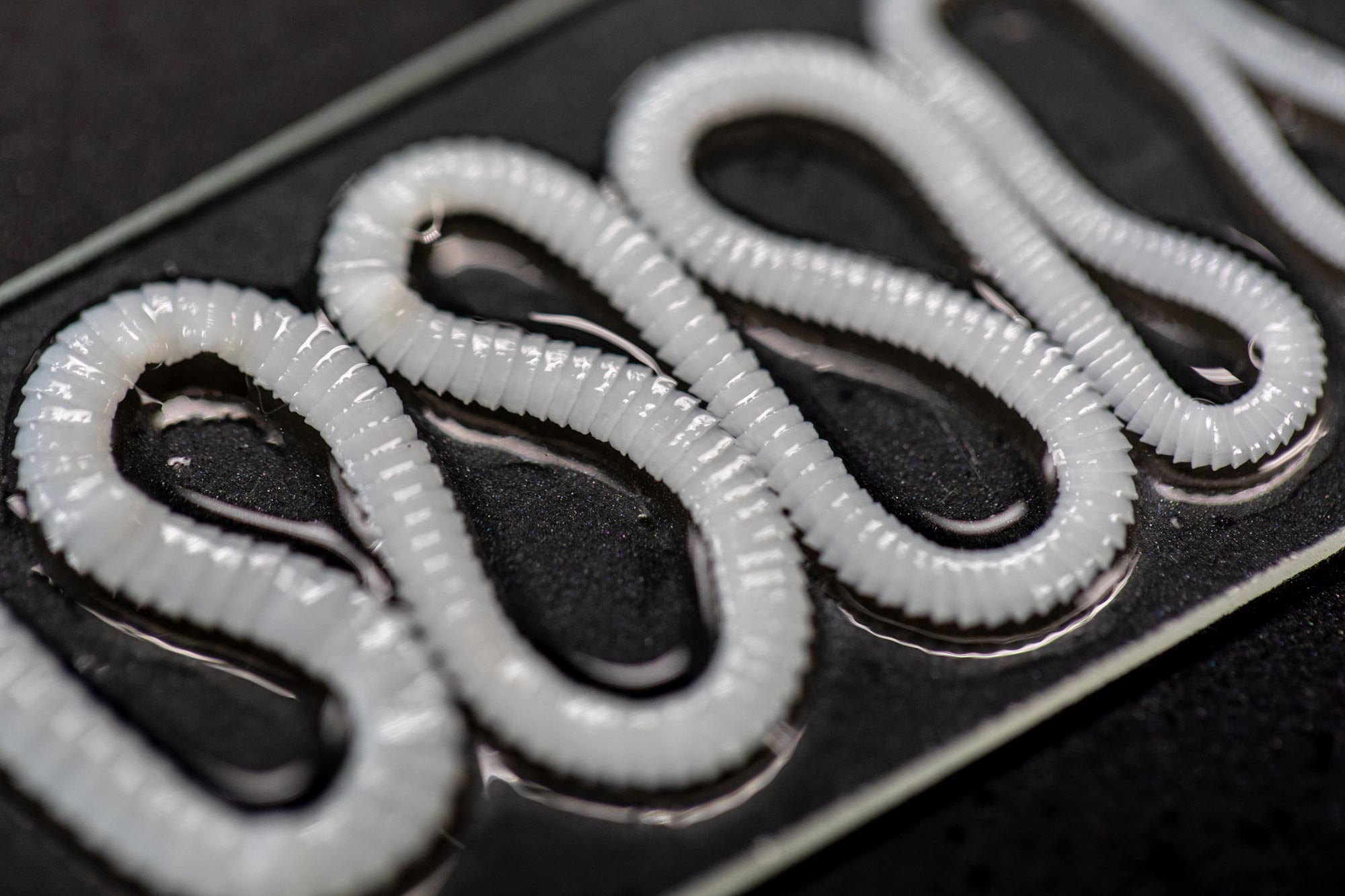
A dangerous tapeworm linked to severe disease in humans and dogs has now been detected in Pacific Northwest coyotes for the first time, raising new public health concerns.
New research suggests a dangerous tapeworm that has been spreading through the United States and Canada has now reached the Pacific Northwest. The parasite, Echinococcus multilocularis, commonly infects coyotes, foxes, and other canids and can cause serious illness in dogs and humans.
For decades, E. multilocularis was considered a major public health concern in parts of Europe and Asia but remained extremely uncommon in North America. That changed about 15 years ago, when infections in people and dogs began appearing in Canada and the Midwest, signaling that the parasite was expanding its range.
A new study led by researchers at the University of Washington marks the first confirmed detection of E. multilocularis in a wild animal host along the contiguous U.S. West Coast. Scientists tested 100 coyotes in the Puget Sound area and found the parasite in 37 of them. The findings were in PLOS Neglected Tropical Diseases.

Dangerous Parasite Found in One-Third of Local Coyotes
“This parasite is concerning because it has been spreading across North America. There have been numerous cases of dogs getting sick, and a handful of people have also picked up the tapeworm,” said lead author Yasmine Hentati, who recently graduated from the UW with a doctorate in environmental and forest science. “The fact that we found it here in one-third of our coyotes was surprising, because it wasn’t found anywhere in the Pacific Northwest until earlier this year.”
When E. multilocularis infects animals or humans, it can produce cancer-like cysts in the liver and sometimes other organs. Without treatment, the infection may become fatal.
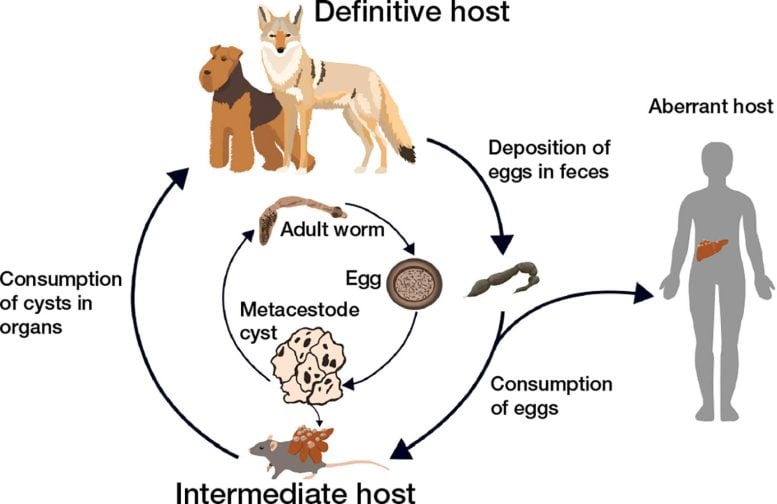
Not every infected animal becomes ill. The parasite has a complicated life cycle involving multiple species. Coyotes and other canids carry adult worms in their intestines, often without symptoms. These worms release eggs through feces.
How the Tapeworm Spreads Between Animals and Humans
Rodents become infected after consuming food contaminated with coyote feces. The parasite eggs then travel to the liver, where they form cysts that can weaken or kill the animal. Coyotes become infected again when they eat infected rodents.
Humans and domestic dogs are considered accidental hosts. People can become infected by swallowing tapeworm eggs from contaminated food or contact with coyote or dog feces. This can lead to alveolar echinococcosis, a disease that causes slow-growing cysts that spread through the body. Symptoms may take five to 15 years to appear, making diagnosis and treatment difficult.
The World Health Organization ranks alveolar echinococcosis among the world’s top 20 neglected tropical diseases and considers it the third most important food-borne illness globally. Many countries closely monitor its spread.
Dogs exposed to E. multilocularis may either carry the parasite without symptoms or develop the same cyst-forming disease seen in other infected animals, depending on the stage of exposure.
Protecting Dogs From Echinococcus multilocularis
“To minimize the risk of dogs getting infected with E. multilocularis, owners should not let them prey on rodents or scavenge their carcasses,” said co-author Guilherme Verocai, an associate professor and director of the Parasitology Diagnostic Laboratory at the Texas A&M University College of Veterinary Medicine and Biomedical Sciences.
Verocai also recommended routine veterinary care, parasite testing, and preventative medications for worms and ticks.
Although researchers detected the parasite in more than one-third of the coyotes tested, there is still limited evidence of widespread transmission to other animals. One study identified seven dog infections in Washington, Oregon, and Idaho since 2023, including five in Washington. No human cases have been reported on the West Coast.

Why Coyotes Carry High Infection Rates
“The reason that it’s so high in coyotes is because they are regularly eating raw rodents, and that is the primary way for them to get infected. Most domestic dogs are not eating the raw livers of wild rodents,” Hentati said.
Before cases began increasing in the 2010s, E. multilocularis had previously been reported on remote islands in northwestern Alaska. Those earlier infections involved a different tundra strain of the parasite. Genetic testing shows the newer outbreak is linked to a more infectious strain with European origins. Researchers found this newer strain in the coyotes studied in Washington, and it is now believed to be the dominant strain in both the United States and Canada.
Neither the United States nor Canada requires dogs to be dewormed when entering the country, which researchers say could have contributed to the parasite’s spread. Earlier studies also suggested the parasite may have arrived in North America through red foxes imported for hunting about 100 years ago, although its exact origins remain uncertain.
“The main takeaway is that Echinococcus multilocularis is here; it’s pretty prevalent in the local coyote population, and people should be aware of potential risks,” Hentati said.
Reference: “Detection of Echinococcus multilocularis in coyotes in Washington State, USA highlights need for increased wildlife surveillance” by Yasmine Hentati, Ellie Reese, Claire C. Curran, Erika M. Miller, Dakeishla M. Díaz-Morales, Samantha E.S. Kreling, Guilherme G. Verocai, Laura R. Prugh, Christopher J. Schell and Chelsea L. Wood, 24 March 2026, PLOS Neglected Tropical Diseases.
DOI: 10.1371/journal.pntd.0013502
This study was funded by the National Science Foundation and the University of Washington Hall Conservation Genetics Fund.
Never miss a breakthrough: Join the SciTechDaily newsletter.
Follow us on Google and Google News.
7 Comments
What about cats ?
Let’s feed those coyotes dewormers
Good idea. There are some coyotes living in Discovery Park rn. I am sure scientists can figure out how tl make that available to them, poor things.
Всё что происходи в человеческой расе имеет поверхностный характер. Койоты едят грызунов и это нормально. Ненормально то, что как заразились грызуны, это более глубокий уровень развития разума. Где очаг заражения грызунов, он искусственного происхождения или натурального. Скорее всего это всё произошло от людей, которые распространили эту заразу через домашних животных или птиц. А грызуны это съели, а их съели койоты.
You are likely correct. There is a chain of events that created the tapeworm spread across different species. There are several inexpensive treatments/pills that can treat humans and animals. The development of Ivermectin (Avermectin) to treat parasitic diseases won a Nobel Prize for Medicine to treat River Blindness and Lymphatic Filariasis. It is also a proven treatment for other parasites and viruses. It is a chemical compound from a specific bacterium that was found in Japanese soil that is its only defense against worms and viruses that attack it.
Ah, Seattle –
This may be a dumb question but New Zealand had been a hotbed of a dog-born parasite called ‘hydatid disease’ which was spread incidentally to humans from family pets and working dogs that were fed raw sheep offal. Back in the ‘seventies you couldn’t tour the countryside without encountering signed back road areas called ‘hydatid dosing strips where everyone took their dogs once a year to be drenched and their excrement checked for the tiny tapeworm. It was also a problem in Australia with canids although not so pronounced as in N.Z. If we are talking about the same thing here it would have been instructive to have mentioned the fact.