

Heartworm’s global spread likely stems from ancient canid hosts, not recent human activity. Findings may reshape treatment approaches.
Research from the University of Sydney is changing how scientists understand one of the most common parasites affecting dogs. The findings suggest heartworm disease has a much older and more complex evolutionary history than previously thought, including a possible ancient origin for Australian heartworms linked to dingoes.
This research is important for improving treatments, especially as resistance to existing drugs continues to grow.
In a large genome-wide analysis, scientists examined more than 100 heartworm genomes collected from domestic dogs and wild canids across several continents. The results challenge the long-standing belief that heartworm spread mainly through the recent, human-driven movement of domestic dogs.


Rethinking How Heartworm Spread
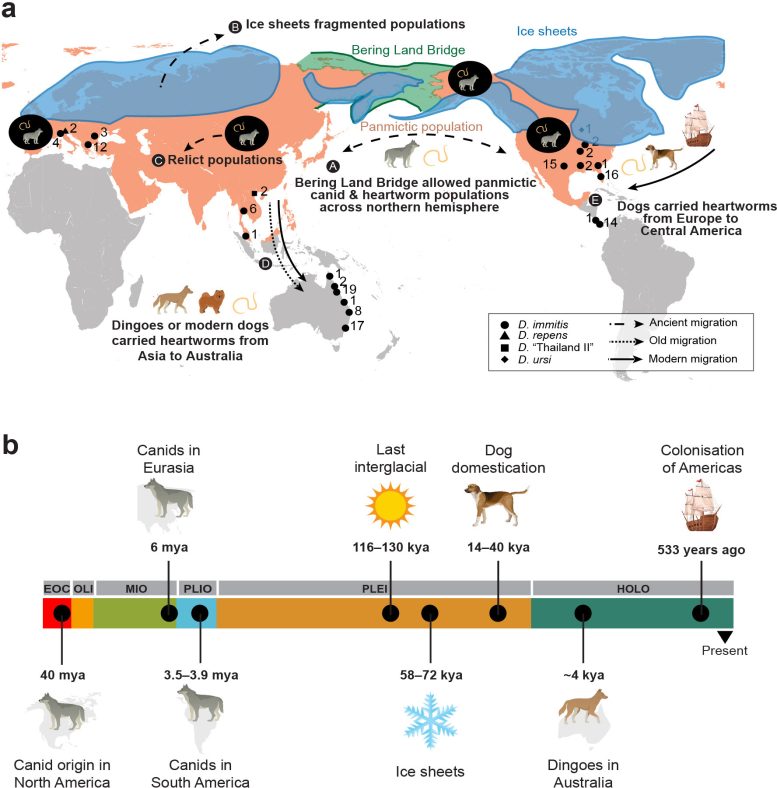
Instead, the study proposes that ancient canids such as wolves and dingoes played a key role in shaping the global distribution of heartworms over tens of thousands of years.
The paper was published in Communications Biology.
Heartworm disease is caused by the parasite Dirofilaria immitis and is transmitted by mosquitoes. If untreated, it can be fatal in dogs. Adult worms, often compared to strands of spaghetti, can grow up to 30 centimeters (about 11.8 inches) long and live in the blood vessels of the heart and lungs.
Australian Heartworm and Dingo Connection
One of the most notable findings involves Australia. Genetic evidence suggests that heartworms in Australia may share ancestry with those found in Asia. This raises the possibility that the parasite arrived with the first dingoes, which likely migrated from Asia thousands of years ago.
However, the researchers stress that this conclusion is not definitive. Another possibility is that heartworm was introduced more recently, after European colonization.
“While our data suggest an ancient link between Australian and Asian heartworms, the sample size means we need to be careful about drawing firm conclusions,” said senior author Professor Jan Slapeta from the University of Sydney School of Veterinary Science.
“What we can say with confidence is that heartworm evolution is far older and more complex than a simple story of parasites hitchhiking with modern dogs.”
Genetic Evidence and Global Patterns
The research team used whole-genome sequencing to compare heartworms from different parts of the world. This approach allowed them to reconstruct population histories and track how the parasites evolved. Their analysis revealed distinct regional populations shaped by the movement and isolation of ancient canids during ice ages and warmer interglacial periods.

Lead author Dr. Rosemonde Power, who completed her PhD at the University of Sydney and is now at Stockholm University, said the results overturn long-held assumptions in parasitology.
Co-Evolution With Canine Hosts
“For decades, we assumed heartworms were spread mainly through recent human activity,” Dr. Power said. “What we’re seeing instead is evidence of deep co-evolution between heartworms and their canine hosts, even before humans were part of the picture.”
The findings also have important implications for animal health, especially as resistance to heartworm treatments continues to emerge in some regions.
“Understanding where heartworms come from and how different populations are related helps us respond more effectively to disease and drug resistance,” Professor Slapeta said. “Heartworms are not the same everywhere, and local history matters.”
Future Research and Implications
The researchers note that although the study included more than 100 genomes, additional sampling will be needed, particularly from underrepresented regions. This will help refine evolutionary timelines and test competing ideas about heartworm origins, including how it first appeared in Australia.
Overall, the study represents a major step forward in understanding the long and complex global history of one of the most dangerous parasites affecting dogs.
Reference: “Population genomics reveals an ancient origin of heartworms in canids” by Rosemonde I. Power, Swaid Abdullah, Heather S. Walden, Guilherme G. Verocai, Tiana L. Sanders, Joe L. Luksovsky, Andrew R. Moorhead, Michael T. Dzimianski, Jeremy M. Foster, Michelle L. Michalski, Alicia Rojas, Samuel C. Chacón, Georgiana Deak, Andrei D. Mihalca, Patrizia Danesi, Elias Papadopoulos, Piyanan Taweethavonsawat, Dung Thi Bui, Anh Do Ngoc, Reuben S. K. Sharma, Simon Y. W. Ho, Stephen R. Doyle and Jan Šlapeta, 20 January 2026, Communications Biology.
DOI: 10.1038/s42003-025-09250-x
Funding was received from the Canine Research Foundation, Dogs Victoria, and the Australian Companion Animal Health Foundation Research Fund. Researchers received support from the Australian Government, the Jean Walker Trust Fellowship, the Australian Society for Parasitology’s Researcher Exchange, UKRI Future Leaders Fellowship, the Pathogen Informatics group at the Wellcome Sanger Institute, and the Sydney Informatics Hub.
Never miss a breakthrough: Join the SciTechDaily newsletter.
Follow us on Google and Google News.