
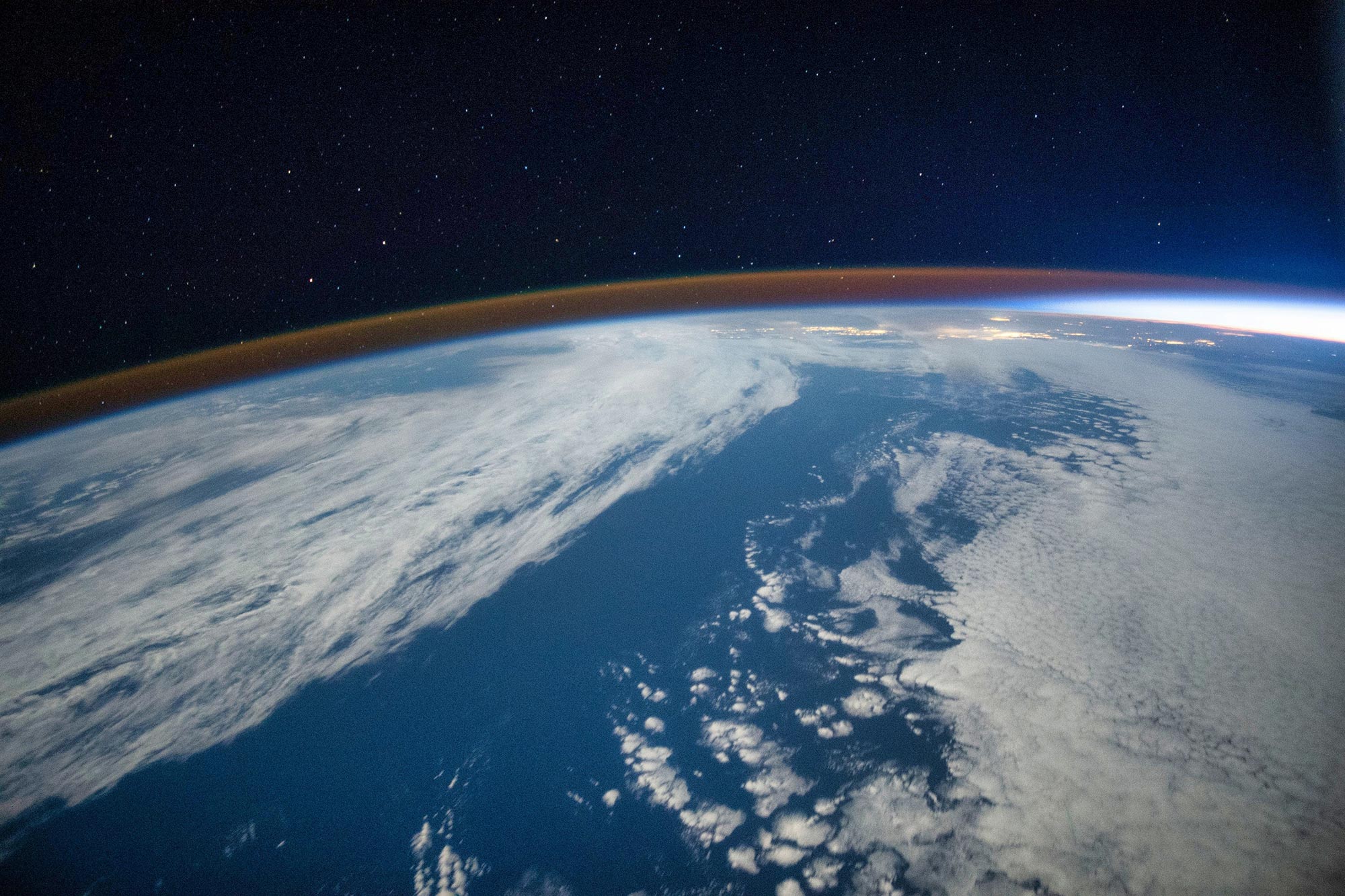
Earth’s surface and lower atmosphere are getting hotter, but far above the planet, another dramatic change has been unfolding in the opposite direction. The upper atmosphere has been steadily cooling for decades, creating one of the most recognizable signs of human-driven climate change. Scientists have understood that this was happening, but the detailed physics behind it remained unclear.
Now, researchers at Columbia University say they have identified the mechanism responsible. Their new study shows that the cooling is closely tied to how carbon dioxide (CO2) interacts with different wavelengths of light in the upper atmosphere.
“It explains a phenomenon that’s a fingerprint of climate change, has been known to occur for decades, and has not been understood,” says Robert Pincus, a research professor of ocean and climate physics at Lamont-Doherty Earth Observatory, which is part of the Columbia Climate School, and co-author of the study published in Nature Geoscience.
Why CO2 Heats Earth but Cools the Stratosphere
Near Earth’s surface, CO2 traps heat that would otherwise escape into space, helping drive global warming. But conditions change dramatically higher in the atmosphere.
In the stratosphere, which stretches from roughly 11km to 50 km above Earth’s surface, CO2 behaves less like a blanket and more like a cooling system. The molecules absorb infrared energy rising from below and then emit part of that energy back into space. As CO2 concentrations increase, the stratosphere becomes even better at releasing heat, causing temperatures there to fall.
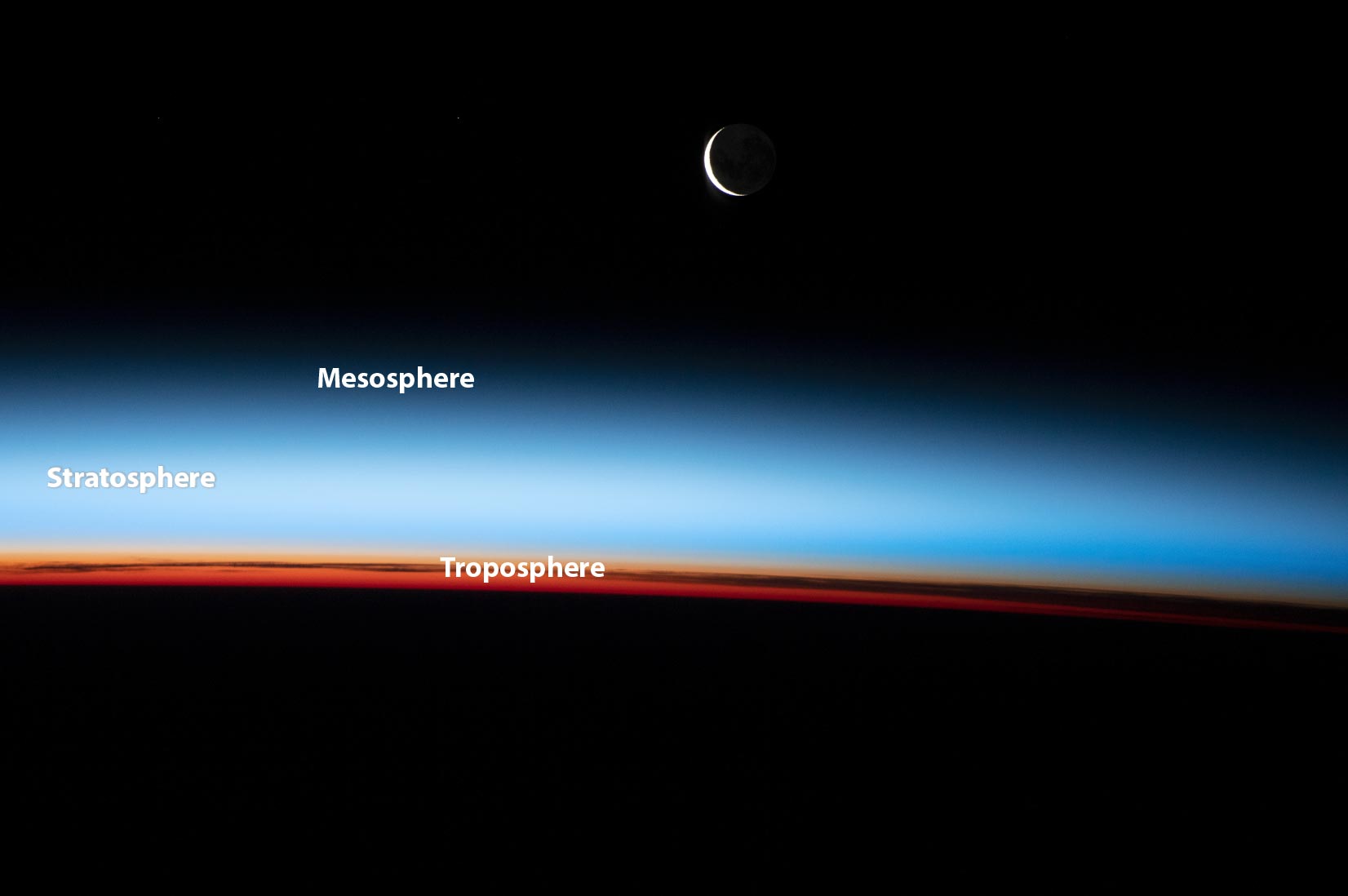
Scientists first predicted this effect in the 1960s through pioneering climate models developed by climatologist Syukuro Manabe, whose work later earned a Nobel Prize. Since the mid-1980s, the stratosphere has cooled by about 2 degrees Celsius. Researchers estimate this cooling is more than 10 times greater than what would have occurred without human-produced CO2 emissions.
Even so, many details of the process remained unresolved.
“The existing theory was incredibly insightful, but at the moment we lack a quantitative theory for CO2-induced stratospheric cooling,” says Sean Cohen, a postdoctoral research scientist at Lamont-Doherty Earth Observatory, which is part of the Columbia Climate School, and the study’s lead author.
The Infrared “Goldilocks Zone”
To better understand the phenomenon, Cohen worked alongside Pincus and Lorenzo Polvani, a geophysicist in Columbia Engineering’s Department of Applied Physics and Applied Mathematics. The team repeatedly refined mathematical models that simulated the processes involved in stratospheric cooling. They compared their calculations with advanced climate simulations and real-world observations, adjusting the equations over several months until the results aligned.
The researchers found that one factor stood out above all others: how CO2 interacts with infrared light, also known as longwave radiation.
Different infrared wavelengths behave differently in the atmosphere. Some are far more effective at driving cooling than others. The team identified a particularly efficient range of wavelengths they described as a “Goldilocks zone.” As atmospheric CO2 levels continue rising, this zone expands.
“It’s those changes in efficiency that are going to ultimately be what’s driving stratospheric cooling,” says Cohen.
The study also measured the influence of ozone and water vapor. Both gases play similar roles by trapping heat lower in the atmosphere while contributing to cooling higher up through heat radiation. However, the researchers found their overall impact on stratospheric cooling is small compared with CO2.
How Upper Atmospheric Cooling Strengthens Warming Below
The team’s equations successfully reproduced several long-observed atmospheric patterns. The models showed that cooling becomes stronger with altitude, with the weakest cooling lower in the stratosphere and the strongest near its upper boundary. They also confirmed that every doubling of CO2 produces about 8 degrees Celsius of cooling at the stratopause, the upper edge of the stratosphere.
The findings also reveal a climate feedback effect. Increasing CO2 helps the stratosphere radiate heat more efficiently, which cools that region. But as the stratosphere cools, the Earth system actually releases less infrared energy into space overall, allowing more heat to remain trapped closer to the surface.
“Here’s this process that we’ve known about for 50-plus years, and we had a pretty decent qualitative understanding of how it worked. However, we didn’t understand the details of what actually drove that process mechanistically,” says Cohen.
According to Cohen and Pincus, the study is not about proving global warming exists. Instead, it provides a clearer understanding of one of climate change’s most important atmospheric processes.
“This is really telling us what is essential,” says Pincus.
The research could also help scientists studying atmospheres beyond Earth, including those of planets elsewhere in the solar system and distant exoplanets.
“Maybe we can better understand what’s going on in the stratospheres of other planets in our solar system or exoplanets,” says Cohen.
Reference: “Stratospheric cooling and amplification of radiative forcing with rising carbon dioxide” by Sean Cohen, Robert Pincus and Lorenzo M. Polvani, 11 May 2026, Nature Geoscience.
DOI: 10.1038/s41561-026-01965-8
Never miss a breakthrough: Join the SciTechDaily newsletter.
Follow us on Google and Google News.
17 Comments
“The study also measured the influence of ozone and water vapor. Both gases play similar roles by trapping heat lower in the atmosphere while contributing to cooling higher up through heat radiation. However, the researchers found their overall impact on stratospheric cooling is small compared with CO2.”
A recent study by Santer et al., summarized here, https://scitechdaily.com/leading-climate-scientist-rebuts-factually-incorrect-us-government-climate-claims/ , claims that the stratospheric cooling is the result of the Montreal Protocol ‘healing’ the ozone layer. One can’t have it both ways — small compared with CO2 AND dominated by returning ozone — so it seems that one has to pick the ‘the effect of the week.’ I have already pointed out to the reader claiming that Santer et al. “obliterates” the claims of the special commission, isn’t supported by the NASA Antarctic ‘ozone hole’ data. If I had to choose, I’d go with the CO2 instead of O3 because CO2 is clearly increasing in concentration.
However, who knows what a new study might come up with. I’d then have to compare the CO2 hypothesis with the new hypothesis. Those who believe that science is ever settled, and that they can claim that some study “obliterates” another, doesn’t really understand how science works.
Let me remind you geniuses in the climate science field that CO2 is 04% of the atmosphere. That includes the upper atmosphere where the air is far less dense as well. That’s less than half of a 10th of a percent to put its more bluntly and yet you want to claim that it is the cause of everything including heating and cooling and every other climate issue on the planet apparently. Historically CO2 levels have been much higher than the current levels that is why plants adapted to utilize much higher levels of CO2 so stop getting your panties all in a bunch about it.
Thank you. Just the title seemed specious to me.
While I am generally sympathetic to your position, I think that you are pushing a logical fallacy. Would you claim that a small dose of cyanide is of no concern simply because of the size of a dose? Every toxin has an LD50 that predicts how potent the toxin is and everything, including drinking water, is toxic, dependent solely on the mass of toxin per kilogram of body weight, the bio-availability, and the rate of consumption or administration.
The effectiveness of various ‘greenhouse gases’ depends on the Global Warming Potential per molecule, the mole-concentration per unit volume (commonly per liter), and the longevity of the molecule. The instantaneous warming effect for a pulse is then integrated over 100-years and compared to a molecule of CO2. The rub in the simple science is that there is no agreement among various experts as to how much warming results from a single molecule of CO2 — known as the Climate Sensitivity for a doubling of CO2 concentration — and thus the global warming potential for all of the rarer gases have a similar uncertainty.
To further complicate things, the CO2 concentration can apparently both warm the air slightly in the troposphere and cool it in the stratosphere, the altitude and coverage of clouds can either warm or cool the troposphere, and warming can cause biogenic processes to release more CO2. Warming impacts the rate of evaporation of water, and hence the potential for clouds to form.
The system is composed of numerous inter-related feedback loops that modern computers attempt to solve. Unfortunately, the solution of all the differential equations in a manner that produces useful answers, in a finite amount of time, cannot be done with existing computers. That requires these same experts to make guesses about how the energy exchanges involving clouds works. That means that the ideal of a mechanical solution is replaced by a subjective solution that probably isn’t right. So far, even the modelers acknowledge that their models tend to run warm.
To go back to the analogy of toxins, think of someone simultaneously taking a poison and an antidote. If they get it right, the poison is neutralized without side-effects. It they don’t get it right, they will probably get very sick and may still die. Or, alternatively, they may be poisoned by the antidote if too much is taken. The whole situation is much more complex than what the alarmists share with the public.
I’ll take the evidence over your intuition about how you feel CO2 warming works. Thanks. Historically there was indeed have more CO2. There was also a planet full of life that had evolved with the very slow rate of change, not the fall-off-a-cliff change we’re seeing now. Also, the worry here is not all life going extinct – it won’t, not by a long shot – it’s the impact on human civilization.
Plant more trees to offset warming, it’s aways colder above 10,000 that’s why it’s hard to breath and you need a heavy jacket or space suit. The planets continual axis shift has created more storms causing lightning and more fires. Cleaning dry vegetation helps avoid climate disasters not caused by humans. No degree needed, just life experiences as I’ve gotten older.
Please read some actual science before making ignorant comments.
Yes, a small amount or small increases can create a tremendous impact. I would not want to discover a small and increasing amount cyanide or arsenic (all natural stuff) in my food or water. We can all imagine how less than 2% or 1/2 gram (below the ingredient facts reporting threshold) would be concerning.
Hi staff, l really enjoy your articles and would like to share some thoughts hoping someone from your organisation will look into these thoughts l have.
Global warming has been blamed on a lot of aspects but there is a lot more to this that isn’t mentioned. Some obvious ones are the wars and demolishing of high rise buildings. How much pollution is added into the atmosphere after each bomb is dropped? The buildings distroyed, what effect does that have? Contamination of the air, water and environment yet nothing has ever been said. The removal of oils, gases, minerals, water etc deep within the earths crust leaves voids where there is a need to refill these areas or the soils around it cave in – earth quacks, tornadoes volcanic eruptions etc then takes place.
My major question is Solar and global warming. Consider this carefully please. Going back approx 60 to 100 years ago. There wasn’t cars or many metal vehicles around, there wasn’t many high rise buildings with large glass panels around, there wasn’t buildings with tin roofs etc.
Now, let’s think on the man made electric radian bar heaters we once used to heat our rooms. The electric element would heat up and the moving air would circulate that heat through out the room. Now let’s apply this to all the above we mentioned. Most cars are parked in the streets in the stinking heat, the tin roofs and glass panels, the solar panel which the most efficient ones are only 21% efficient on the market to date all absorb heat, reflect heat and light all back into the atmosphere – has anyone stopped to calculate these effects on global heating. This would be massive yet no one talks about them. The Iran war, the Ukraine war, the bombing the destruction what are they causing. It would be nice if a study was made on these issues and published for the world to see. We are our own worst enemies.
Everything is truly made up with carbon atoms. I keep hearing that the carbon footprint is truly a great big problem. But i don’t think that this is a real issue. I also don’t believe that we are going to have a huge negative impact on the planet. It’s been here for a few years more than any human. Plus before automobiles were supposed to be the problem. Trash was burned all over the world. Plus factory smoke stacks. And volcanic eruptions are going to make a big difference in the atmospheric weather and I think that we don’t have any idea about what is truly happening to the planet. But it’s so out of the realm of what is being said that I am still not a believer in the Global warming. And the south pole is getting colder while the north pole is getting warmer. This should have a better place for all those who study in the atmosphere of the planet. It’s all guess work. With a little bit of facts thrown in. And the whole situation is truly a real way to make people believe that they are going to destroy the world. Because the Globalist are trying to control the whole planet. Period.
All statistic blabla.
If global warming exists and we live in a bubble then explain why are temperatures different around our world. And why do glaciers exist, why haven’t they melted. Why do some places have nasty humidity and you travel 50 miles away it might be cooler no humidity. Or it’s hotter in one city and 20dg cooler in another just 20 miles away. Try explain that, get out of your comfort zone and travel see the real world.
Dear Larry, we live in a world of more than the three dimentions of space and the dimention of time. Other dimentions affect us and the earth, sea, air around us. Such dimentions are: heat (temprature), pressure (altitude), gravity (mass), lumonisity (radiation), the strong and weak atomic forces (chemical reactions between elements), all of these factors have an effect to some degree. Unless you understand differential equations, which explains how these multitude of dimentions interact, you should re-read a gradeschool book about this. Or perhaps a basic earth science college book. I don’t know your level of understanding so the only advice i can offer for a quick answer is to start asking an AI with followup questions.
Unless you already know enough to challenge the consensus boiler plate received from any of the extant LLMs, you won’t get the truth. It has been my experience that when I challenge the initial response, there is no push back. Instead, they apologize profusely for the obvious mistakes they make. Asking “followup questions” will just get more alarmist reinforcement unless you either offer counter evidence or ask it to logically defend the indefensible.
And regardless of what the climate does, there’s always climate scammers trying to take the money out of your jeans. They’re almost like invasive worms. As soon as some country has a lot of money, the worms grow. It’s a head-scratcher.
U still Don know how 🤔 everything is working 💪… I am sad to know 😔
Everything is truly made up with carbon atoms. I keep hearing that the carbon footprint is truly a great big problem. But i don’t think that this is a real issue. I also don’t believe that we are going to have a huge negative impact on the planet. It’s been here for a few years more than any human. Plus before automobiles were supposed to be the problem. Trash was burned all over the world. Plus factory smoke stacks. And volcanic eruptions are going to make a big difference in the atmospheric weather and I think that we don’t have any idea about what is truly happening to the planet. But it’s so out of the realm of what is being said that I am still not a believer in the Global warming. And the south pole is getting colder while the north pole is getting warmer. This should have a better place for all those who study in the atmosphere of the planet. It’s all guess work. With a little bit of facts thrown in. And the whole situation is truly a real way to make people believe that they are going to destroy the world. Because the Globalist are trying to control the whole planet. Period.