

Scientists have uncovered a previously unknown brain feedback system that links deep sleep, growth hormone release, and wakefulness.
Most people think of sleep as a time when the body simply rests. In reality, the brain is carrying out a complex series of processes that regulate everything from metabolism and tissue repair to memory and hormone production. One of the most important of these hormones is growth hormone, which helps build muscle and bone, regulate fat metabolism, and support overall health.
Scientists have known for decades that growth hormone is closely tied to deep sleep, especially the early stages of non-REM sleep. Even a lack of sleep for a single night can reduce hormone levels. But exactly how the brain controls this process has remained poorly understood.
Researchers Map the Brain Circuit Behind Growth Hormone Release
Now, researchers at the University of California, Berkeley, have identified the brain circuits responsible for controlling growth hormone release during sleep. Their study, published in Cell, also uncovered a previously unknown feedback system in the brain that helps keep hormone levels balanced while regulating wakefulness.
The findings provide a clearer picture of how sleep and hormone regulation are connected. Researchers say the discovery could eventually contribute to new treatments for sleep disorders linked to metabolic diseases such as diabetes, as well as neurodegenerative conditions including Parkinson’s and Alzheimer’s disease.
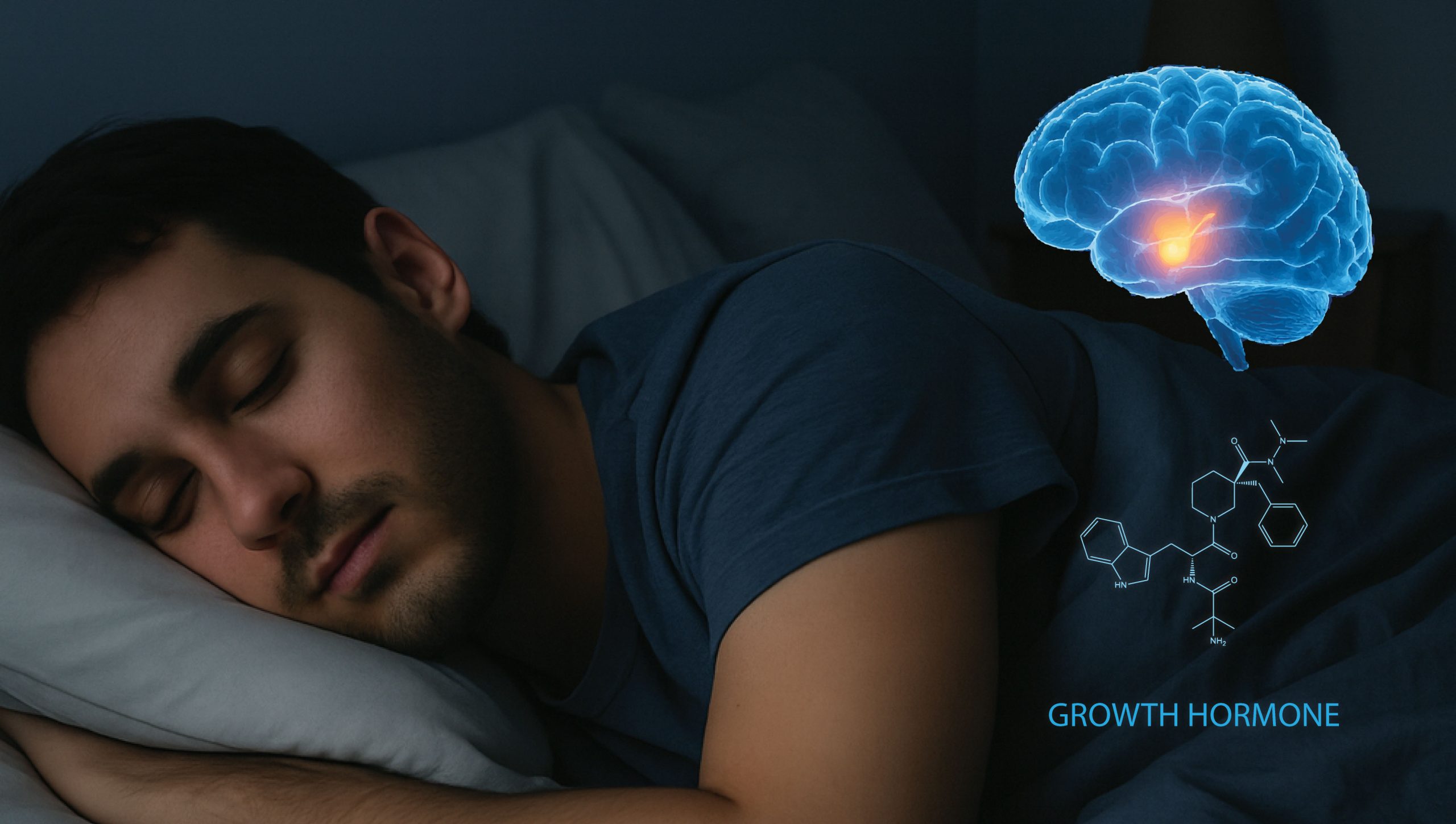
“People know that growth hormone release is tightly related to sleep, but only through drawing blood and checking growth hormone levels during sleep,” said study first author Xinlu Ding, a postdoctoral fellow in UC Berkeley’s Department of Neuroscience and the Helen Wills Neuroscience Institute. “We’re actually directly recording neural activity in mice to see what’s going on. We are providing a basic circuit to work on in the future to develop different treatments.”
Because growth hormone also affects glucose and fat metabolism, poor sleep may increase the risk of obesity, diabetes, and cardiovascular disease.
Key Brain Regions Involved in Sleep and Hormone Regulation
The neurons responsible for regulating growth hormone release during the sleep-wake cycle are located deep within the hypothalamus, a brain region shared across mammals. These include growth hormone releasing hormone (GHRH) neurons and two types of somatostatin neurons.
After growth hormone is released, it increases activity in the locus coeruleus, a brainstem region involved in attention, arousal, cognition, and responses to new experiences. Problems affecting the locus coeruleus have been associated with several psychiatric and neurological disorders.
“Understanding the neural circuit for growth hormone release could eventually point toward new hormonal therapies to improve sleep quality or restore normal growth hormone balance,” said Daniel Silverman, a UC Berkeley postdoctoral fellow and study co-author. “There are some experimental gene therapies where you target a specific cell type. This circuit could be a novel handle to try to dial back the excitability of the locus coeruleus, which hasn’t been talked about before.”
Working in the lab of Yang Dan, a professor of neuroscience and molecular and cell biology, the researchers implanted electrodes into mouse brains and monitored neural activity while stimulating hypothalamic neurons with light. Because mice sleep in short bursts lasting only a few minutes throughout the day and night, they provided researchers with repeated opportunities to examine hormone activity during sleep cycles.
Distinct Hormone Activity During REM and Non-REM Sleep
Using advanced neural circuit tracing techniques, the researchers found that the two peptide hormones involved in growth hormone release behave differently depending on the stage of sleep. GHRH stimulates growth hormone release, while somatostatin suppresses it.
During REM sleep, levels of both hormones rise sharply, increasing growth hormone release. During non-REM sleep, somatostatin levels drop while GHRH levels rise more moderately, which also boosts growth hormone production.
The researchers also found evidence of a feedback system involving the locus coeruleus. As growth hormone gradually builds during sleep, it stimulates this brain region and encourages wakefulness. However, when the locus coeruleus becomes overly active, it can unexpectedly increase sleepiness, according to earlier work by Silverman.
“This suggests that sleep and growth hormone form a tightly balanced system: Too little sleep reduces growth hormone release, and too much growth hormone can in turn push the brain toward wakefulness,” Silverman said. “Sleep drives growth hormone release, and growth hormone feeds back to regulate wakefulness, and this balance is essential for growth, repair, and metabolic health.”
Because the locus coeruleus also helps regulate overall brain arousal during wakefulness, researchers believe maintaining the right balance in this system could influence attention and cognitive function as well.
“Growth hormone not only helps you build your muscle and bones and reduce your fat tissue, but may also have cognitive benefits, promoting your overall arousal level when you wake up,” Ding said.
Reference: “Neuroendocrine circuit for sleep-dependent growth hormone release” by Xinlu Ding, Fuu-Jiun Hwang, Daniel Silverman, Peng Zhong, Bing Li, Chenyan Ma, Lihui Lu, Grace Jiang, Zhe Zhang, Xiaolin Huang, Xun Tu, Zhiyu Melissa Tian, Jun Ding and Yang Dan, 24 June 2025, Cell.
DOI: 10.1016/j.cell.2025.05.039
The work was funded by the Howard Hughes Medical Institute (HHMI), which until this year supported Dan as an HHMI investigator, and the Pivotal Life Sciences Chancellor’s Chair fund. Dan is the Pivotal Life Sciences Chancellor’s Chair in Neuroscience. Other co-authors of the paper are Peng Zhong, Bing Li, Chenyan Ma, Lihui Lu, Grace Jiang, Zhe Zhang, Xiaolin Huang, Xun Tu and Zhiyu Melissa Tian of UC Berkeley; and Fuu-Jiun Hwang and Jun Ding of Stanford University.
Never miss a breakthrough: Join the SciTechDaily newsletter.
Follow us on Google and Google News.