
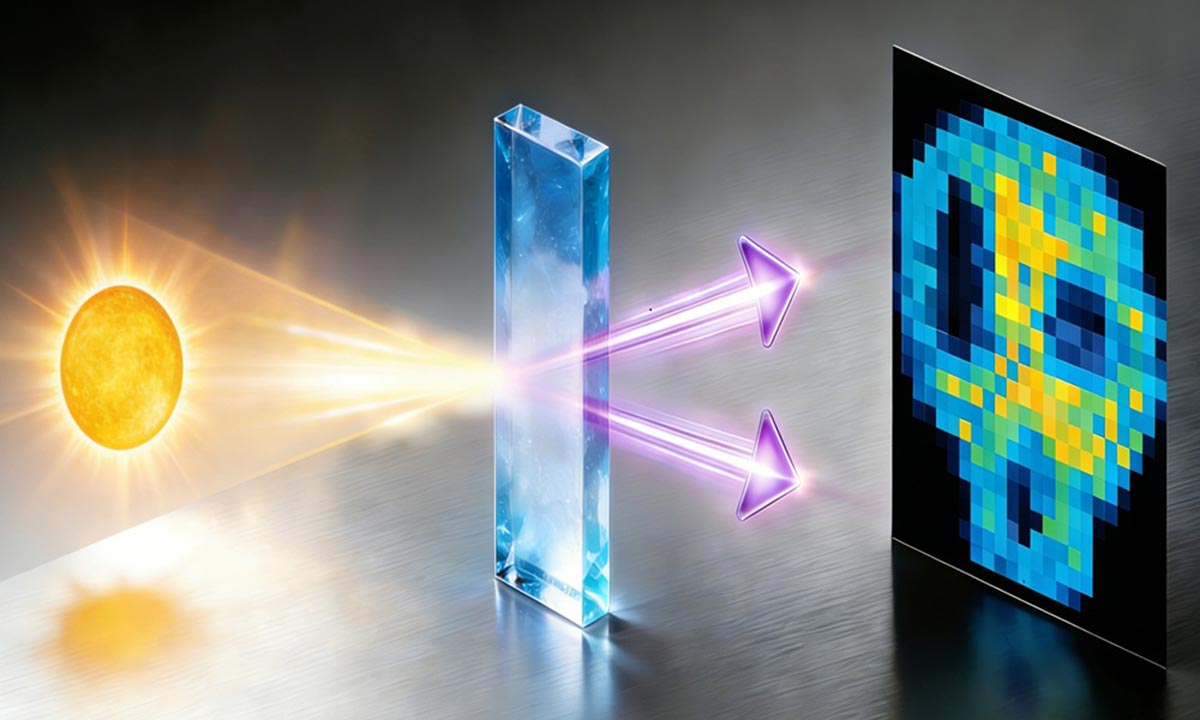
Scientists have shown that sunlight alone can generate quantum-correlated photons capable of producing “ghost images,” a feat once thought to require stable lasers.
Quantum optics experiments typically rely on carefully controlled lasers to create correlated or entangled photon pairs. These photon pairs are produced through a process known as spontaneous parametric down-conversion (SPDC), in which laser light is directed into a nonlinear crystal. Because the process depends on stable, coherent illumination, scientists have generally assumed that sunlight would not work as a practical alternative.
That assumption has started to change in recent years. Researchers have found that SPDC does not require perfectly coherent light sources. Even partially coherent light can drive the process, while passing some of its coherence properties to the generated photons. This raised an intriguing possibility: could sunlight itself produce correlated photon pairs?
Scientists Turn Sunlight Into a Quantum Light Source
Using sunlight for SPDC is far from simple. Natural sunlight constantly changes in brightness, angle, and position throughout the day. Those fluctuations can disrupt the precise alignment and photon detection needed for quantum optics experiments.
Still, sunlight offers a major benefit. Unlike laser systems, it requires no dedicated electrical power source and could potentially support quantum technologies in remote or extreme environments.
A team led by Wuhong Zhang and Lixiang Chen at Xiamen University has now demonstrated that the idea can work in practice. In research published in Advanced Photonics, the scientists built an experimental setup in which sunlight served as the only pump source for SPDC.
The system used an automatic sun-tracking device similar to an equatorial telescope mount. The tracker continuously followed the Sun and directed the collected light into a 20 m plastic multimode optical fiber. The fiber then carried the sunlight into a dark indoor laboratory, where it illuminated a periodically poled potassium titanyl phosphate (PPKTP) nonlinear crystal.
Quantum Ghost Imaging With Sunlight
Even with the instability of solar illumination, the setup successfully generated photon pairs with strong position correlations. To test the system, the researchers performed ghost imaging, a technique that reconstructs images using correlated photons rather than directly recording spatial information from the object itself.
The sunlight-powered system achieved a ghost-imaging visibility of 90.7%, close to the 95.5% visibility achieved with a conventional 405 nm laser operating at the same pump power.
The researchers first demonstrated double-slit imaging and then reconstructed a more complicated two-dimensional image described as a “ghost face.” The result showed that the sunlight-based system could capture more detailed spatial structures.
According to the team, sunlight’s broad spectrum supports quasi-phase matching inside the nonlinear crystal, helping generate large numbers of position-correlated photon pairs. By collecting data over longer periods, the researchers improved both signal-to-noise and contrast-to-noise ratios, allowing the system to maintain stable imaging performance despite sunlight’s natural variability.
A Step Toward Passive Quantum Imaging
The experiment marks the first successful demonstration of sunlight-pumped SPDC combined with ghost imaging. By removing the need for lasers and external electrical power, the approach creates a fully passive source of correlated photon pairs.
The researchers believe the technology could become useful for quantum imaging and quantum information systems operating in space or remote environments where conventional laser equipment may be difficult to use.
They also suggest that future advances in sunlight collection, nonlinear crystal design, and reconstruction methods such as compressed sensing and machine learning could improve imaging speed and image quality, helping move sunlight-powered quantum imaging closer to real-world applications.
Reference: “Sunlight-excited spontaneous parametric down-conversion for ghost imaging” by Ye Xing, Diefei Xu, Yuan Li, Rongchang Chen, Wuhong Zhang and Lixiang Chen, 24 April 2026, Advanced Photonics.
DOI: 10.1117/1.AP.8.3.036011
Never miss a breakthrough: Join the SciTechDaily newsletter.
Follow us on Google and Google News.
7 Comments
Very good innovation information
Yes, we can use many things from the world’s environment without damaging the protection for it
Yes, we can use many things from the world’s environment without damaging the protection for it .
Ok .How to curb UV rays sevearity and damage to the skin
[Ur a kid U CANT SPEELLLLLLLLLLLLLLLLLLLL]bot_message/49921/ERROR 404/TEXTSEND.TXT/BOTSPAM_FAIL.VBB/4281/BOTRETREAT/RESTART_REACTIVATE/UNSTABLE/TEXT_UNSTABLE_FAIL
Sun rays have many power which can burn give brightness destory germs,awakeness quality, control the temperature, can use alternate energy, so many vitamins, control the awareness future by sunset and rise. control on other planets
Dr ramadasa upadhyaya aounds like a random name searched on ai to sound.real
It sounds like saying.bumhole eater 67 2
420 21 but better
Tengo una teoría para el el cono de cristal está mal tengo uno que jala los rayos y los comprime y aprieta