

Close Menu
    Facebook X (Twitter) Instagram
    SciTechDaily
    • Biology
    • Chemistry
    • Earth
    • Health
    • Physics
    • Science
    • Space
    • Technology
    Facebook X (Twitter) Pinterest YouTube RSS
    SciTechDaily
    Home»Technology»Dynamic Control of THz Wavefronts by Rotating Layers of Cascaded Metasurfaces
    Technology

    Dynamic Control of THz Wavefronts by Rotating Layers of Cascaded Metasurfaces

    By SPIE-International Society for Optics and PhotonicsJuly 31, 2021No Comments4 Mins Read
    Facebook Twitter Pinterest Telegram LinkedIn WhatsApp Email Reddit
    Share
    Facebook Twitter LinkedIn Pinterest Telegram Email Reddit
    Metadevice for Dynamically Controlling THz Wavefronts
    A metadevice for dynamically controlling THz wavefronts by rotating layers of cascaded metasurfaces. Credit: Shanghai University

    Cascaded metasurfaces for dynamic control of THz wavefronts

    Electromagnetic (EM) waves in the terahertz (THz) regime contribute to important applications in communications, security imaging, and bio- and chemical sensing. Such wide applicability has resulted in significant technological progress. However, due to weak interactions between natural materials and THz waves, conventional THz devices are typically bulky and inefficient. Although ultra-compact active THz devices do exist, current electronic and photonic approaches to dynamic control have lacked efficiency.

    Recently, rapid developments in metasurfaces have opened new possibilities for the creation of high-efficiency, ultracompact THz devices for dynamic wavefront control. Ultrathin metamaterials formed by subwavelength planar microstructures (i.e., meta-atoms), metasurfaces enable tailored optical responses for control of EM wavefronts. By constructing metasurfaces that possess certain predesigned phase profiles for transmitted or reflected waves, scientists have demonstrated fascinating wave-manipulation effects, such as anomalous light deflection, polarization manipulation, photonic spin-Hall, and holograms.
    Dynamic Beam-Steering Metadevice
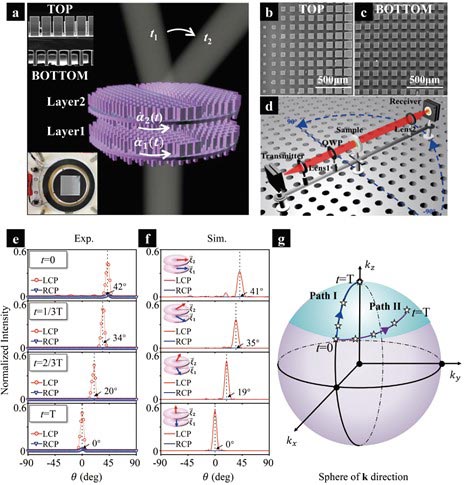
    Demonstration of the dynamic beam-steering metadevice: (a) Schematics of the metadevice, which consists of two layers of transmissive metasurfaces aligned by a motorized rotation stage. (b) Top view (left) and (c) bottom view (right) SEM pictures of the fabricated metadevice. (d) Schematics of the experimental setup shown to characterize the meta-device. (e) Experimental and (f) simulated far-field scattering power distributions with the metadevice illuminated by an LCP light at 0.7 THz, and evolving along Path I at different time instants. (g) Evolution of transmitted wave directions on the sphere of k direction as the metadevice moves along Path I and Path II, with solid line (star-symbols) denoting the simulated (experimental) results. Here, the blue region denotes the solid angle for beam-steering coverage. Credit: X. Cai et al., doi 10.1117/1.AP.3.3.036003

    Moreover, integrating active elements with individual meta-atoms inside passive metasurfaces allows for “active” metadevices that can dynamically manipulate EM wavefronts. While active elements in deep subwavelengths are easily found in the microwave regime (e.g., PIN diodes and varactors), and successfully contribute to active metadevices for beam-steering, programmable holograms, and dynamic imaging, they are difficult to create at frequencies higher than THz. This difficulty is due to size restrictions and significant ohmic losses in electronic circuits. Although THz frequencies can control THz beams in a uniform manner, they are typically unable to dynamically manipulate the THz wavefronts. This is ultimately due to deficiencies in the local-tuning capabilities at deep-subwavelength scales in this frequency domain. Therefore, developing new approaches that bypass reliance on local tuning is a priority.

    Rotating Multilayer Metasurfaces for Dynamic Control

    As reported in Advanced Photonics, researchers from Shanghai University and Fudan University developed a general framework and metadevices for achieving dynamic control of THz wavefronts. Instead of locally controlling the individual meta-atoms in a THz metasurface (e.g., via PIN diode, varactor, etc.), they vary the polarization of a light beam with rotating multilayer cascaded metasurfaces. They demonstrate that rotating different layers (each exhibiting a particular phase profile) in a cascaded metadevice at different speeds can dynamically change the effective Jones-matrix property of the whole device, achieving extraordinary manipulations of the wavefront and polarization characteristics of THz beams. Two metadevices are demonstrated: the first metadevice can efficiently redirect a normally incident THz beam to scan over a wide solid-angle range, while the second one can dynamically manipulate both wavefront and polarization of a THz beam.

    This work proposes an attractive alternative way to achieve low-cost dynamic control of THz waves. The researchers hope that the work will inspire future applications in THz radar, as well as bio- and chemical sensing and imaging.

    Reference: “Dynamically controlling terahertz wavefronts with cascaded metasurfaces” by Xiaodong Cai, Rong Tang, Haoyang Zhou, Qiushi Li, Shaojie Ma, Dongyi Wang, Tong Liu, Xiaohui Ling, Wei Tan, Qiong He, Shiyi Xiao and Lei Zhou, 26 June 2021, Advanced Photonics.
    DOI: 10.1117/1.AP.3.3.036003

    Never miss a breakthrough: Join the SciTechDaily newsletter.
    Follow us on Google and Google News.

    Electromagnetics Optics Photonics SPIE
    Share. Facebook Twitter Pinterest LinkedIn Email Reddit

    Related Articles

    Forget Wi-Fi This Laser Tech Hits 360 Gbps at Half the Power

    Miniature Black Hole? This New Device Swallows and Spits Out Light

    Parallel and Multiplexed: The New Wave of All-Optical Logic Operations

    Revolutionizing 3D: New Holographic Technique Breaks Computational Barriers

    Unleashing Photonic Power: Groundbreaking Advancements in Optical Computing

    Superconducting Silicon-Photonic Chip Developed for Quantum Communication

    New Holographic Light Collector Boosts Solar Panel Efficiency

    Extreme Events in Quantum Cascade Lasers Enable an Optical Neuron System 10,000× Faster Than Biological Neurons

    Engineers Design New LED-Based Train Headlight Optimized for Energy Savings

    Leave A Reply Cancel Reply

    • Facebook
    • Twitter
    • Pinterest
    • YouTube

    Don't Miss a Discovery

    Subscribe for the Latest in Science & Tech!

    Trending News

    Why Popular Diabetes Drugs Like Ozempic Don’t Work for Everyone: The “Genetic Glitch”

    Scientists Stunned After Finding Plant Thought Extinct for 60 Years

    Scientists Discover Tiny New Spider That Hunts Prey 6x Its Size

    Natural Component From Licorice Shows Promise for Treating Inflammatory Bowel Disease

    Scientists Warn: Popular Sweetener Linked to Dangerous Metabolic Effects

    Monster Storms on Jupiter Unleash Lightning Beyond Anything on Earth

    Scientists Create “Liquid Gears” That Spin Without Touching

    The Simple Habit That Could Help Prevent Cancer

    Follow SciTechDaily
    • Facebook
    • Twitter
    • YouTube
    • Pinterest
    • Newsletter
    • RSS
    SciTech News
    • Biology News
    • Chemistry News
    • Earth News
    • Health News
    • Physics News
    • Science News
    • Space News
    • Technology News
    Recent Posts
    • Ancient Bacteria Turned a DNA System Into a Cell Skeleton
    • Researchers Finally Solve 50-Year-Old Blood Group Mystery
    • Scientists Discover “Molecular Switch” That Fuels Alzheimer’s Brain Inflammation
    • Hidden Ocean Currents Revealed in Stunning Detail by AI
    • Trees Emit Tiny Lightning Flashes During Storms and Scientists Finally Prove It
    Copyright © 1998 - 2026 SciTechDaily. All Rights Reserved.
    • Science News
    • About
    • Contact
    • Editorial Board
    • Privacy Policy
    • Terms of Use

    Type above and press Enter to search. Press Esc to cancel.