
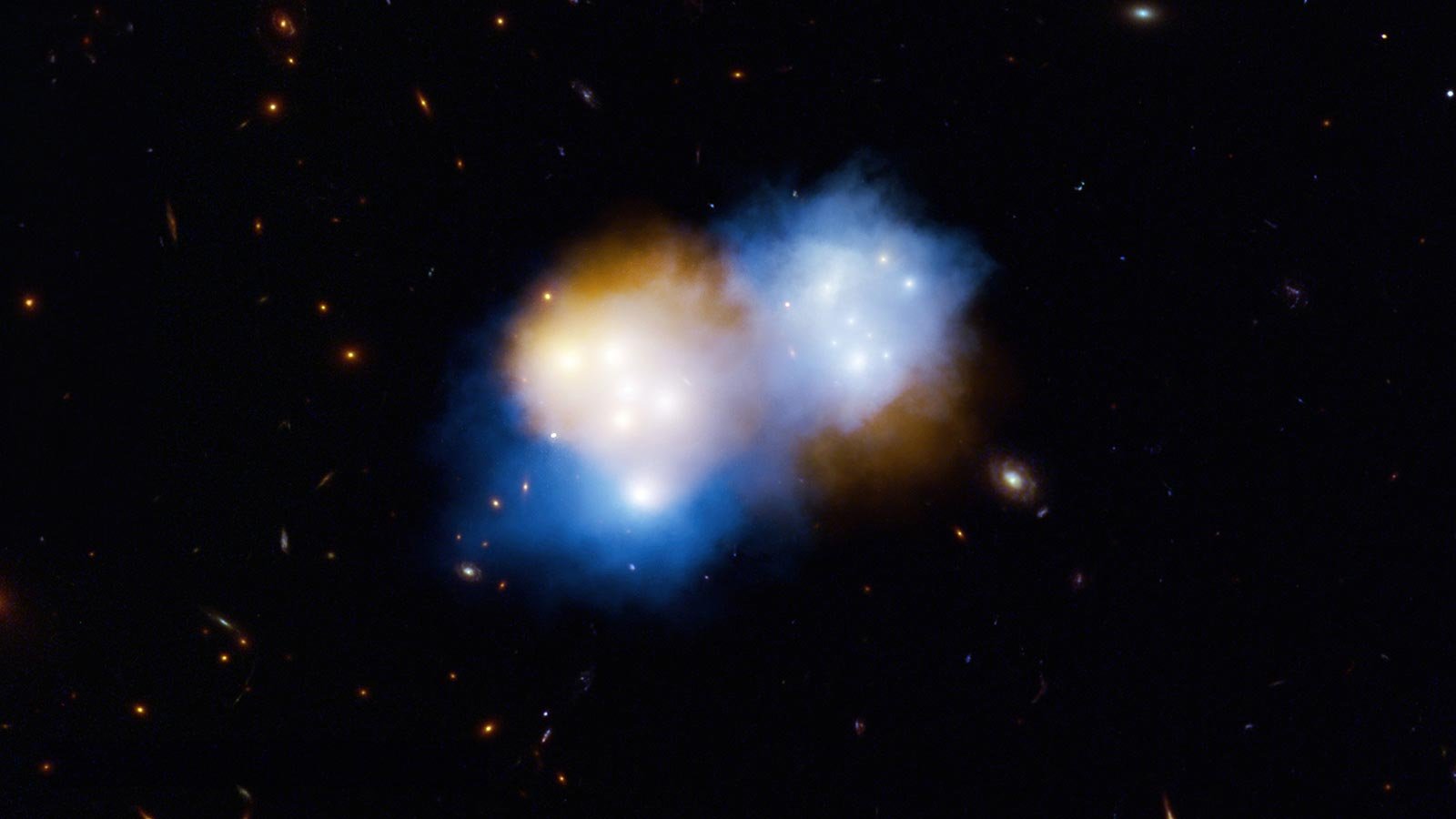
Astronomers have observed a unique collision between two galaxy clusters, revealing how dark matter and normal matter separate during such encounters.
Using a combination of advanced telescopes and observational techniques, including the SZ effect, researchers tracked the decoupled velocities of dark and normal matter. The study enhances our understanding of the mysterious nature of dark matter and sets the stage for future research.
Dark Matter Decoupling in Galaxy Clusters
Astronomers have untangled a messy collision between two massive clusters of galaxies in which the clusters’ vast clouds of dark matter have decoupled from the so-called normal matter. The two clusters each contain thousands of galaxies and are located billions of light-years away from Earth. As they plowed through each other, the dark matter—an invisible substance that feels the force of gravity but emits no light—sped ahead of the normal matter. The new observations are the first to directly probe the decoupling of the dark and normal matter velocities.
Glued together by the force of gravity, galaxy clusters are among the largest structures in the universe. Only 15 percent of the mass in such clusters is normal matter, the same matter that makes up planets, people, and everything you see around you. Of this normal matter, the vast majority is hot gas, while the rest is stars and planets. The remaining 85 percent of the cluster mass is dark matter.
This artist’s animation depicts a collision between two massive clusters of galaxies. As the collision progresses, the dark matter in the galaxy clusters (blue) moves ahead of the associated clouds of hot gas, or normal matter (orange). Animation credit: W.M. Keck Observatory/Adam Makarenko
Collision Dynamics and Matter Interaction
During the tussle that took place between the clusters, known collectivity as MACS J0018.5+1626, the individual galaxies themselves largely went unscathed because so much space exists between them. But when the enormous stores of gas between the galaxies (the normal matter) collided, the gas became turbulent and superheated. While all matter, including both normal matter and dark matter, interacts via gravity, the normal matter also interacts via electromagnetism, which slows it down during a collision. So, while the normal matter became bogged down, the pools of dark matter within each cluster sailed on through.

Think of a massive collision between multiple dump trucks carrying sand, suggests Emily Silich, lead author of a new study describing the findings in The Astrophysical Journal. “The dark matter is like the sand and flies ahead.” Silich is a graduate student working with Jack Sayers, research professor of physics at Caltech and principal investigator of the study.
Research Methodology and Observational Insights
The discovery was made using data from the Caltech Submillimeter Observatory (which was recently removed from its site on Maunakea in Hawai‘i and will be relocated to Chile), the W.M. Keck Observatory on Maunakea, NASA’s Chandra X-ray Observatory, NASA’s Hubble Space Telescope, the European Space Agency’s now-retired Herschel Space Observatory and Planck observatory (whose affiliated NASA science centers were based at Caltech’s IPAC), and the Atacama Submillimeter Telescope Experiment in Chile. Some of the observations were made decades ago, while the full analysis using all the datasets took place over the past couple of years.
Comparative Analysis With the Bullet Cluster
Such decoupling of dark and normal matter has been seen before, most famously in the Bullet Cluster. In that collision, the hot gas can be seen clearly lagging behind the dark matter after the two galaxy clusters shot through each other. The situation that took place in MACS J0018.5+1626 (referred to subsequently as MACS J0018.5) is similar, but the orientation of the merger is rotated, roughly 90 degrees relative to that of the Bullet Cluster. In other words, one of the massive clusters in MACS J0018.5 is flying nearly straight toward Earth while the other one is rushing away. That orientation gave researchers a unique vantage point from which to, for the first time, map out the velocity of both the dark matter and normal matter and elucidate how they decouple from each other during a galaxy cluster collision.
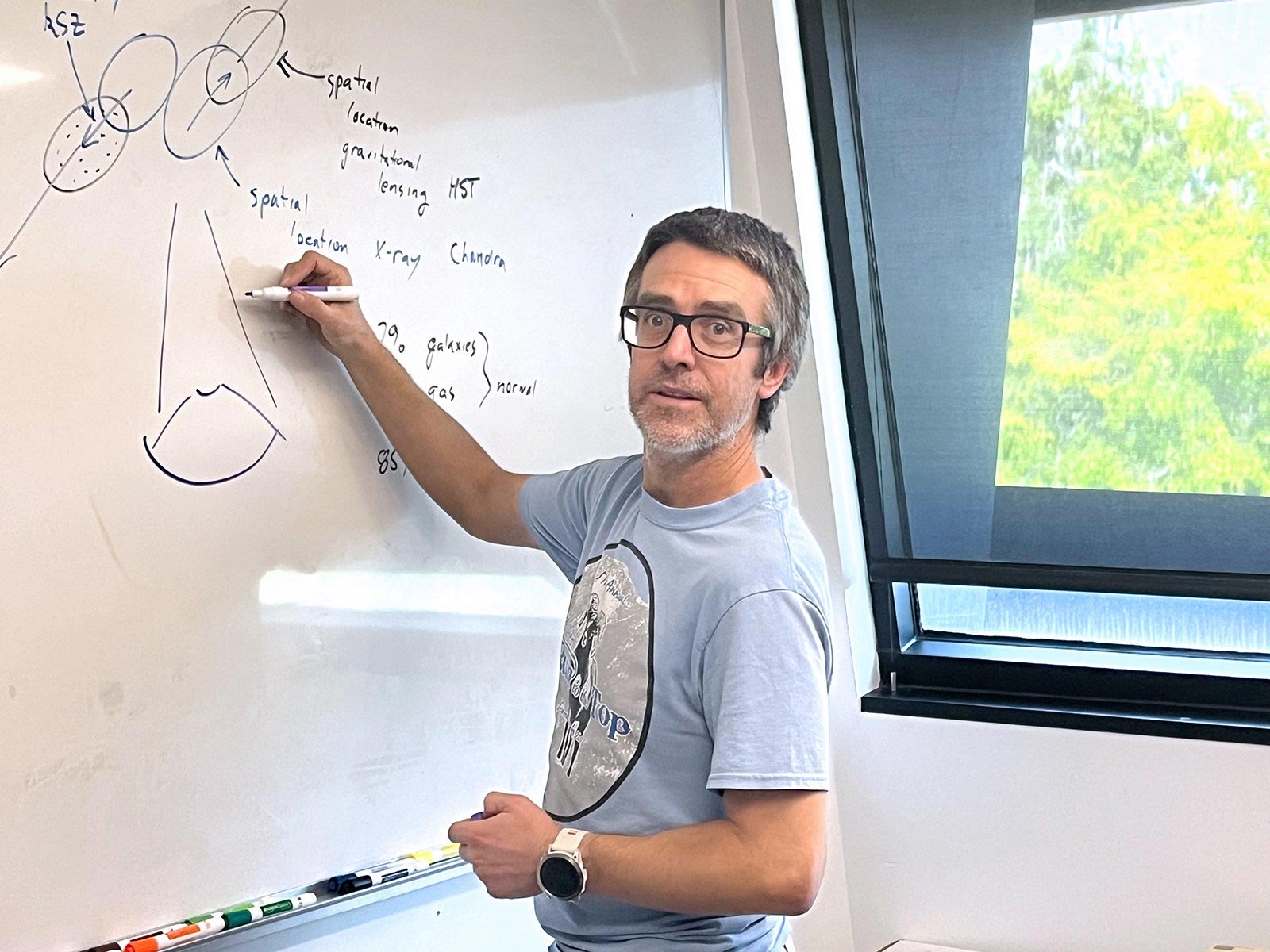
“With the Bullet Cluster, it’s like we are sitting in a grandstand watching a car race and are able to capture beautiful snapshots of the cars moving from left to right on the straightaway,” says Sayers. “In our case, it’s more like we are on the straightaway with a radar gun, standing in front of a car as it comes at us and are able to obtain its speed.”
Measuring Matter Velocities Using the SZ Effect
To measure the speed of the normal matter, or gas, in the cluster, researchers used an observational method known as the kinetic Sunyaev-Zel’dovich (SZ) effect. Sayers and his colleagues made the first observational detection of the kinetic SZ effect on an individual cosmic object, a galaxy cluster named MACS J0717, back in 2013, using data from CSO (the first SZ effect observations taken of MACS J0018.5 date back to 2006).
The kinetic SZ effect occurs when photons from the early universe, the cosmic microwave background (CMB), scatter off electrons in hot gas on their way toward us on Earth. The photons undergo a shift, called a Doppler shift, due to the motions of the electrons in the gas clouds along our line of sight. By measuring the change in brightness of the CMB due to this shift, researchers can determine the speed of gas clouds within galaxy clusters.
This poem excerpt, written by Emily Silich, a Caltech graduate student in astronomy, was inspired by her studies of collisions between massive clusters of galaxies. In fact, she wrote it during the many hours while her analysis of simulations of galaxy cluster collisions ran on hundreds of computer cores.
t = zero:
particles initialized,
gas defined as air.Opposing dipoles
traversing as livid breath
sans its collisions.Magma-colorized,
decoupling from itself in
tumultuous twistsfrom tessellations.
An issue of memory
nonessential forepochs defined by
some time within another;
Parallel elapse.The full poem was published as part of a collection in the Altadena Poetry Review Anthology.
The Role of Advanced Observatories and Future Prospects
“The Sunyaev-Zeldovich effects were still a very new observational tool when Jack and I first turned a new camera at the CSO on galaxy clusters in 2006, and we had no idea there would be discoveries like this,” says Sunil Golwala, professor of physics and Silich’s faculty PhD advisor. “We look forward to a slew of new surprises when we put next-generation instruments on the telescope at its new home in Chile.”
By 2019, the researchers had made these kinetic SZ measurements in several galaxy clusters, which told them the speed of the gas, or normal matter. They had also used Keck to learn the speed of the galaxies in the cluster, which told them by proxy the speed of the dark matter (because the dark matter and galaxies behave similarly during the collision). But at this stage in the research, the team had a limited understanding of the orientations of the clusters. They only knew that one of them, MACS J0018.5, showed signs of something strange going on—the hot gas, or normal matter, was traveling in the opposite direction to the dark matter.
Challenges and Breakthroughs in Understanding Dark Matter
“We had this complete oddball with velocities in opposite directions, and at first we thought it could be a problem with our data. Even our colleagues who simulate galaxy clusters didn’t know what was going on,” Sayers says. “And then Emily got involved and untangled everything.”
For part of her PhD thesis, Silich tackled the conundrum of MACS J0018.5. She turned to data from the Chandra X-ray Observatory to reveal the temperature and location of the gas in the clusters as well as the degree to which the gas was being shocked. “These cluster collisions are the most energetic phenomena since the Big Bang,” Silich says. “Chandra measures the extreme temperatures of the gas and tells us about the age of the merger and how recently the clusters collided.” The team also worked with Adi Zitrin of the Ben-Gurion University of the Negev in Israel to use Hubble data to map the dark matter using a method known as gravitational lensing.
Additionally, John ZuHone of the Center for Astrophysics at Harvard & Smithsonian helped the team simulate the cluster smashup. These simulations were used in combination with data from the various telescopes to ultimately determine the geometry and evolutionary stage of the cluster encounter. The scientists found that, prior to colliding, the clusters were moving toward each other at approximately 3000 kilometers/second, equal to roughly one percent of the speed of light.
With a more complete picture of what was going on, the researchers were able to figure out why the dark matter and normal matter appeared to be traveling in opposite directions. Though the scientists say it’s hard to visualize, the orientation of the collision, coupled with the fact that dark matter and normal matter had separated from each other, explains the oddball velocity measurements.
Conclusion and Future Research Directions
In the future, the researchers hope that more studies like this one will lead to new clues about the mysterious nature of dark matter. “This study is a starting point to more detailed studies into the nature of dark matter,” Silich says. “We have a new type of direct probe that shows how dark matter behaves differently from normal matter.”
Sayers, who recalls first collecting the CSO data on this object almost 20 years ago, says, “It took us a long time to put all the puzzle pieces together, but now we finally know what’s going on. We hope this leads to a whole new way to study dark matter in clusters.”
Reference: “ICM-SHOX. I. Methodology Overview and Discovery of a Gas–Dark Matter Velocity Decoupling in the MACS J0018.5+1626 Merger” by Emily M. Silich, Elena Bellomi, Jack Sayers, John ZuHone, Urmila Chadayammuri, Sunil Golwala, David Hughes, Alfredo Montaña, Tony Mroczkowski, Daisuke Nagai, David Sánchez-Argüelles, S. A. Stanford, Grant Wilson, Michael Zemcov and Adi Zitrin, 12 June 2024, The Astrophysical Journal.
DOI: 10.3847/1538-4357/ad3fb5
The study was funded by the National Science Foundation, the Wallace L. W. Sargent Graduate Fellowship at Caltech, the Chandra X-ray Center, the United States-Israel Binational Science Foundation, the Ministry of Science & Technology in Israel, the AtLAST (Atacama Large Aperture Submillimeter Telescope) project, and the Consejo Nacional de Humanidades Ciencias y Technologías.
Never miss a breakthrough: Join the SciTechDaily newsletter.
Follow us on Google and Google News.
18 Comments
“They had also used Keck to learn the speed of the galaxies in the cluster, which told them by proxy the speed of the dark matter (because the dark matter and galaxies behave similarly during the collision).”
Pretty confusing. It’s apparently like the Bullet Cluster in some respects. People are convinced the BC also shows dark matter clumps being displaced from luminous cluster matter clumps, but frankly the alleged displacements are not at all evident to an unbiased observer, and the x-ray data in red always included in the standard BC picture serves only to hinder any observation of lagging DM in blue
Here an orange color is similarly used to brighten the central region, which no doubt helps to sell the point that clumps of DM in blue are acting independently from clumps of LM (luminous matter) shown in some mysterious hot mix of white and orange, with DM moving past a collision point faster than the LM thought to be involved. It’s also not clear from the picture which LM sources are too far in front or behind the cluster to matter. To sum it up there’s never any wonder why DM articles traditionally lead with artist’s impressions.
One might expect a significant amount of unusually hot matter should be left behind as it’s the most strongly interacting portion of the collision.
Someone suggested the distracting redness in the Bullet Cluster x-ray data doesn’t create any confusion about where the most luminous matter is concentrated, since there are SR’s relativistic hot mass increases to consider, which is of course ridiculous but could easily help conceal an obvious inability to distinguish normal cosmological cold matter from DM.
It is unclear (to me) what you want to say.
The Bullet Cluster observations speak for themselves (and I haven’t looked at the mass of papers there) and dark matter [DM] is “normal cosmological cold matter”.
The paper similarly speaks for itself, regardless of the artist impression which is *very* loosely based on the model assumptions and shouldn’t be used to understand what the work does and show. What the paper illustrates is how the observer dipole flips due to viewing angle and the normal matter lagging the dark matter, the very oddity that they wanted to explore in the first place.
“Figure 11. Simple 2D illustration of an induced rotational offset between the DM and ICM velocity dipoles in projection when observed along the merger axis (left) and offset from the merger axis in the plane of the merger (right). In this simple schematic, which assumes only that the ICM distribution lags the DM distribution as the merger evolves near the pericenter passage, the DM/ICM dipole alignment flips from 0 degrees to 180 degrees.”
“dark matter [DM] is ‘normal cosmological cold matter’”
Fool, you know DM is ALWAYS identified as to kids as exotic and only capable of interactions with normal matter through gravity, but good for you, you didn’t let that get in the way of being a standard Einsteinian gravity scarecrow.
It is unclear (to me) what you want to say.
But you’re a special pretender slash contrarian, a precise contrary indicator with a team-reddit aroma including a standard special precious mix of super-extremely obscure worthless wonky jargon combined with pointed kiddie-level critical insights, inevitably centered around Einstein’s peerless prickly gravity field scarecrow brilliance which, through some mysterious money-oriented osmosis inspires you to imagine a degree of outreach effectiveness. Feed your inner fascist, have a rainbow cookie and remember the future is preordained according to your messiah of gravity.
“What the paper illustrates is how the observer dipole flips due to viewing angle and the normal matter lagging the dark matter…”
“Figure 11. Simple 2D illustration of an induced rotational offset between the DM and ICM velocity dipoles in projection when observed along the merger axis (left) and offset from the merger axis in the plane of the merger (right). In this simple schematic, which assumes only that the ICM distribution lags the DM distribution as the merger evolves near the pericenter passage, the DM/ICM dipole alignment flips from 0 degrees to 180 degrees.”
Nice wonky but superficial analysis founded on too many data manipulation assumptions for anyone, even an Einsteinian hit-and-run outreach artist, to attempt to list. Suppose especially compact gravity sources creates an unexpected effect “aura” in the form of a galaxy-scaled inverse-square-damped “ripple” gravity pattern and even a larger, cluster-scaled, ripple gravity pattern.
Being surrounding “aura” ripples (stationarily “frozen” for stationary sources) they largely cancel in places between sources. So, for two separating auras, mutual interference is minimal for the leading and following ripple-pattern edges.
“It is unclear (to me) what you want to say.”
Classic hit-and-run response lead-up from you. It’s a language problem that keeps you forever blind and clueless, that’s got to be it, right?
For average readers, they should also mention that 20 year observation gave scientists only 0.01% displacement idea of the actual million year collision process to calculate the process data.
When normal and dark matter speed is the same, the lagging cloud shouldn’t matter in the speed measurement.
They don’t try to constrain the speeds, what they wanted to see if they could explain the odd dipole observations due to the viewing angle and the collision (at different speeds). And they could. Some other constraints dropped out from the simulation description:
“We constrain the MACS J0018.5+1626 cluster component masses and gas profiles, as well as global system properties: viewing angle, epoch, initial impact parameter, and initial relative velocity.”
Having your expectations defied in science comes if you can’t even define the thing you’re studying. And if that thing doesn’t really exist, it will defy ALL your expectations.
I’m tempted to add, since the two first comments seem genuinely interested yet does not seem to grapple with the extensive work the scientists put in to make a satisfying explanation, from the very early days of the web:
“RTFM!” 🙀
[I’m not saying I grappled with it either, I speed read the parts that went into answering the questions those and my own queries raised. Any mistakes are mine.]
For the last comment, alas, unfounded personal opinion has no value in science or on science sites. Dark matter is of course since many years well observed by many independent means in many independent surveys, and – somewhat ironically here – “What is claimed without evidence can be dismissed without evidence.” 😁
Site warning: the comment box posting filter censors explicit language used outside US. 🙀🙀🙀
This kind of confirms my thoughts that Dark Mater is repelled by Normal Mater. So, the solar system has been here for 4.5 Billion years, and has had all that time to push all the Dark Mater away. That’s why we have never seen any indications of Dark Mater, it’s simply not here. You won’t find Dark Mater anywhere around here because it has been driven out by all this normal mater here. To find Dark Mater, you would have to get far away from our solar system to have any hope of detecting Dark Mater.
Colliding galaxies and here is me thinking that they are all rushing away from each other like those proverbial spots on the expanding balloon.
Despite this thread being graced by the expert troll in the cat suit, there’s nothing “normal” about something that occupies ~85% of the mass of the universe and supposedly exists locally despite that it’s little more than another Einsteinian over-reach hallucination about bent “spacetime” enabling “c” to act as if it’s truly constant. Read about the guy who imagined gravity bending light so hard it could produce a star that emitted no light, apparently over 100 years before Einstein, and so well known I’d never heard of him that I can recall in over 50 years of being interested in gravity and science history.
Analyzing any complicated paper on DM is a waste of time.
I’ll make it simple – Suppose here that, embedded within the well-known inverse-square Newtonian-type gravity effect, there is a “ripple-shaped” surrounding “aura” carrying wavelengths of radiated gravitational energy flow, existing on both the standard galactic scale and standard cluster scales. Such ripples are stationarily “frozen” for a positionally “frozen” gravity source.
Ripples naturally cancel in places midway between sufficiently separated ripple centers, leaving the leading edges of two separating sources on both ends relatively unaffected by the interference, relatively amplifying their gravity “Dark Matter” effect impact.