
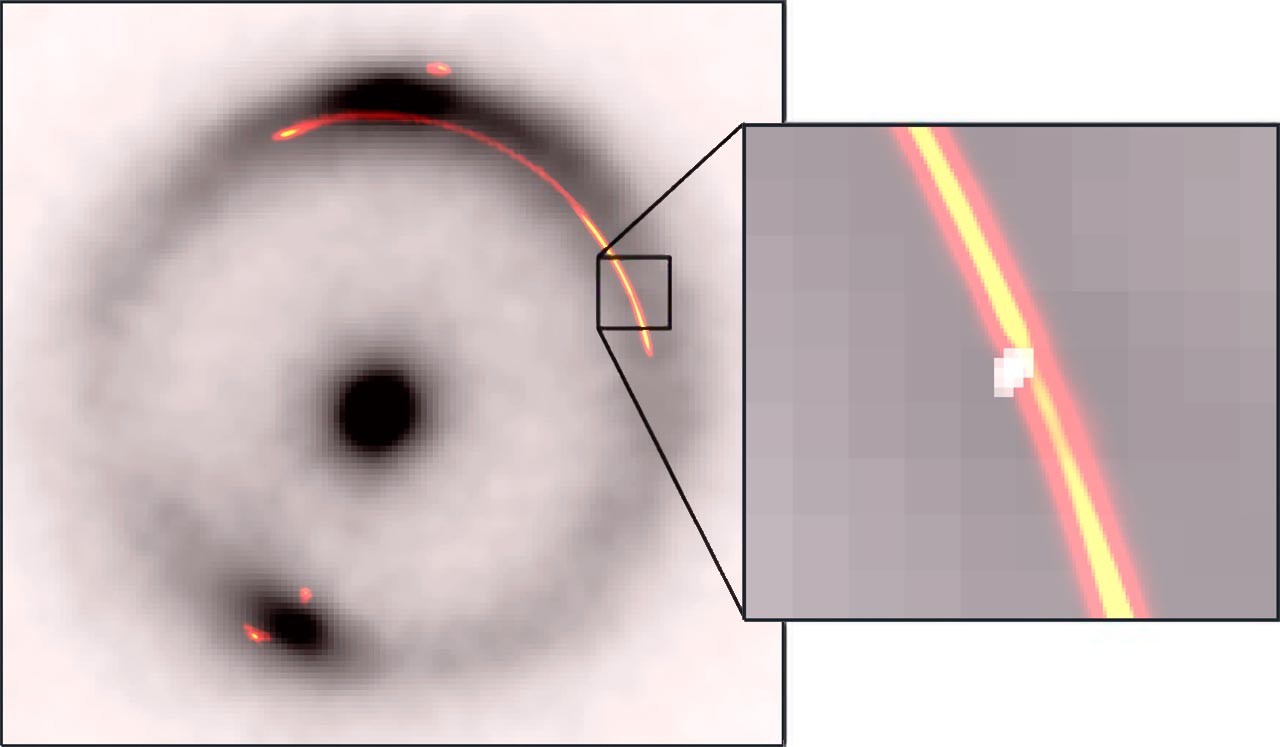
Astronomers have identified the universe’s lowest-mass dark object by observing its faint gravitational distortion of light.
The hidden mass, roughly a million times the weight of the Sun, may be either a dense knot of dark matter or a tiny, inactive galaxy. The discovery supports existing dark matter theories and proves that current technology can detect even smaller, invisible structures in space.
Discovery of a Tiny Cosmic Enigma
Astronomers have used a worldwide system of telescopes to identify the smallest dark object ever detected in the universe. Finding more of these faint, hidden masses and learning what they are could help scientists eliminate certain explanations for dark matter, the mysterious material believed to make up about a quarter of all matter in existence. The discovery is detailed in two studies published on October 9 in Nature Astronomy and the Monthly Notices of the Royal Astronomical Society.
Since this object emits no light or detectable radiation, astronomers spotted it by observing how its gravity warped light traveling nearby, a phenomenon known as gravitational lensing. By studying the subtle distortion of light, researchers were able to estimate how much matter the invisible object contains.
The object is so small that its presence appeared only as a tiny “pinch” within the warped image created by a much larger gravitational lens, similar to a slight imperfection in a funhouse mirror.
What the Finding Means for Dark Matter
“It’s an impressive achievement to detect such a low mass object at such a large distance from us,” said Chris Fassnacht, professor in the Department of Physics and Astronomy at the University of California, Davis, who is a co-author on the Nature Astronomy paper. “Finding low-mass objects such as this one is critical for learning about the nature of dark matter.”
The newly found object has an estimated mass about one million times that of the Sun. Its true identity remains uncertain: it could be a dense clump of dark matter roughly 100 times smaller than any previously discovered, or perhaps a very compact, inactive dwarf galaxy.
Though invisible except for its gravitational pull, dark matter is thought to influence how galaxies, stars, and other visible matter are arranged throughout the universe. One of the central questions in astronomy is whether dark matter can exist in small, starless clumps. Proving or disproving that idea could help scientists refine or overturn current theories about what dark matter really is.
Building an Earth-Sized Telescope
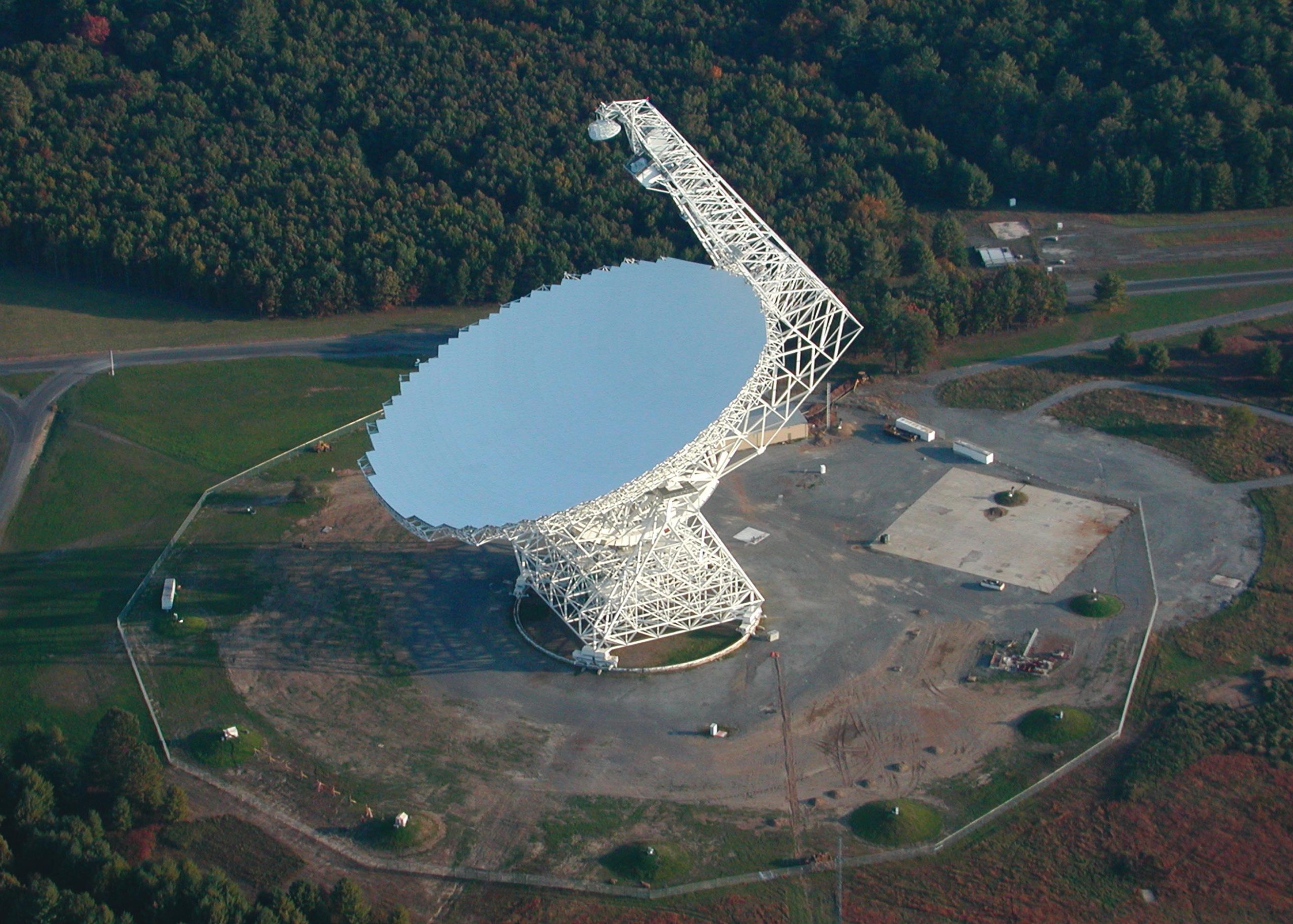
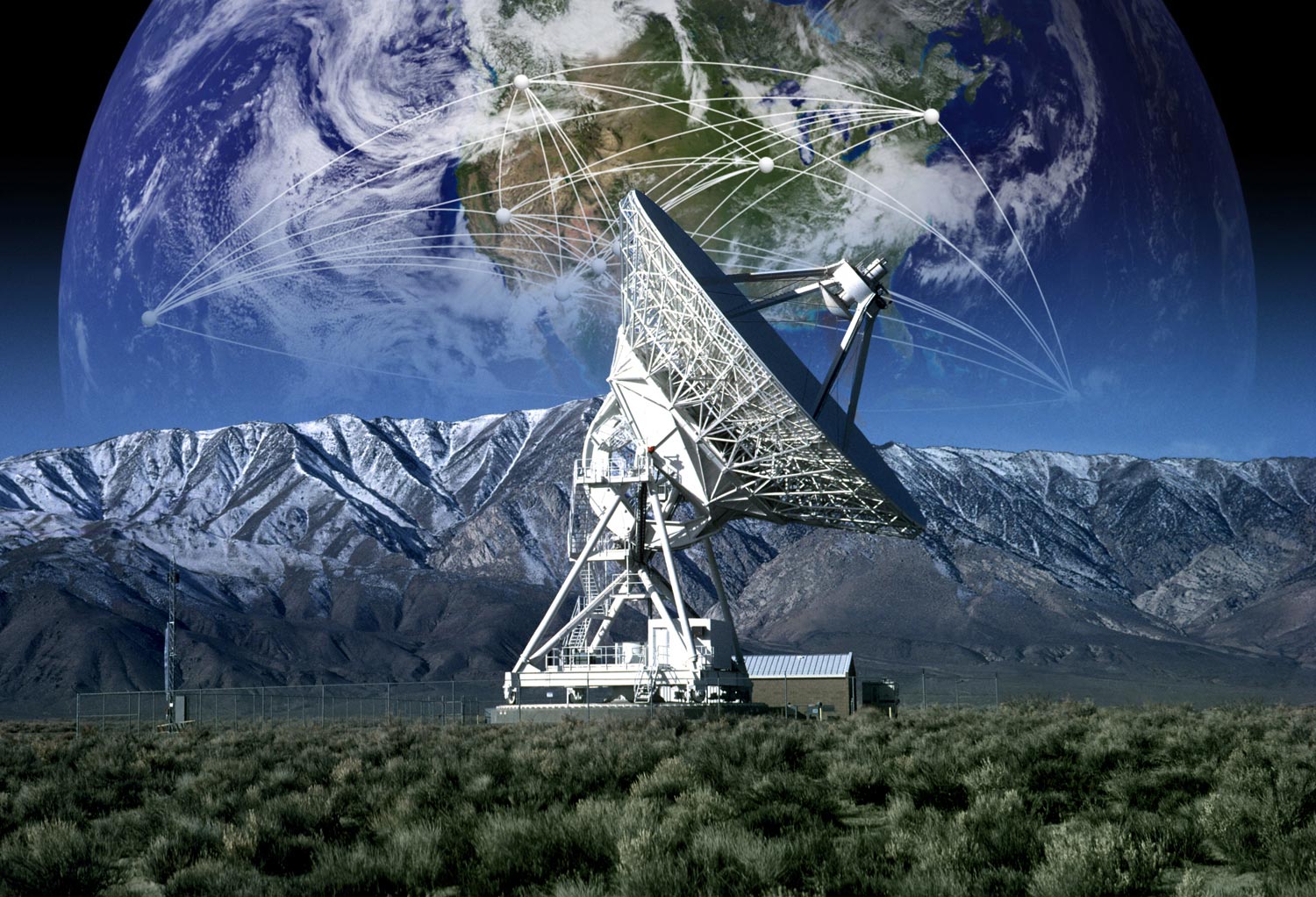
The team used instruments including the Green Bank Telescope (GBT), West Virginia; the Very Long Baseline Array (VLBA), Hawaiʻi; and the European Very Long Baseline Interferometric Network (EVN), which includes radio telescopes in Europe, Asia, South Africa and Puerto Rico to create an Earth-sized super-telescope, to capture the subtle signals of gravitational lensing by the dark object.
A Breakthrough for the Cold Dark Matter Theory
It is by a hundred-fold the lowest mass object yet found by this technique, suggesting that the method could be used to find other, similar objects.
“Given the sensitivity of our data, we were expecting to find at least one dark object, so our discovery is consistent with the so-called ‘cold dark matter theory’ on which much of our understanding of how galaxies form is based,” said lead author Devon Powell at the Max Planck Institute for Astrophysics (MPA), Germany. “Having found one, the question now is whether we can find more and whether the numbers will still agree with the models.”
Next Steps in the Cosmic Hunt
The team is further analyzing the data to better understand the nature of the dark object, and also looking for more examples of such dark objects in other parts of the sky.
References:
“A million-solar-mass object detected at a cosmological distance using gravitational imaging” by D. M. Powell, J. P. McKean, S. Vegetti, C. Spingola, S. D. M. White and C. D. Fassnacht, 9 October 2025, Nature Astronomy.
DOI: 10.1038/s41550-025-02651-2
“An extended and extremely thin gravitational arc from a lensed compact symmetric object at redshift of 2.059” by J P McKean, C Spingola, D M Powell and S Vegetti, 9 October 2025, Monthly Notices of the Royal Astronomical Society: Letters.
DOI: 10.1093/mnrasl/slaf039
Additional authors are: John McKean, University of Groningen, the Netherlands, South African Radio Observatory and University of Pretoria; Simona Vegetti, MPA; Cristiana Spingola, Istituto di Radioastronomia, Bologna; and Simon D. M. White, MPA.
The work was supported in part by the European Research Council, the Italian Ministry of Foreign Affairs and International Cooperation and the National Research Foundation of South Africa. The National Radio Astronomy Observatory is a facility of the U.S. National Science Foundation.
Never miss a breakthrough: Join the SciTechDaily newsletter.
Follow us on Google and Google News.
4 Comments
There is plenty of margin in the tools used/applied in gravitational lensing observations and analysis, including Bayesian inferencing and initial lens mass model assumptions that go into the prior distributions. I’m skeptical of the results and their interpretation that it is a small clump of starless DM.
In my opinion, the Kelvin scale of temperature from zero to infinity is causing problems in theoretical physics. It should be from infinity to negative infinity, like other temperature scales. Then, approximately 0.75K will represent a neutral temperature at which a body is neither hot not cold. Below that, bodies can be treated as actually cold, not relatively cold. Black holes are cold bodies that do not emit any thermal radiations, but absorbs all, thus becoming dark. No minimum mass is required if black holes are just cold bodies. So, what is observed is just a black hole, not any dark matter.
If you describe infinity and negative infinity as singularities, the math becomes simpler. Take any two rational numbers and put a exponent of zero behind them, what do you get? The same value. Works for large and small scales of the Universe, too.
A small galaxy, star cluster or low mass super massive black hole could all probably explain the lens while not being readily observable from our perspective in time and space(not luminous enough to be seen) so yeah I don’t think you can conclusively claim it’s dark matter.