
For nearly a century, dark matter has lurked unseen, shaping galaxies while refusing to reveal itself. Now, new gamma-ray data from NASA’s Fermi Telescope may have caught its elusive signature.
A University of Tokyo astronomer believes he has detected the exact high-energy photons predicted when hypothetical WIMP particles collide and annihilate—potentially giving humanity its first direct glimpse of dark matter.
Early Clues Pointing to Dark Matter
In the early 1930s, Swiss astronomer Fritz Zwicky noticed that many galaxies were moving far faster than their visible mass could account for. This led him to propose that an unseen structure — dark matter — was providing the extra gravitational pull needed to keep these galaxies intact. Nearly a century later, data from NASA’s Fermi Gamma-ray Space Telescope may offer the first direct glimpse of this hidden material, potentially allowing scientists to “see” dark matter for the first time.
Why Dark Matter Has Been So Difficult to Detect
Dark matter has puzzled researchers since Zwicky first suggested its existence. Until now, scientists have only been able to study it indirectly by watching how it affects stars and galaxies, such as by generating enough gravity to keep galactic systems from flying apart. The reason it cannot be viewed directly is that its particles do not interact with electromagnetic force — meaning they do not absorb, reflect, or emit light.
WIMPs and the Search for Gamma Ray Clues
Many scientists suspect that dark matter consists of weakly interacting massive particles, or WIMPs. These particles are thought to be heavier than protons and interact very little with normal matter. Even so, theory predicts that when two WIMPs collide, they annihilate each other and release energetic particles, including gamma-ray photons.
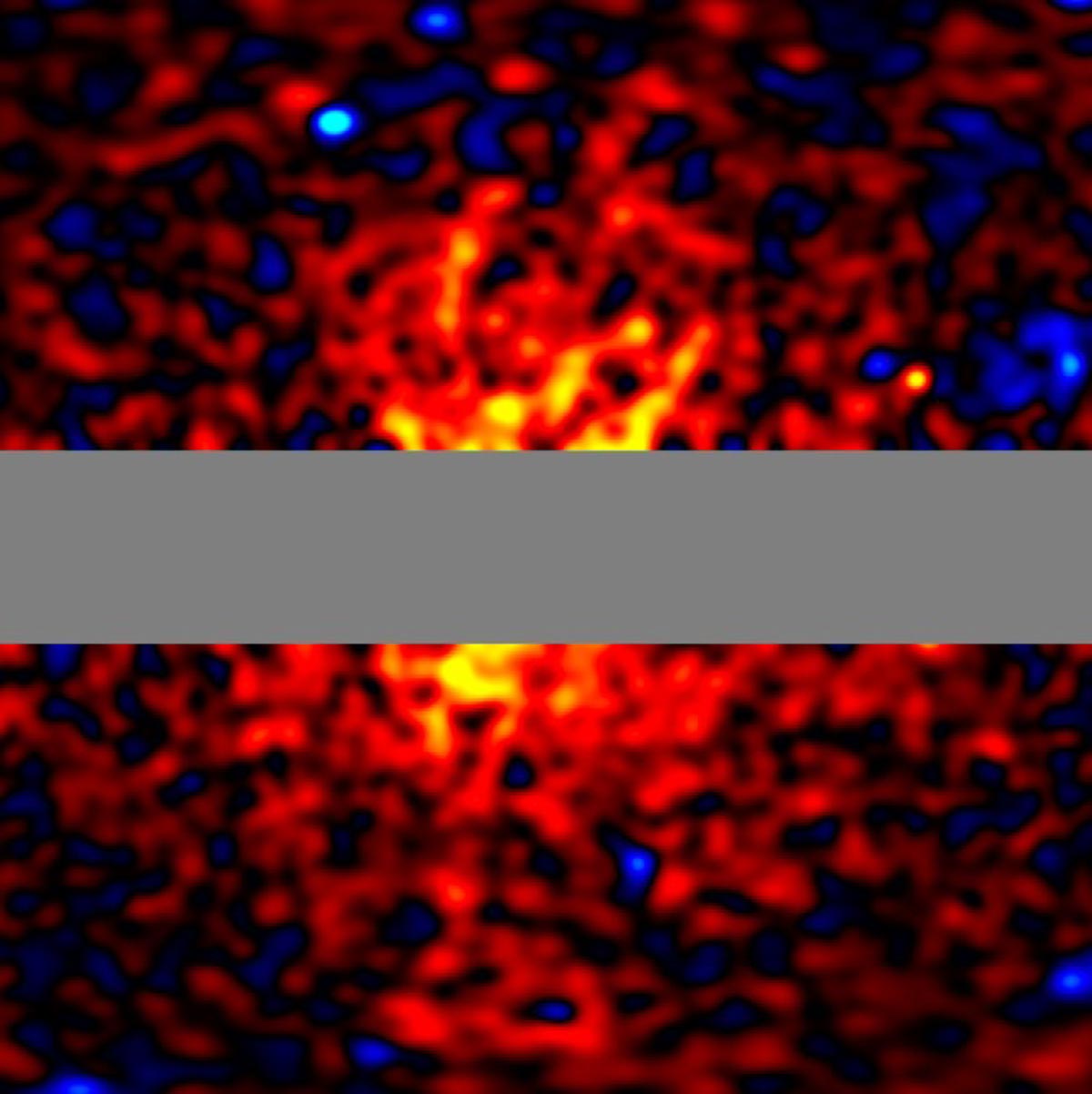
Because of this possibility, astronomers have spent years studying areas where dark matter should be most abundant, including the center of the Milky Way. Professor Tomonori Totani of the University of Tokyo used new observations from the Fermi Gamma-ray Space Telescope to look for these expected signals. He now believes he has identified gamma rays consistent with the predicted results of dark matter particle annihilation.
Totani’s findings were published today (November 26) in the Journal of Cosmology and Astroparticle Physics.
A 20-GeV Gamma Ray Halo Around the Milky Way
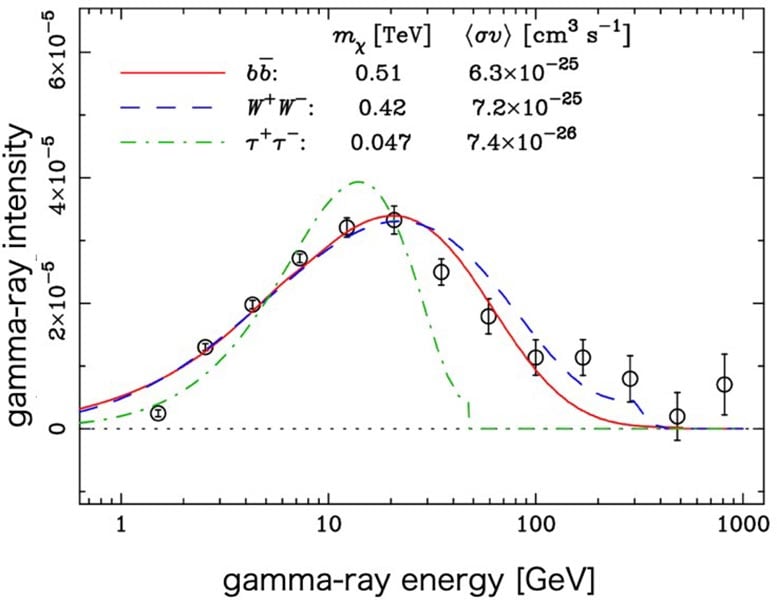
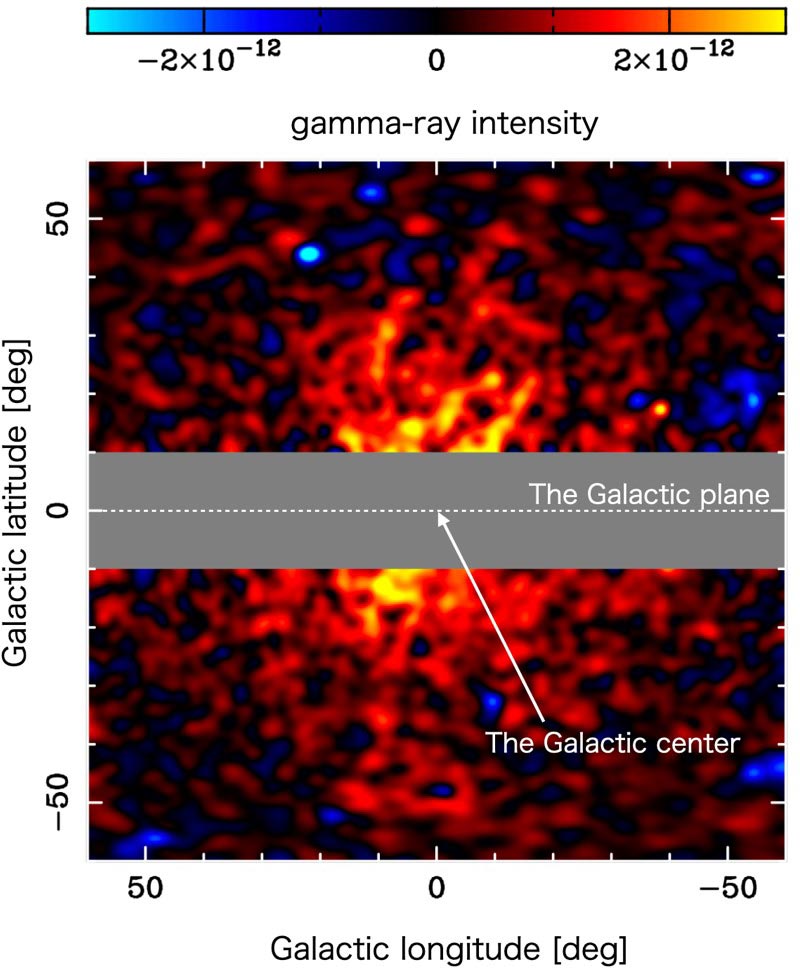
“We detected gamma rays with a photon energy of 20 gigaelectronvolts (or 20 billion electronvolts, an extremely large amount of energy) extending in a halolike structure toward the center of the Milky Way galaxy. The gamma-ray emission component closely matches the shape expected from the dark matter halo,” said Totani.
Further analysis shows that the energy spectrum, or distribution of gamma ray intensities, aligns with the levels predicted for the annihilation of hypothetical WIMPs with masses about 500 times that of a proton. The estimated rate of WIMP annihilation based on the gamma-ray brightness also fits within established theoretical expectations.
A Promising Signal, But Still Under Review
Totani notes that the measurements cannot be easily explained by other known astronomical processes or common sources of gamma rays. Because of this, he views the data as a strong potential indication of dark matter emission, something researchers have been trying to detect for decades.
“If this is correct, to the extent of my knowledge, it would mark the first time humanity has ‘seen’ dark matter. And it turns out that dark matter is a new particle not included in the current standard model of particle physics. This signifies a major development in astronomy and physics,” said Totani.
Next Steps Toward Confirming the Discovery
Despite his confidence, Totani emphasizes that these results must be independently verified by other researchers. Even if his findings are confirmed, scientists will still seek further evidence to ensure that the halolike radiation truly comes from dark matter annihilation rather than another cosmic source.
One way to strengthen the case is by identifying similar gamma ray signals in other places with dense concentrations of dark matter. Dwarf galaxies within the Milky Way halo are considered especially promising candidates. “This may be achieved once more data is accumulated, and if so, it would provide even stronger evidence that the gamma rays originate from dark matter,” said Totani.
Reference: “20 GeV halo-like excess of the Galactic diffuse emission and implications for dark matter annihilation” by Tomonori Totani, 26 November 2025, Journal of Cosmology and Astroparticle Physics.
This work was supported by JSPS/MEXT KAKENHI Grant Number 18K03692.
Never miss a breakthrough: Join the SciTechDaily newsletter.
Follow us on Google and Google News.
6 Comments
Sick and neck pain and honestly
And then again, they may have not.
This genius assay finally proofed the dark matters made by extreme kenetic particles! My best gest, the dark energy is the same thing keeping the kenetic state or called axile tone.
This genius assay finally proofed the dark matters made by extreme kenetic particles! My best gest, the dark energy is the same thing keeping the kenetic state or called axile tron.
I’m SO sick of hearing about Dark Matter when they literally MADE IT UP as a math kludge to explain why gravity didn’t behave the way “it’s supposed to” yet gravity is a big unknown in physics. These asinine “scientists” like to pretend they know how it works, but they don’t and can’t admit it! Anything made up as a mat kludge isn’t real! It’s like imaginary numbers. It works mathematically, but they don’t exist! You can’t find the real answer if you aren’t looking for it!
See Alzheimers. They are stuck on that plaque when there are a lot of people with loads of plaques don’t have Alzheimers! It’s blatantly obvious to this outsider scientist the real cause are two viral infections that re-occur (Shingles and Herpes) and sometimes go right through the brain instead of your back or lips! The body attacks them (causing plaques), but the damage and the disease is from the viruses! They can’t really treat those, though so they look at the symptoms instead of the cure!
I know the Higgs-Boson “find” at CERN was bogus as well. They aren’t one step closer to understanding gravity. They called some random squiggle on the cloud chamber a match, but it’s bogus. They are DESPARATE to keep the money coming in at CERN and keep their jobs when the entire place is a giant pile of burning money!
Alberto, Care to post a list of your peer-reviewed articles on physic and/or cosmology?