
A strange energy source at the center of the Milky Way may be a new type of dark matter.
Scientists found that hydrogen gas there is ionized in an unexpected way, which cosmic rays can’t explain. Instead, they propose that lightweight dark matter particles are colliding and producing charged particles. This could reshape how we think about dark matter and its role in the universe.
Mysterious Signals from the Galactic Core
A strange phenomenon at the center of our galaxy might be linked to a new type of dark matter.
Dark matter, an invisible substance thought to make up 85% of the universe’s mass, remains one of science’s greatest mysteries. Despite decades of research, its true nature is still unknown.
Now, in a groundbreaking study, scientists have uncovered a potential clue. They suggest that an alternative form of dark matter could be responsible for unexplained chemical reactions happening in the Milky Way.
A Possible New Energy Source Identified
Dr. Shyam Balaji, a postdoctoral research fellow at King’s College London and one of the study’s lead authors, explains: “At the center of our galaxy sit huge clouds of positively charged hydrogen, a mystery to scientists for decades because normally the gas is neutral. So, what is supplying enough energy to knock the negatively charged electrons out of them?
“The energy signatures radiating from this part of our Galaxy suggest that there is a constant, roiling source of energy doing just that, and our data says it might come from a much lighter form of dark matter than current models consider.”
The most established theory for dark matter is that it is likely a group of particles known as ‘Weakly Interacting Massive Particles’ (WIMPs), which pass through regular matter without much interaction, making them extremely hard to detect.
However, this study, published on March 10 in Physical Review Letters, has potentially revived another type of dark matter with a much lower mass than a WIMP.
Tiny Particles, Big Consequences
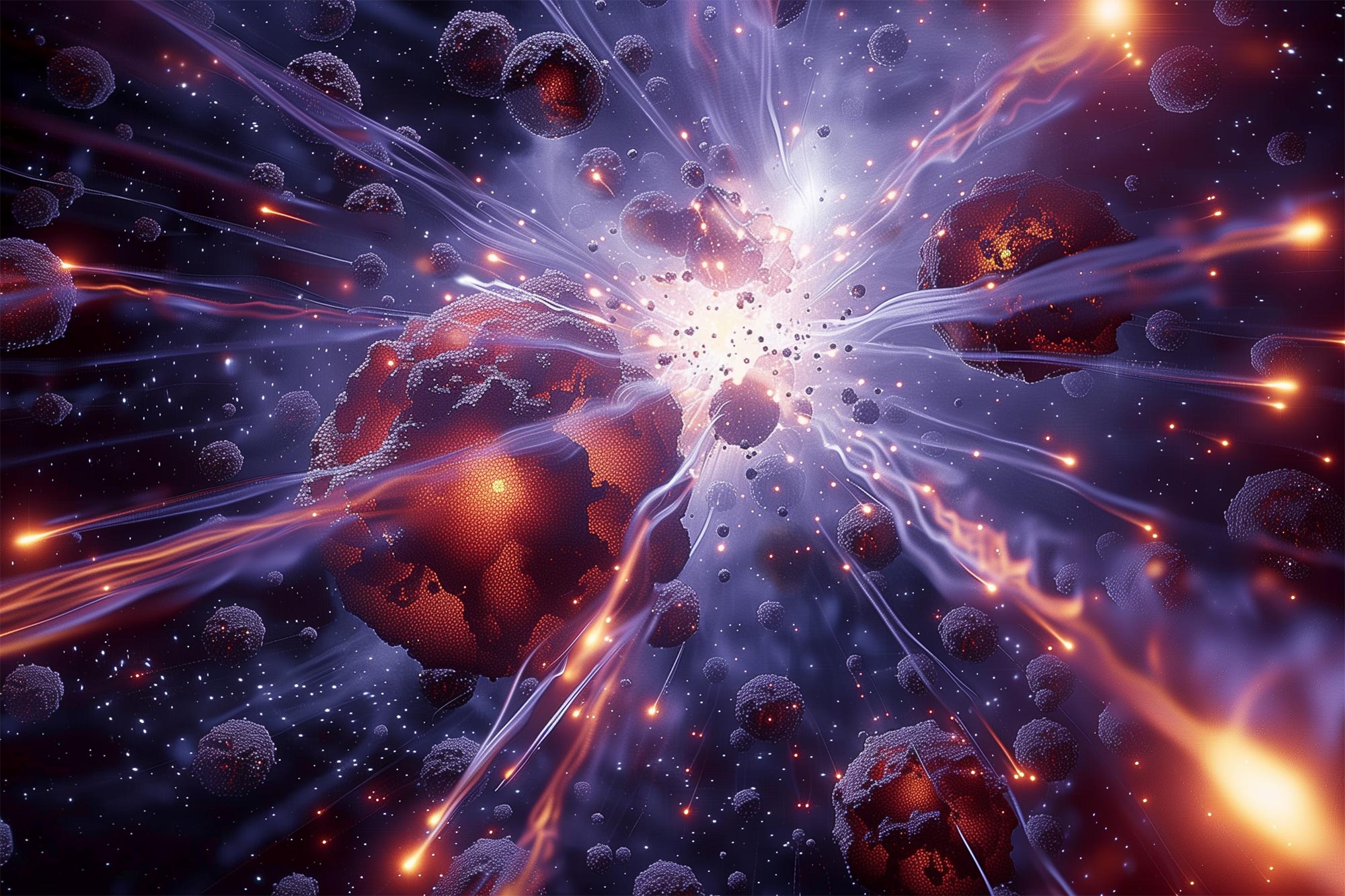
The researchers think that these tiny dark matter particles are crashing into each other and producing new charged particles in a process called ‘annihilation’. These newly produced charged particles can subsequently ionize the hydrogen gas.
Previous attempts to explain this ionization process had relied on cosmic rays, fast and energetic particles that travel throughout the universe. However, this explanation has faced some difficulties, as energy signatures recorded from observations of the Central Molecular Zone (CMZ) where this is happening, don’t seem to be large enough to be attributed to cosmic rays. Such a process doesn’t seem to be possible with WIMPs either.
A Lighter Dark Matter Alternative?
The research team was left with the explanation that the energy source causing the annihilation is slower than a cosmic ray and less massive than a WIMP.
Dr. Balaji said “The search for dark matter is science’s biggest manhunt, but a lot of experiments are based on Earth. By using gas at the CMZ for a different kind of observation, we can get straight to the source. The data is telling us that dark matter could potentially be a lot lighter than we thought.”
“The search for dark matter is one of fundamental science’s most important objectives, but a lot of experiments are based on Earth, waiting with hands outstretched for the dark matter to come to them. By peering into the center of our Milky Way, the Hydrogen gas in the CMZ is suggesting that we may be closer to identifying evidence on the possible nature of dark matter.”
A Breakthrough in Understanding Our Galaxy
This finding may simultaneously explain wider mysteries of our Galaxy, such as a specific type of X-ray observation found at the center of the Milky Way – known as the ‘511-keV emission line’. This specific energy signature could also be due to the same low-mass dark matter colliding and producing charged particles.
Reference: “Anomalous Ionization in the Central Molecular Zone by Sub-GeV Dark Matter” by Pedro De la Torre Luque, Shyam Balaji and Joseph Silk, 10 March 2025, Physical Review Letters.
DOI: 10.1103/PhysRevLett.134.101001
Never miss a breakthrough: Join the SciTechDaily newsletter.
Follow us on Google and Google News.
6 Comments
I still say it’s Pretendium.
Yep, at this point they’re just making sh!t up to keep getting funded.
With science, you must continuously research.
Agree.
Then we have nothing to worry about.
Most of science are people trying to prove what they were taught in school via the same math. – They make experiments and filter with that math for what they are expecting to find, thus thinking they found it.
Their notions are that the Universe is as empty as the physics classroom they were first told particles are bouncing around in.