
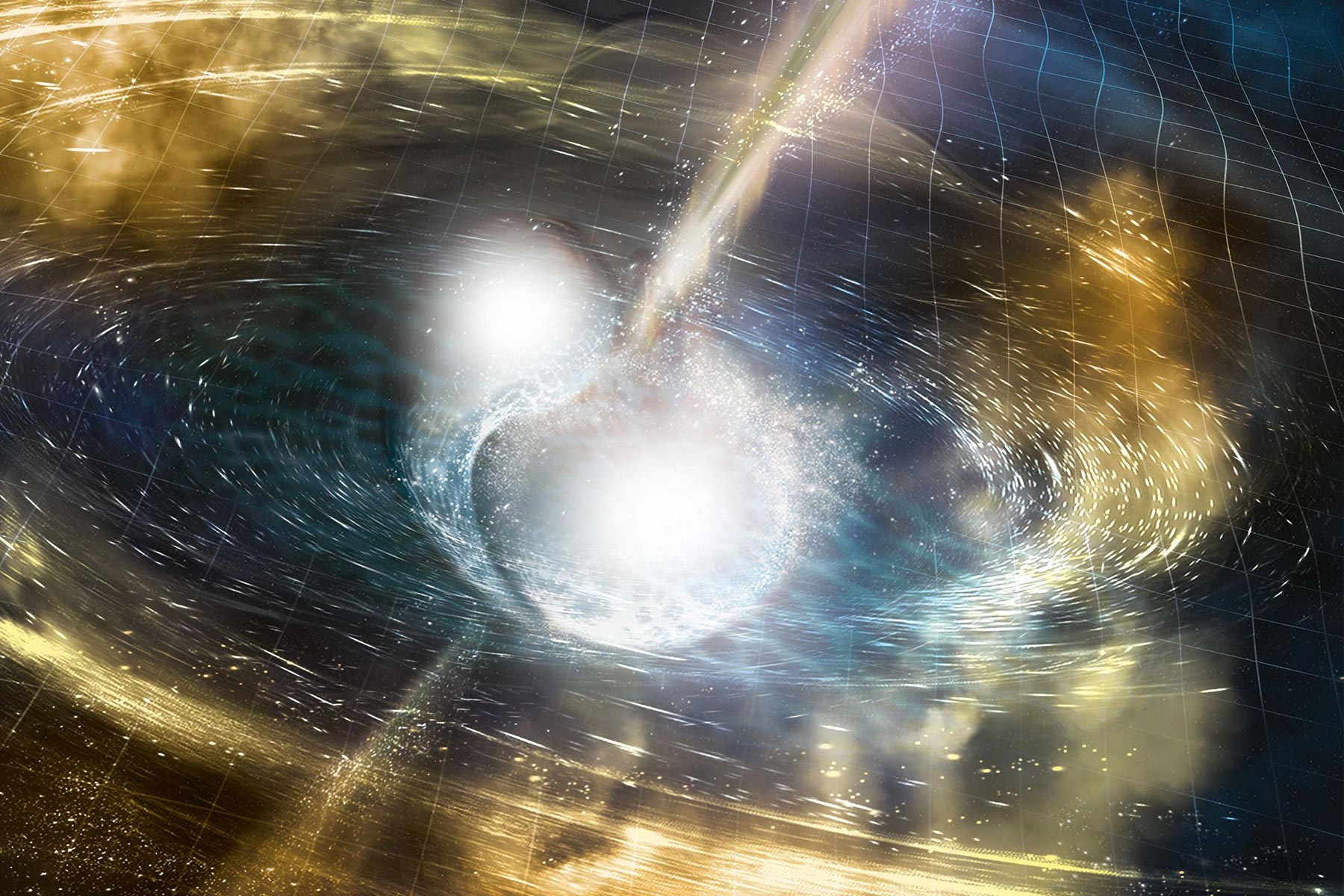
Neutron star mergers are a treasure trove for new physics signals, with implications for determining the true nature of dark matter, according to research from Washington University in St. Louis.
On August 17, 2017, the Laser Interferometer Gravitational-wave Observatory (LIGO), in the United States, and Virgo, a detector in Italy, detected gravitational waves from the collision of two neutron stars. For the first time, this astronomical event was not only heard in gravitational waves but also seen in light by dozens of telescopes on the ground and in space.
Research on Axion-Like Particles
Physicist Bhupal Dev in Arts & Sciences used observations from this neutron star merger — an event identified in astronomical circles as GW170817 — to derive new constraints on axion-like particles. These hypothetical particles have not been directly observed, but they appear in many extensions of the standard model of physics.
Axions and axion-like particles are leading candidates to compose part or all of the “missing” matter, or dark matter, of the universe that scientists have not been able to account for yet. At the very least, these feebly-interacting particles can serve as a kind of portal, connecting the visible sector that humans know much about to the unknown dark sector of the universe.
“We have good reason to suspect that new physics beyond the standard model might be lurking just around the corner,” said Dev, first author of the study in Physical Review Letters and a faculty fellow of the university’s McDonnell Center for the Space Sciences.
Insights From Neutron Star Mergers
When two neutron stars merge, a hot, dense remnant is formed for a brief period of time. This remnant is an ideal breeding ground for exotic particle production, Dev said. “The remnant gets much hotter than the individual stars for about a second before settling down into a bigger neutron star or a black hole, depending on the initial masses,” he said.
Doomed neutron stars whirl toward their demise in this animation, which represents phenomena observed up to nine days after GW170817. Credit: NASA’s Goddard Space Flight Center/CI Lab
These new particles quietly escape the debris of the collision and, far away from their source, can decay into known particles, typically photons. Dev and his team — including WashU alum Steven Harris (now NP3M fellow at Indiana University), as well as Jean-Francois Fortin, Kuver Sinha, and Yongchao Zhang — showed that these escaped particles give rise to unique electromagnetic signals that can be detected by gamma-ray telescopes, such as NASA’s Fermi-LAT.
The research team analyzed spectral and temporal information from these electromagnetic signals and determined that they could distinguish the signals from the known astrophysical background. Then they used Fermi-LAT data on GW170817 to derive new constraints on the axion-photon coupling as a function of the axion mass. These astrophysical constraints are complementary to those coming from laboratory experiments, such as the Axion Dark Matter eXperiment (ADMX), which probes a different region of the axion parameter space.
Future Prospects in Particle Physics
In the future, scientists could use existing gamma-ray space telescopes, like the Fermi-LAT, or proposed gamma-ray missions, like the WashU-led Advanced Particle-astrophysics Telescope (APT), to take other measurements during neutron star collisions and help improve upon their understanding of axion-like particles.
“Extreme astrophysical environments, like neutron star mergers, provide a new window of opportunity in our quest for dark sector particles like axions, which might hold the key to understanding the missing 85% of all the matter in the universe,” Dev said.
Reference: “First Constraints on the Photon Coupling of Axionlike Particles from Multimessenger Studies of the Neutron Star Merger GW170817” by P. S. Bhupal Dev, Jean-François Fortin, Steven P. Harris, Kuver Sinha and Yongchao Zhang, 5 March 2024, Physical Review Letters.
DOI: 10.1103/PhysRevLett.132.101003
This work was supported by the Department of Energy’s Office of Science.
Never miss a breakthrough: Join the SciTechDaily newsletter.
Follow us on Google and Google News.