
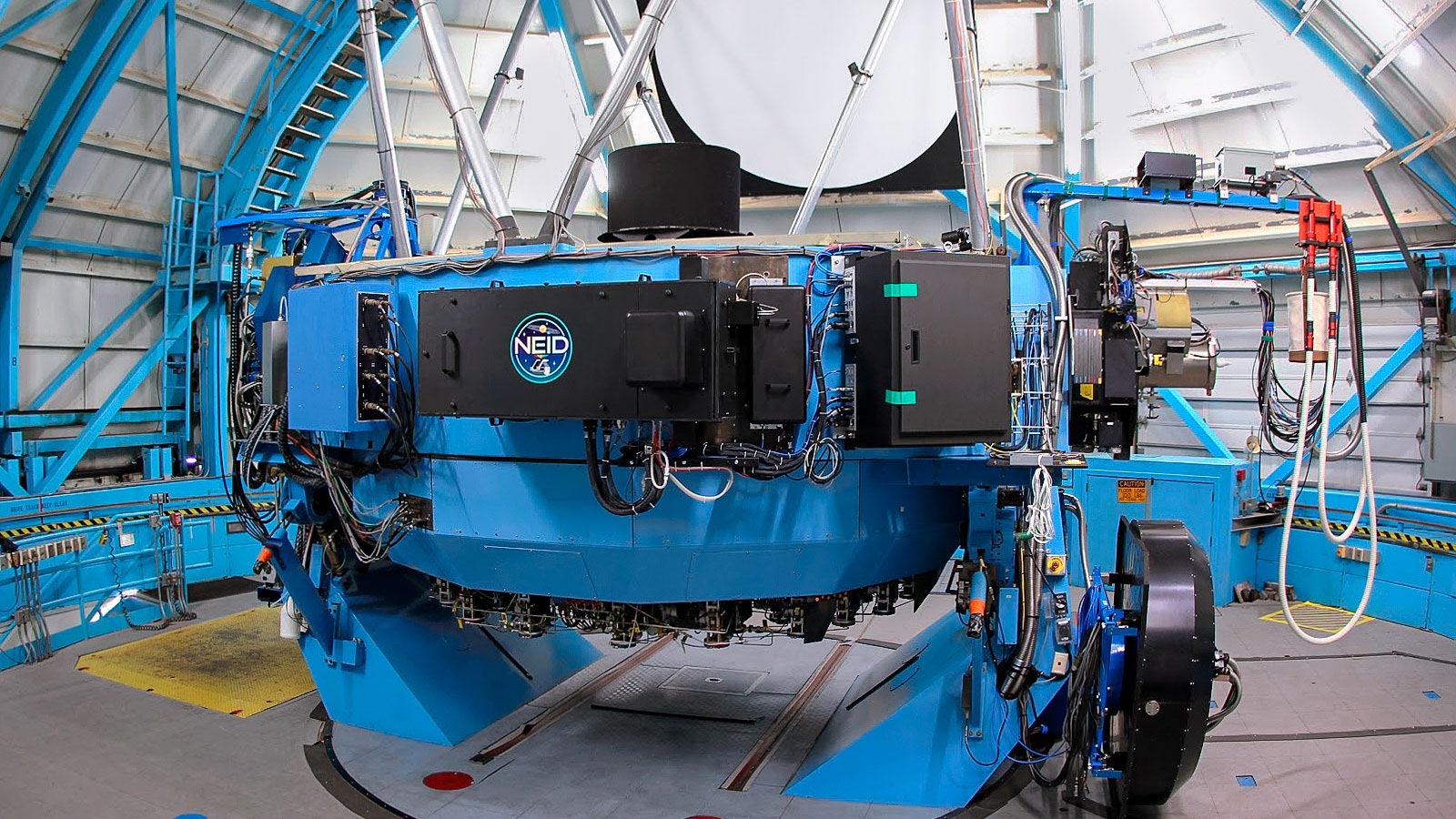
The NEID instrument will help astronomers determine the density of distant planets, which can reveal whether the planet is rocky, like Earth, or mostly gaseous, like Jupiter.
A new instrument called NEID (pronounced “NOO-id”; sounds like “fluid”) will help scientists measure the masses of planets outside our solar system — exoplanets — by observing the gravitational pull they exert on their parent stars. That information can help reveal a planet’s composition, one critical aspect in determining its potential habitability. It was funded by NASA and the National Science Foundation (NSF).
NEID recently made its first observations on the WIYN 3.5-meter (11.5-foot) telescope at Kitt Peak National Observatory when it studied 51 Pegasi, which in 1995 was the first Sun-like star found to host an exoplanet.
A new NASA-funded planet-hunting instrument has been installed on the WIYN telescope, on Arizona’s Kitt Peak. NEID (pronounced “NOO-id,” rhymes with fluid) is a spectrometer that is one of the first instruments of its kind with the precision to detect small, terrestrial planets around nearby stars. NEID will also confirm the presence of planets discovered by NASA’s TESS space telescope, and reveal details of their anatomy.
Located in southern Arizona, the observatory sits on land of the Tohono O’odham Nation, and NEID’s pronunciation evokes a word that roughly translates as “to see” in the Tohono O’odham language. The instrument finds and studies planets using what is called the radial velocity method, where scientists measure how the star wobbles slightly due to an orbiting planet’s gravitational pull. The more massive the planet, the stronger its tug and the faster the star moves. (A smaller star is also more susceptible to a planet’s gravitational pull than a larger one.)
Armed with measurements of a planet’s diameter and mass, scientists can determine its density as well, which can typically reveal whether the planet is rocky (like Earth, Venus, and Mars) or mostly gaseous (like Jupiter and Saturn). This is a first step toward finding potentially habitable worlds similar to Earth. When applied to many planets, the method provides a more comprehensive view of what types are most common in the galaxy and how other planetary systems form.
Measuring Wobble
Planets in our own solar system cause our Sun to wobble: Jupiter, with its immense gravity, causes our home star to move back and forth at roughly 43 feet per second (13 meters per second), whereas Earth causes a more sedate movement of only 0.3 feet per second (0.1 meters per second). The speed is proportional to an orbiting planet’s mass as well as to the mass of the star and the distance between those two objects.
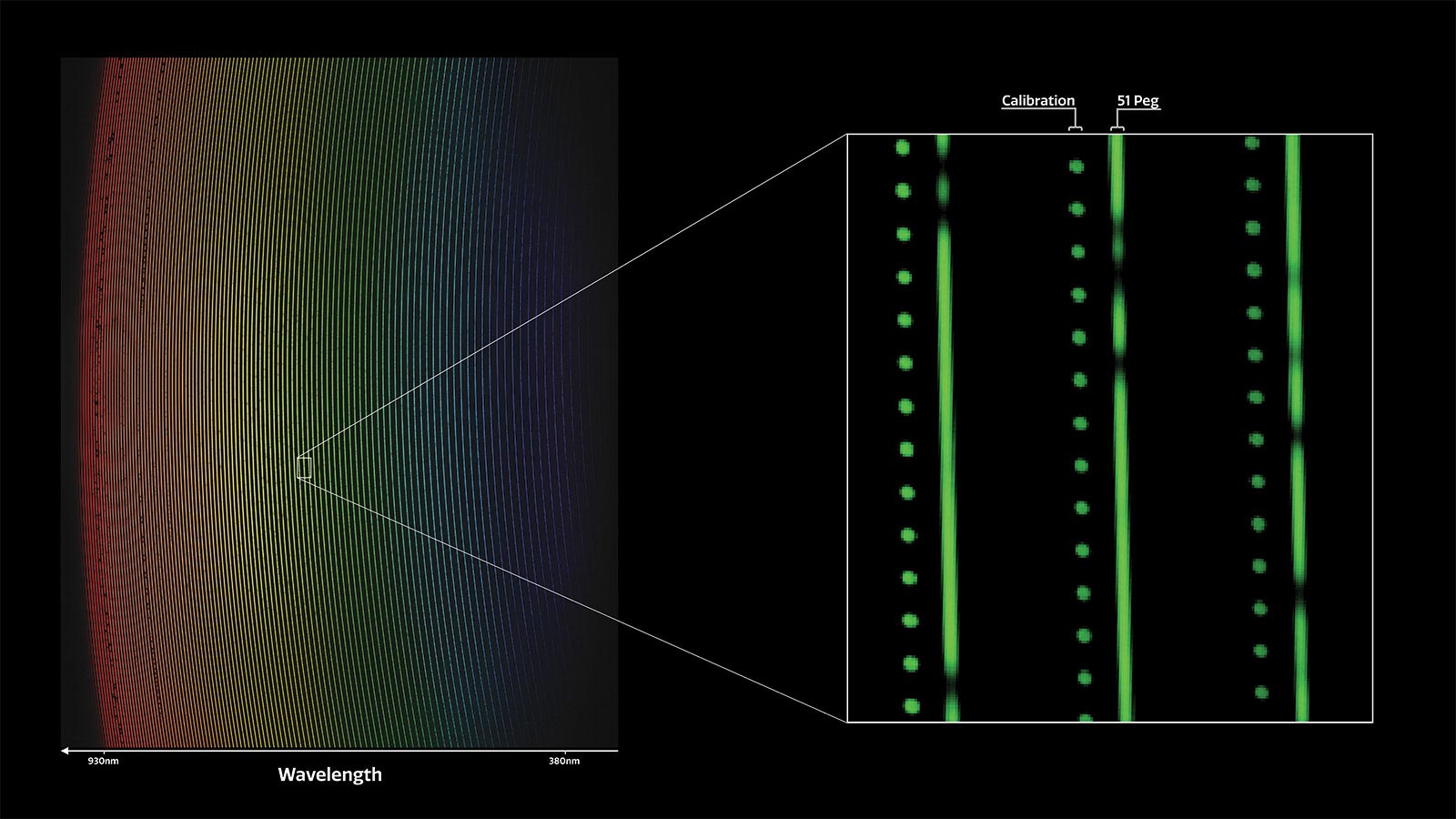
Until now, instruments have typically been able to measure speeds as low as about 3 feet per second (1 meter per second), but NEID belongs to a new generation of instruments capable of achieving about three-times-finer precision. It has the potential to detect and study rocky planets around stars smaller than the Sun. In addition, the scientists and engineers working with the instrument want to use it to demonstrate “extreme precision radial velocity” that could perhaps one day detect planets as small as Earth-orbiting around Sun-like stars in the habitable zone, where liquid water could potentially exist on a planet’s surface.
NEID will also confirm the presence and measure masses of planets discovered by NASA’s recently launched TESS (or Transiting Exoplanet Survey Satellite) space telescope, which detects planets via a different method from NEID: TESS hunts for tiny dips in the light coming from nearby stars, an indication that a planet is crossing the star’s face, or disk. This approach can reveal how big around the planet is (information necessary for calculating the planet’s density) and, based on the wobble, the length of its “year,” or one trip around its star. NEID can also investigate planet candidates found by other telescopes.
Members of the NEID team will discuss the first light results at the 235th meeting of the American Astronomical Society in Honolulu.
The NASA-NSF Exoplanet Observational Research (NN-EXPLORE) partnership funds NEID, short for NN-EXPLORE Exoplanet Investigations with Doppler spectroscopy. NN-EXPLORE is managed at NASA by the Exoplanet Exploration Program (ExEP), based at the Jet Propulsion Laboratory in Pasadena, California. The NEID team is led by the Pennsylvania State University with major partners at the University of Pennsylvania, the University of Arizona, NASA’s Goddard Space Flight Center and the NASA Exoplanet Science Institute at Caltech.
The NEID spectrograph was built at the Pennsylvania State University. NSF’s National Optical-Infrared Astronomy Research Laboratory (OIR Lab) was responsible for modifications to the WIYN 3.5-meter telescope to accommodate NEID. The telescope port adapter design was led by the OIR Lab and was constructed at the University of Wisconsin. Additional NEID participants include Carleton College, the National Institute for Standards and Technology, the University of California Irvine, the University of Colorado and Macquarie University.
Never miss a breakthrough: Join the SciTechDaily newsletter.
Follow us on Google and Google News.
1 Comment
High time India should Possess Modern Telescope stations, Institutes to encourage youth to study Astrophysics – Beacons to Earth.