
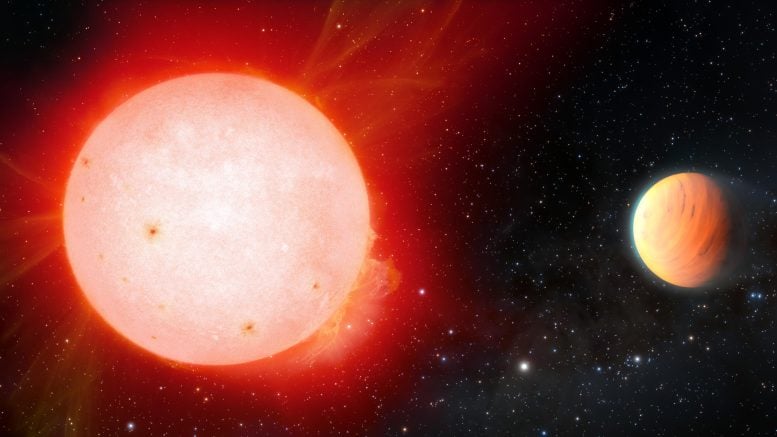
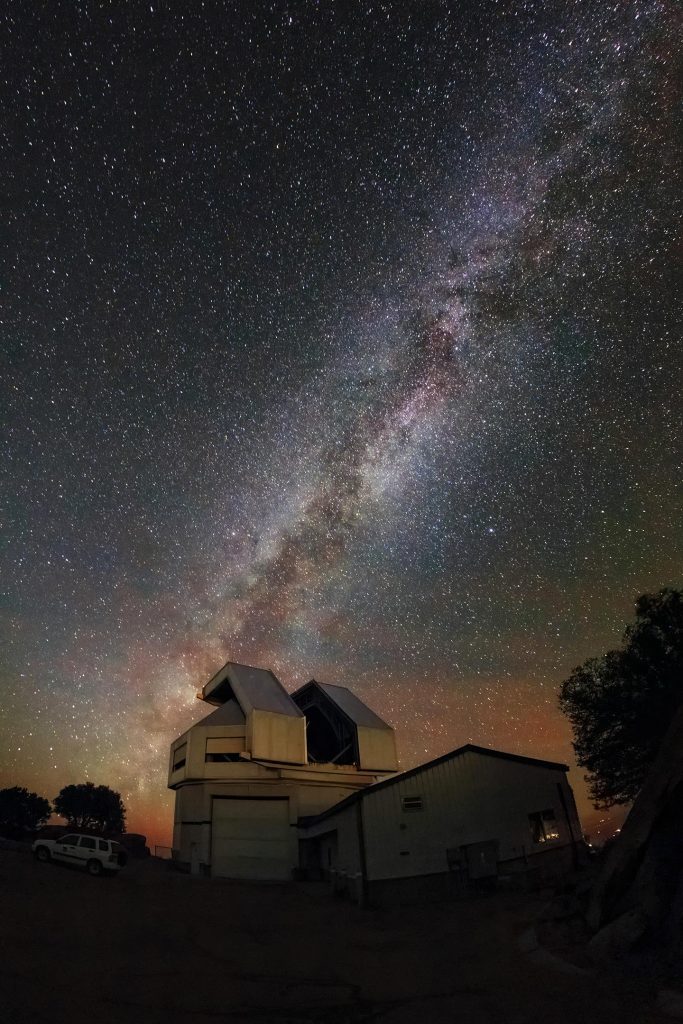
A gas giant exoplanet with the density of a marshmallow has been detected in orbit around a cool red dwarf star. A suite of astronomical instruments was used to make the observations, including the NASA-funded NEID radial-velocity instrument on the WIYN 3.5-meter Telescope at Kitt Peak National Observatory, a Program of NSF’s NOIRLab. Named TOI-3757 b, the exoplanet is the fluffiest gas giant planet ever discovered around this type of star.
Using the WIYN 3.5-meter Telescope at Kitt Peak National Observatory in Arizona, astronomers have observed an unusual Jupiter-like planet in orbit around a cool red dwarf star. Located in the constellation of Auriga the Charioteer around 580 light-years from Earth, this planet, identified as TOI-3757 b, is the lowest-density planet ever detected around a red dwarf star and is estimated to have an average density akin to that of a marshmallow.
Red dwarf stars are the smallest and dimmest members of so-called main-sequence stars — stars that convert hydrogen into helium in their cores at a steady rate. Although they are “cool” compared to stars like our Sun, red dwarf stars can be extremely active and erupt with powerful flares. This can strip orbiting planets of their atmospheres, making this star system a seemingly inhospitable location to form such a gossamer planet.
“Giant planets around red dwarf stars have traditionally been thought to be hard to form,” says Shubham Kanodia, a researcher at Carnegie Institution for Science’s Earth and Planets Laboratory and first author on a paper published in The Astronomical Journal. “So far this has only been looked at with small samples from Doppler surveys, which typically have found giant planets further away from these red dwarf stars. Until now we have not had a large enough sample of planets to find close-in gas planets in a robust manner.”
Theories on How TOI-3757 b Formed
There are still unexplained mysteries surrounding TOI-3757 b, the big one being how a gas-giant planet can form around a red dwarf star, and especially such a low-density planet. Kanodia’s team, however, thinks they might have a solution to that mystery.
They propose that the extra-low density of TOI-3757 b could be the result of two factors. The first relates to the rocky core of the planet; gas giants are thought to begin as massive rocky cores about ten times the mass of Earth, at which point they rapidly pull in large amounts of neighboring gas to form the gas giants we see today. TOI-3757b’s star has a lower abundance of heavy elements compared to other M-dwarfs with gas giants, and this may have resulted in the rocky core forming more slowly, delaying the onset of gas accretion and therefore affecting the planet’s overall density.
The second factor may be the planet’s orbit, which is tentatively thought to be slightly elliptical. There are times it gets closer to its star than at other times, resulting in substantial excess heating that can cause the planet’s atmosphere to bloat.
NASA’s Transiting Exoplanet Survey Satellite (TESS) initially spotted the planet. Kanodia’s team then made follow-up observations using ground-based instruments, including NEID and NESSI (NN-EXPLORE Exoplanet Stellar Speckle Imager), both housed at the WIYN 3.5-meter Telescope; the Habitable-zone Planet Finder (HPF) on the Hobby-Eberly Telescope; and the Red Buttes Observatory (RBO) in Wyoming.
Calculating the Size, Mass, and Density of TOI-3757 b
TESS surveyed the crossing of this planet TOI-3757 b in front of its star, which allowed astronomers to calculate the planet’s diameter to be about 150,000 kilometers (100,000 miles) or about just slightly larger than that of Jupiter. The planet finishes one complete orbit around its host star in just 3.5 days, 25 times less than the closest planet in our Solar System — Mercury — which takes about 88 days to do so.
The astronomers then used NEID and HPF to measure the star’s apparent motion along the line of sight, also known as its radial velocity. These measurements provided the planet’s mass, which was calculated to be about one-quarter that of Jupiter, or about 85 times the mass of the Earth. Knowing the size and the mass allowed Kanodia’s team to calculate TOI-3757 b’s average density as being 0.27 grams per cubic centimeter (about 17 grams per cubic feet), which would make it less than half the density of Saturn (the lowest-density planet in the Solar System), about one quarter the density of water (meaning it would float if placed in a giant bathtub filled with water), or in fact, similar in density to a marshmallow.
“Potential future observations of the atmosphere of this planet using NASA’s new James Webb Space Telescope could help shed light on its puffy nature,” says Jessica Libby-Roberts, a postdoctoral researcher at Pennsylvania State University and the second author on this paper.
“Finding more such systems with giant planets — which were once theorized to be extremely rare around red dwarfs — is part of our goal to understand how planets form,” says Kanodia.
The discovery highlights the importance of NEID in its ability to confirm some of the candidate exoplanets currently being discovered by NASA’s TESS mission, providing important targets for the new James Webb Space Telescope (JWST) to follow up on and begin characterizing their atmospheres. This will in turn inform astronomers what the planets are made of and how they formed and, for potentially habitable rocky worlds, whether they might be able to support life.
Reference: “TOI-3757 b: A low-density gas giant orbiting a solar-metallicity M dwarf” by Shubham Kanodia, Jessica Libby-Roberts, Caleb I. Cañas, Joe P. Ninan, Suvrath Mahadevan, Gudmundur Stefansson, Andrea S. J. Lin, Sinclaire Jones, Andrew Monson, Brock A. Parker, Henry A. Kobulnicky, Tera N. Swaby, Luke Powers, Corey Beard, Chad F. Bender, Cullen H. Blake, William D. Cochran, Jiayin Dong, Scott A. Diddams, Connor Fredrick, Arvind F. Gupta, Samuel Halverson, Fred Hearty, Sarah E. Logsdon, Andrew J. Metcalf, Michael W. McElwain, Caroline Morley, Jayadev Rajagopal, Lawrence W. Ramsey, Paul Robertson, Arpita Roy, Christian Schwab, Ryan C. Terrien, John Wisniewski and Jason T. Wright, 5 August 2022, The Astronomical Journal.
DOI: 10.3847/1538-3881/ac7c20
Never miss a breakthrough: Join the SciTechDaily newsletter.
Follow us on Google and Google News.