
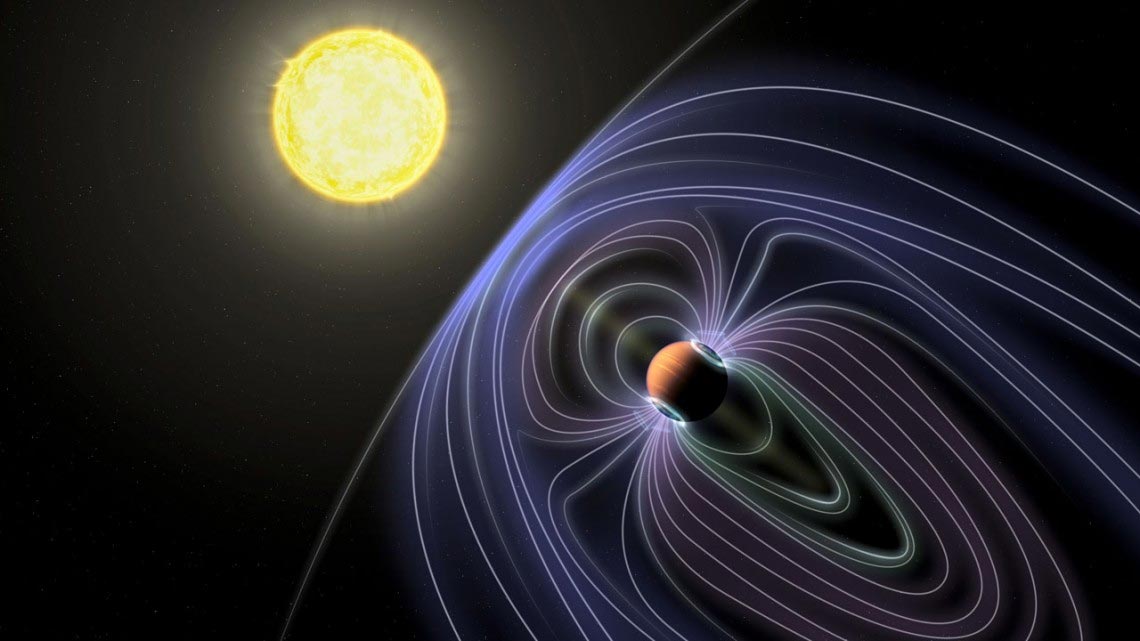
By monitoring the cosmos with a radio telescope array, an international team of scientists has detected radio bursts emanating from the constellation Boötes – that could be the first radio emission collected from a planet beyond our solar system.
The team, led by Cornell postdoctoral researcher Jake D. Turner, Philippe Zarka of the Observatoire de Paris – Paris Sciences et Lettres University and Jean-Mathias Griessmeier of the Université d’Orléans will publish their findings in the forthcoming research section of Astronomy & Astrophysics, on December 16 (2020).
“We present one of the first hints of detecting an exoplanet in the radio realm,” Turner said. “The signal is from the Tau Boötes system, which contains a binary star and an exoplanet. We make the case for an emission by the planet itself. From the strength and polarization of the radio signal and the planet’s magnetic field, it is compatible with theoretical predictions.”
Among the co-authors is Turner’s postdoctoral advisor Ray Jayawardhana, the Harold Tanner Dean of the College of Arts and Sciences, and a professor of astronomy.
“If confirmed through follow-up observations,” Jayawardhana said, “this radio detection opens up a new window on exoplanets, giving us a novel way to examine alien worlds that are tens of light-years away.”
By monitoring the cosmos with a radio telescope array, an international team of scientists has detected radio bursts emanating from the constellation Boötes – that could be the first radio emission collected from a planet beyond our solar system. Cornell postdoctoral researcher Jake D. Turner explains the research. Credit: Ryan MacDonald/Carl Sagan Institute
Using the Low Frequency Array (LOFAR), a radio telescope in the Netherlands, Turner and his colleagues uncovered emission bursts from a star-system hosting a so-called hot Jupiter, a gaseous giant planet that is very close to its own sun. The group also observed other potential exoplanetary radio-emission candidates in the 55 Cancri (in the constellation Cancer) and Upsilon Andromedae systems. Only the Tau Boötes exoplanet system – about 51 light-years away – exhibited a significant radio signature, a unique potential window on the planet’s magnetic field.
Observing an exoplanet’s magnetic field helps astronomers decipher a planet’s interior and atmospheric properties, as well as the physics of star-planet interactions, said Turner, a member of Cornell’s Carl Sagan Institute.
Earth’s magnetic field protects it from solar wind dangers, keeping the planet habitable. “The magnetic field of Earth-like exoplanets may contribute to their possible habitability,” Turner said, “by shielding their own atmospheres from solar wind and cosmic rays, and protecting the planet from atmospheric loss.”
Two years ago, Turner and his colleagues examined the radio emission signature of Jupiter and scaled those emissions to mimic the possible signatures from a distant Jupiter-like exoplanet. Those results became the template for searching radio emission from exoplanets 40 to 100 light-years away.
After poring over nearly 100-hours of radio observations, the researchers were able to find the expected hot Jupiter signature in Tau Boötes. “We learned from our own Jupiter what this kind of detection looks like. We went searching for it and we found it,” Turner said.
The signature, though, is weak. “There remains some uncertainty that the detected radio signal is from the planet. The need for follow-up observations is critical,” he said.
Turner and his team have already begun a campaign using multiple radio telescopes to follow up on the signal from Tau Boötes.
Reference: “The search for radio emission from the exoplanetary systems 55 Cancri, upsilon Andromedae, and tau Boötis using LOFAR beam-formed observations” by J.D. Turner, P. Zarka, J.-M. Griessmeier, J. Lazio, B. Cecconi, J.-E. Enriquez, J.N. Girard, R. Jayawardhana, L. Lamy, J.D. Nichols and I. Pater, 16 December 2020, Astronomy & Astrophysics.
DOI: 10.1051/0004-6361/201937201
In addition to Turner, Jayawardhana, Griessmeier and Zarka, the co-authors are Laurent Lamy and Baptiste Cecconi of the Observatoire de Paris, France; Joseph Lazio from NASA’s Jet Propulsion Laboratory; J. Emilio Enriquez and Imke de Pater from the University of California, Berkeley; Julien N. Girard from Rhodes University, Grahamstown, South Africa; and Jonathan D. Nichols from the University of Leicester, United Kingdom.
Turner, who laid the groundwork for this research while earning his doctorate at the University of Virginia, received funding from the National Science Foundation.
Never miss a breakthrough: Join the SciTechDaily newsletter.
Follow us on Google and Google News.
8 Comments
Human consciousness exists in the realm of Quantum entanglement. Thoughts travel unencumbered through time and space. Many beings can experience similar emotional awareness (epiphany) or ideas at the same moment. Teaching and learning are being rapidly accelerated by increased awareness and mental activity.
So true! Unfortunately, in my opinion, the majority of the world’s population is being intentionally dumbed down. Basic science and mathematics, as well as history, is no longer taught by unbiased teachers. Politics dominates, as well as hate against every possible race and creed. If more were taught factual, unbiased info from a younger age, perhaps our species would further itself more conscientiously in our evolution. Have a wonderful day, Sir. thefogandthefool-dot-com
This news of radio waves is exciting. Brings up more questions than answers. Does this prove life exists other than our own. Or is this just echos of our own noise pollution?
Dump out all the biased teaching at university and let the bright students have free thought about our universe, then we might have discovery
A Jupiter like planet would be unlikely to have life capable of making radio signals. But if like our Jupiter it has earth sized moons, maybe??
The writing of this news release doesn’t make it super-clear, but the idea is that these radio emissions are natural, not artificial – neither our own “noise pollution” nor intelligent alien broadcasts. They’re saying they’re generated by planets’ magnetic fields, I guess maybe in interaction with their stars’ own emissions, like a kind of invisible aurora maybe? The headline is a wicked tease. 😐
Is there another Howard Stern out there?
Identifying the electromagnetic signal of a Jupiter planet will refine in time to identifying the electromagnetic signal of an earth-like planet. It would be a good way to fine our twin world.