

Close Menu
    Facebook X (Twitter) Instagram
    SciTechDaily
    • Biology
    • Chemistry
    • Earth
    • Health
    • Physics
    • Science
    • Space
    • Technology
    Facebook X (Twitter) Pinterest YouTube RSS
    SciTechDaily
    Home»Biology»Discovery of Ancient Giant Virus Remnants Offers New Clues to the Origins of Complex Life
    Biology

    Discovery of Ancient Giant Virus Remnants Offers New Clues to the Origins of Complex Life

    By Queen Mary University of LondonJuly 24, 2024No Comments4 Mins Read
    Facebook Twitter Pinterest Telegram LinkedIn WhatsApp Email Reddit
    Share
    Facebook Twitter LinkedIn Pinterest Telegram Email Reddit
    Red Bacteria Microbes
    A new study found that the genetic code of the single-celled Amoebidium contains remnants of ancient giant viruses, offering insights into the genetic evolution of complex life. This discovery reveals that these viral genes, though potentially harmful, are kept inactive by chemical processes within Amoebidium’s DNA, suggesting a more intricate relationship between viruses and their hosts, which could impact our understanding of genetic evolution in other organisms, including humans.

    Microorganisms reveal how our single-celled predecessors incorporated viral DNA into their own genomes.

    Researchers have discovered remnants of ancient giant viruses in the genome of Amoebidium, a single-celled organism, suggesting that such viral sequences may have played a role in the evolution of complex life forms. This study highlights the dynamic relationship between viruses and their hosts, also reflecting on human genetics.

    A surprising twist in the evolutionary history of complex life has been uncovered in a new study published in Science Advances. Researchers at Queen Mary University of London have found that a single-celled organism, closely related to animals, contains remnants of ancient giant viruses within its genetic code. This discovery provides insight into how complex organisms may have acquired some of their genes and underscores the dynamic interplay between viruses and their hosts.

    The study focused on a microbe called Amoebidium, a unicellular parasite found in freshwater environments. By analyzing Amoebidium’s genome, the researchers led by Dr. Alex de Mendoza Soler, Senior Lecturer at Queen Mary’s School of Biological and Behavioural Sciences, found a surprising abundance of genetic material originating from giant viruses – some of the largest viruses known to science. These viral sequences were heavily methylated, a chemical tag that often silences genes.

    “It’s like finding Trojan horses hiding inside the Amoebidium’s DNA,” explains Dr de Mendoza Soler. “These viral insertions are potentially harmful, but Amoebidium seems to be keeping them in check by chemically silencing them.”


    The microbe Amoebidium appalachense undergoing its developmental life cycle in the laboratory. The nuclei divide within a cell until maturity (~40h in the video), when each nucleus becomes a single cell and the colony breaks giving rise to the progeny. Credit: Alex de Mendoza

    Ongoing Research and Implications

    The researchers then investigated how widespread this phenomenon might be. They compared the genomes of several Amoebidium isolates and found significant variation in the viral content. This suggests that the process of viral integration and silencing is ongoing and dynamic.

    “These findings challenge our understanding of the relationship between viruses and their hosts,” says Dr. de Mendoza Soler. “Traditionally, viruses are seen as invaders, but this study suggests a more complex story. Viral insertions may have played a role in the evolution of complex organisms by providing them with new genes. And this is allowed by the chemical taming of these intruders’ DNA.”
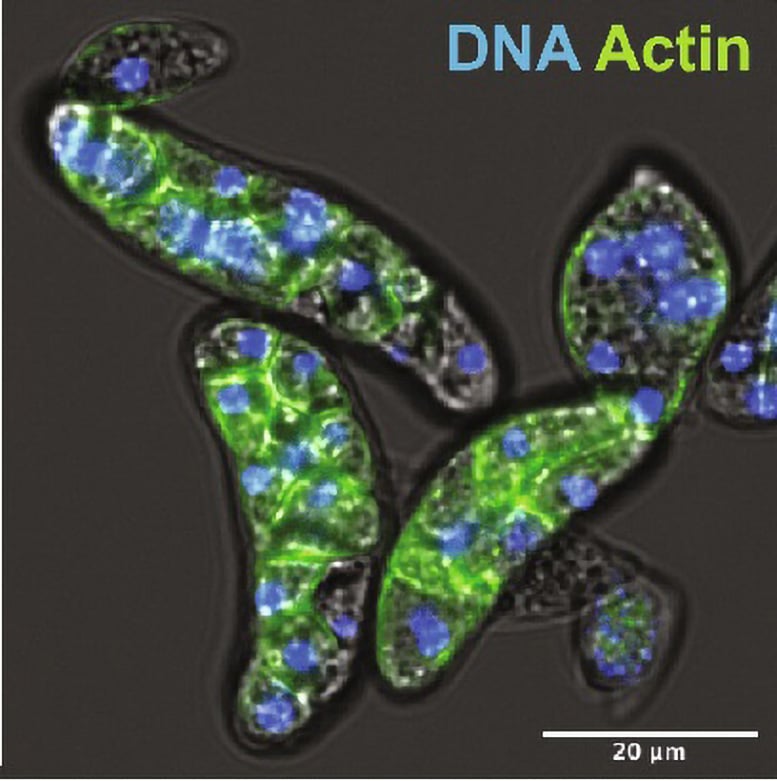
    Amoebidium appalachense Cells
    Amoebidium appalachense cells stained for DNA (in blue, showing the nucleus) and actin (in green), highlighting the cell membranes in the cellularization step of the colony. Credit: Alex de Mendoza

    Furthermore, the findings in Amoebidium offer intriguing parallels to how our own genomes interact with viruses. Similar to Amoebidium, humans and other mammals have remnants of ancient viruses, called Endogenous Retroviruses, integrated into their DNA. While these remnants were previously thought to be inactive “junk DNA,” some might now be beneficial. However, unlike the giant viruses found in Amoebidium, Endogenous Retroviruses are much smaller, and the human genome is significantly larger. Future research can explore these similarities and differences to understand the complex interplay between viruses and complex life forms.

    Reference: “DNA methylation enables recurrent endogenization of giant viruses in an animal relative” by Luke A. Sarre, Iana V. Kim, Vladimir Ovchinnikov, Marine Olivetta, Hiroshi Suga, Omaya Dudin, Arnau Sebé-Pedrós and Alex de Mendoza, 12 July 2024, Science Advances.
    DOI: 10.1126/sciadv.ado6406

    Never miss a breakthrough: Join the SciTechDaily newsletter.
    Follow us on Google and Google News.

    DNA Evolutionary Biology Genetics Microbes Popular Queen Mary University of London Virology
    Share. Facebook Twitter Pinterest LinkedIn Email Reddit

    Related Articles

    DNA Flip Switches Found To “Supercharge” Evolution

    Decade-Long Study Challenges Traditional Views of Evolution

    Mankind’s Missing Puzzle Pieces: The “Deleted” Genes That Made Us Human

    Mammalian Mysteries: How 240 Species Unravel the Secrets of Human Genes

    Considered Impossible – New Study of 5 Million People Reveals Genetic Links to Height

    Research Team Finds New Species of Coronaviruses in Some Unexpected Places

    Bacteria Evolved a Multitude of Defense Systems That Offer Strong Immunity for Protection Against Viruses

    Unexpected Snippets of Genetic Material From Viruses Found Lurking in Our DNA

    Researchers Complete Genome Sequence of a Denisovan Human Finger Bone

    Leave A Reply Cancel Reply

    • Facebook
    • Twitter
    • Pinterest
    • YouTube

    Don't Miss a Discovery

    Subscribe for the Latest in Science & Tech!

    Trending News

    The Universe Is Expanding Too Fast and Scientists Can’t Explain Why

    “Like Liquid Metal”: Scientists Create Strange Shape-Shifting Material

    Early Warning Signals of Esophageal Cancer May Be Hiding in Plain Sight

    Common Blood Pressure Drug Shows Surprising Power Against Deadly Antibiotic-Resistant Superbug

    Scientists Uncover Dangerous Connection Between Serotonin and Heart Valve Disease

    Scientists Discover a “Protector” Protein That Could Help Reverse Hair Loss

    Bone-Strengthening Discovery Could Reverse Osteoporosis

    Scientists Uncover Hidden Trigger Behind Stem Cell Aging

    Follow SciTechDaily
    • Facebook
    • Twitter
    • YouTube
    • Pinterest
    • Newsletter
    • RSS
    SciTech News
    • Biology News
    • Chemistry News
    • Earth News
    • Health News
    • Physics News
    • Science News
    • Space News
    • Technology News
    Recent Posts
    • Scientists Stunned After Finding Plant Thought Extinct for 60 Years
    • A Common Diabetes Drug May Hold the Key to Stopping HIV From Coming Back
    • Ancient “Syphilis-Like” Disease in Vietnam Challenges Key Scientific Assumptions
    • Drinking Alcohol To Cope in Your 20s Could Damage Your Brain for Life
    • Scientists Crack Alfalfa’s Chromosome Mystery After Decades of Debate
    Copyright © 1998 - 2026 SciTechDaily. All Rights Reserved.
    • Science News
    • About
    • Contact
    • Editorial Board
    • Privacy Policy
    • Terms of Use

    Type above and press Enter to search. Press Esc to cancel.