
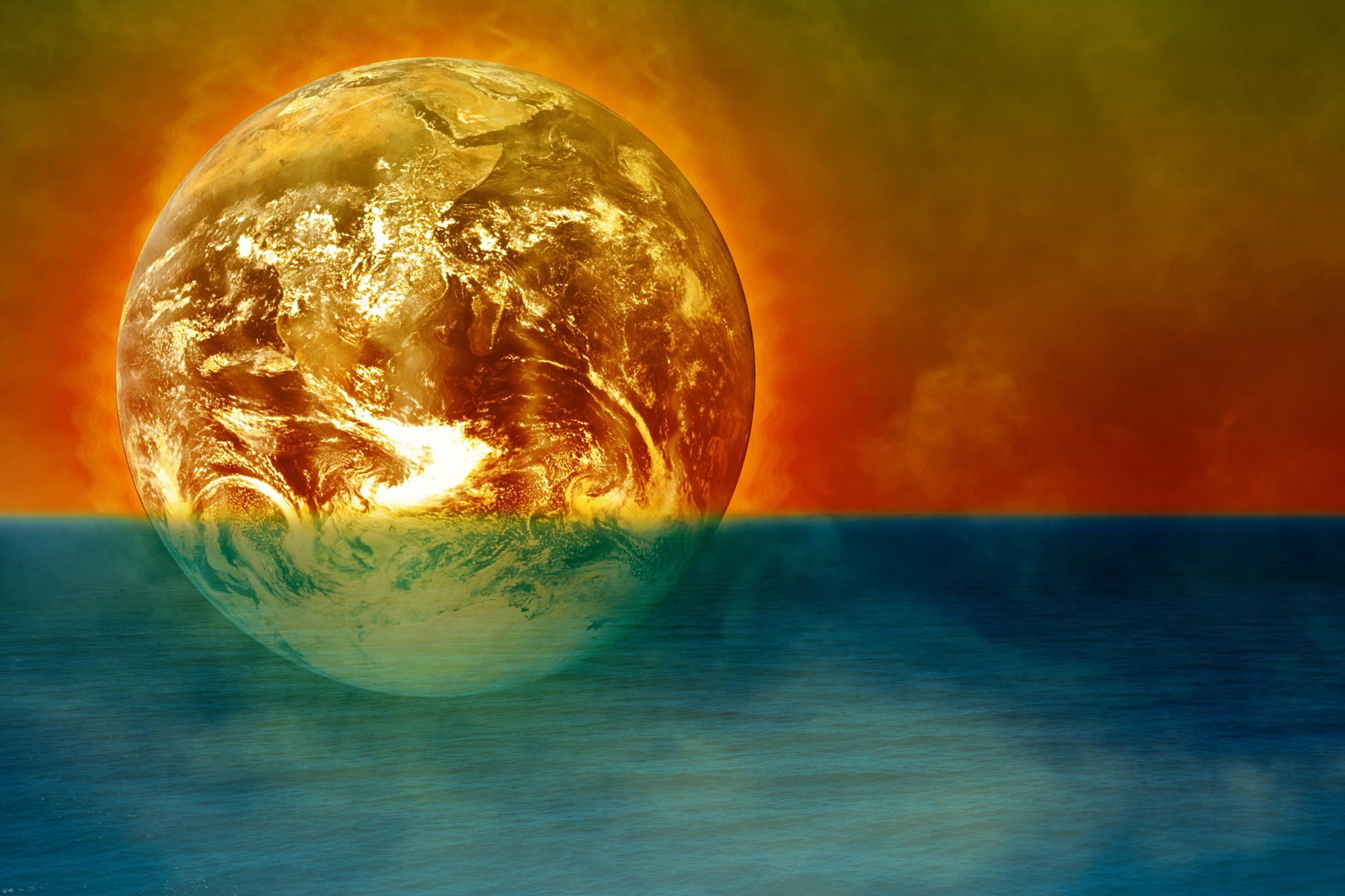
Warming oceans could unlock a hidden methane boost that speeds up climate change.
The oceans may be contributing to climate change in a subtle but important way that scientists are only starting to recognize.
Hidden Source of Ocean Methane
A new study published in the journal Proceedings of the National Academy of Sciences sheds light on how methane is produced in the open ocean. Researchers at the University of Rochester, including Thomas Weber, an associate professor in the Department of Earth and Environmental Sciences, along with graduate student Shengyu Wang and postdoctoral research associate Hairong Xu, identified a process that could grow stronger as global temperatures rise. Their findings suggest a potential feedback loop that could worsen global warming.
Methane is a powerful greenhouse gas, yet scientists have long been puzzled by an unusual pattern. Surface ocean waters regularly release methane into the atmosphere, even though these waters contain plenty of oxygen. Traditionally, methane formation has been linked to environments without oxygen, such as wetlands or deep ocean sediments.
Microbial Process Linked to Phosphate Scarcity
To better understand this contradiction, the research team combined global data with computer simulations. They found that certain microbes can produce methane as they break down organic material, but only when phosphate, a key nutrient, is in short supply.
“This means that phosphate scarcity is the primary control knob for methane production and emissions in the open ocean,” Weber says.
This discovery changes how scientists view methane production in marine environments. Instead of being rare, methane generation in oxygen-rich waters may occur widely in areas where phosphate levels are low.
Warming Oceans and Reduced Nutrient Mixing
The study also highlights how climate change could influence this process in the future. As the ocean warms, the difference in density between surface water and deeper layers increases.
“Climate change is warming the ocean from the top down, increasing the density difference between surface and deep waters,” Weber says. “This is expected to slow the vertical mixing that carries nutrients like phosphate up from depth.”
With less mixing, fewer nutrients reach the surface. The team’s model shows that this could leave surface waters increasingly depleted of phosphate, creating favorable conditions for methane-producing microbes.
Methane Feedback Loop and Climate Impact
If methane production rises, more of this gas could escape into the atmosphere. Because methane is so effective at trapping heat, this creates the risk of a reinforcing cycle. Warmer oceans lead to higher methane emissions, which then contribute to further warming.
The research underscores how small-scale biological activity in the ocean can influence the global climate.
Missing Link in Climate Models
Importantly, this feedback mechanism is not yet included in most major climate models. As scientists work to improve predictions, accounting for processes like this may be crucial for understanding how quickly climate change will progress.
“Our work will help fill a key gap in climate predictions, which often overlook interactions between the changing environment and natural greenhouse gas sources to the atmosphere,” Weber says.
Reference: “Phosphate scarcity governs methane production in the global open ocean” by Shengyu Wang, Hairong Xu and Thomas S. Weber, 17 March 2026, Proceedings of the National Academy of Sciences.
DOI: 10.1073/pnas.2521235123
Never miss a breakthrough: Join the SciTechDaily newsletter.
Follow us on Google and Google News.
7 Comments
What a load of made up bs. If you were that worried, stop polluting everything then. For instance, spraying everything from above, with your chemtrails. Why is New Zealand still using 1080? Ships at sea billowing goodness knows what. The evils running this World, need to stop what they are up to. Stop blaming us, because we know it is all money hungry greedy bstds doing it. Since you all introduced plastics, polyester, fast food joints, everything has gone to the dogs. You all took away milk in glass bottles etc. Paper bags for your groceries, etc… Forced all this stuff on us, then blame and penalized us for the world’s made up global warming, which are complete lies.
“Paper bags for your groceries, etc…”
As I recollect, part of the impetus for removing paper bags was the Left-leaning conservationists who were trying to ‘save’ trees. Sometimes the blame is well deserved. Your tin-foil hat claims about so-called ‘chemtrails’ is out on a limb. If you look at old movies about WWII bombers, even they produced condensation trails.
OK Clyde, here is your assignment. Lookup John Brennan, CIA, statospheric aerosol injection. This is the official sanctioned terms for what “the little people” call chemtrails. Do some research before you call someone a tin-foil hat wearing so and so. You are either a paid troll or an empty vessel incapable of critical thought. Please, go sit down somewhere and let the adults discuss important matters.
“Traditionally, methane formation has been linked to environments without oxygen, such as wetlands or deep ocean sediments.”
Speaking of wetlands, there has recently been a push to reintroduce beavers in areas from which they have been extirpated in the past. Those advocating re-introduction don’t see the contradiction with their generally shared concern about methane.
Fortunately, the concern about methane is misplaced, apparently the result of politicians wanting to look like they are doing something about the claimed anthropogenic global warming. See here: https://wattsupwiththat.com/2023/03/06/the-misguided-crusade-to-reduce-anthropogenic-methane-emissions/
Methane is not a powerful green house gas. It’s pretty easy to ask your favorite AI site to find out that if methane doubles in the atmosphere it might cause as much as 0.3C° of warming and it will take about 250 years for that to happen. You can also find out that the basic climate sensitivity, doubling, of CO2 is 1.2C°. That makes CO2 around 4 times as powerful as methane at “Trapping Heat” not the other way around. The 82.5 more powerful than CO2 claim we read about in the media is classic misinformation.
Gee, areas with low phosphates are a problem. I remember doing laundry back in the day before phosphates were outlawed in laundry products. The clothes were cleaner, softer, and whiter. And it turns out the methane production was suppressed. Science by public opinion scores another failure.
{+_+}
From the actual published article: “Although an additional source of ~2 Tg CH4/y from the ocean is relatively minor compared to direct anthropogenic emissions [~300 Tg/y, …, most future climate scenarios assume that anthropogenic sources will peak and then decline during the next few centuries …”
Considering that anthro’ sources are a small fraction of all methane sources, one could reasonably say that the phosphate-controlled methane sources are negligible.