

New observations and simulations by a research team led by MPE show that a massive binary star near the center of our Galaxy is creating a series of enigmatic gas clouds, compact clumps that help feed the supermassive black hole Sagittarius A*.
The center of the Milky Way is one of the most crowded and active environments in our Galaxy. At its core is the supermassive black hole Sagittarius A* (Sgr A*), which is surrounded by stars, gas, and dust moving through an extreme gravitational field. This region gives astronomers a rare chance to study how material behaves near a black hole and how black holes receive the matter that keeps them active.
During the past two decades, astronomers have used infrared observations to detect several small, dense gas clouds close to Sgr A*. These compact clumps may help explain how gas makes its way toward the black hole. However, their origin and the processes that shaped them have remained unclear.
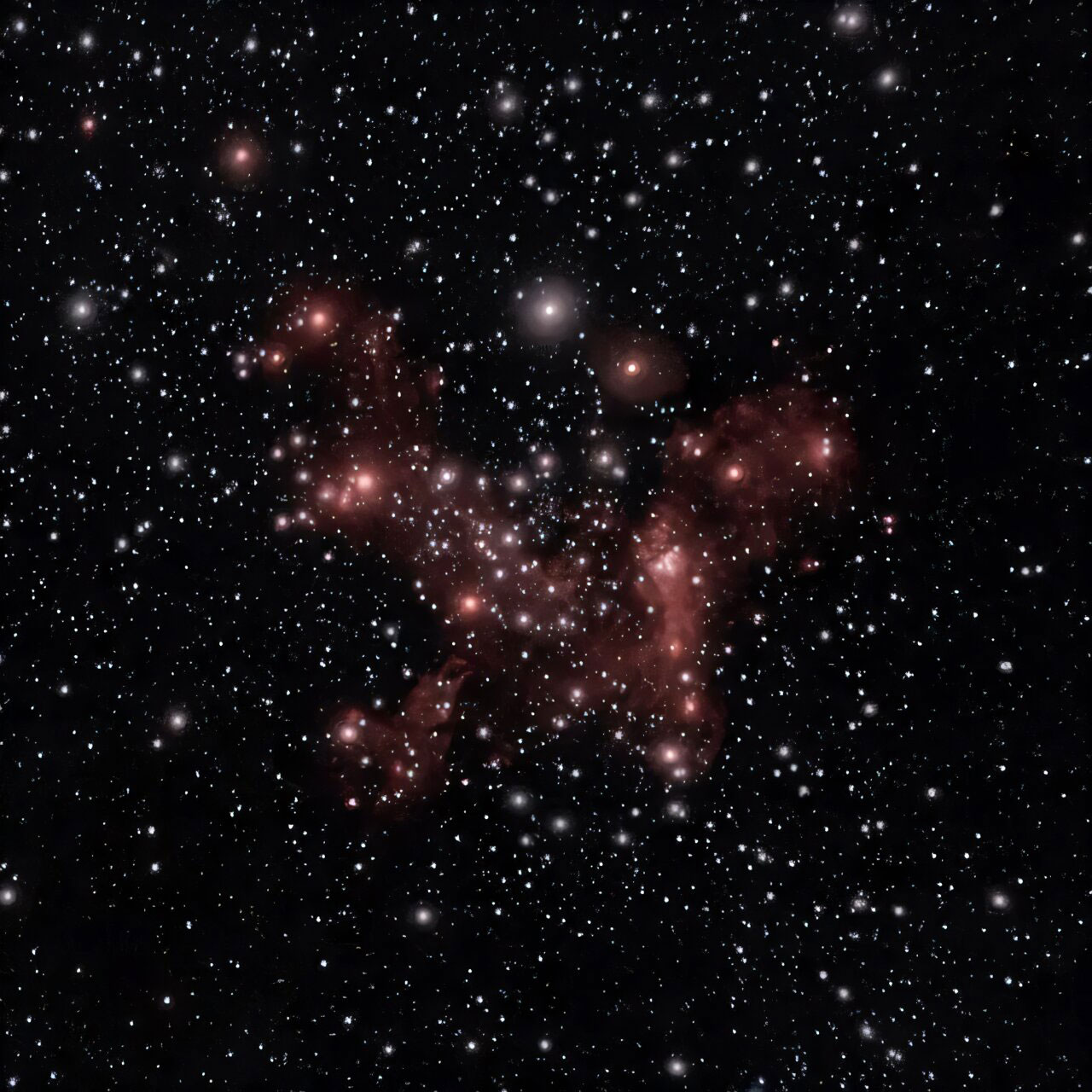
The G‑Clouds: A Growing Family
Astronomers first identified a compact cloud of ionized gas called G2 in 2012. It contains a few Earth masses of material and emits hydrogen and helium light, which is typical of hot gas mixed with dust. G2 moves around Sgr A* on a stretched-out orbit and has a faint trailing feature called G2t. When astronomers reexamined older data, they soon found a similar object, G1, following a comparable path.
G1, G2, and G2t have been suggested to be dense knots within the same stream of gas. Even modest changes in density can make a gas cloud look clumpy, because its brightness rises with the square of its density. More recently, researchers found that material from G2’s tail had condensed into a third compact clump on a similar trajectory, which one could now call G3, except that this name had by now already been given to a different object. Together, the objects form a connected structure, the G1–2–3 streamer, that traces gas moving through the Galactic Center.
Models suggest that if one clump falls inward roughly every decade, carrying about one Earth mass of material, it could supply enough gas to maintain the present activity of Sgr A*. For that reason, identifying how these clumps form is central to understanding how the black hole is fueled.
Searching for the Source
Astronomers have considered several possible sources for the clouds, including winds from massive stars, explosive events such as novae, and material stripped away by the gravity of Sgr A*. To investigate these possibilities, an international team led by MPE used the adaptive optics-assisted spectrographs SINFONI and ERIS, which can produce detailed infrared spectra. By focusing on the hydrogen Brackett-γ emission line, the team reconstructed the orbits of the three clouds using their positions and velocities.
The results showed that G1, G2, and G2t move along orbits with nearly the same shape and orientation. It is extremely unlikely that three unrelated objects would share such specific orbital properties by chance. This points to a shared origin for all three clumps.
A Binary Star as the Creator
By tracing the gas streamer backward through space and radial velocity, the researchers found a plausible source: IRS 16SW, a massive contact binary star located in the clockwise disk of young stars orbiting Sgr A*. The slight differences among the G cloud orbits can be explained by the binary star’s own motion.
Hydrodynamical simulations strengthen this interpretation. They show that gas clumps can arise when the binary’s stellar winds collide with nearby material, creating a shock between the two stars. In that region, gas builds up, becomes compressed, and eventually breaks away as separate clumps that move inward, similar to what astronomers observe in the G1–2–3 streamer.
What does it mean?
The findings indicate that massive stars near the Galactic Center may continuously feed material toward the black hole through their stellar winds.
The result links stellar evolution, gas motion, and black hole feeding in a single picture, showing how star formation and black hole activity can be connected even within the Milky Way.
Reference: “The gas streamer G1–2–3 in the Galactic center” by S. Gillessen, F. Eisenhauer, J. Cuadra, R. Genzel, D. Calderon, S. Joharle, T. Piran, D. C. Ribeiro, C. M. P. Russell, M. Sadun Bordoni, A. Burkert, G. Bourdarot, A. Drescher, F. Mang, T. Ott, G. Agapito, A. Agudo Berbel, A. Baruffolo, M. Bonaglia, M. Black, R. Briguglio, Y. Cao, L. Carbonaro, G. Cresci, Y. Dallilar, R. Davies, M. Deysenroth, I. Di Antonio, A. Di Cianno, G. Di Rico, D. Doelman, M. Dolci, S. Esposito, D. Fantinel, D. Ferruzzi, H. Feuchtgruber, N. M. Förster Schreiber, A. M. Glauser, P. Grani, M. Hartl, D. Henry, H. Huber, C. Keller, M. Kenworthy, K. Kravchenko, J. Lightfoot, D. Lunney, D. Lutz, M. Macintosh, F. Mannucci, D. Pearson, A. Puglisi, S. Rabien, C. Rau, A. Riccardi, B. Salasnich, T. Shimizu, F. Snik, E. Sturm, L. J. Tacconi, W. Taylor, A. Valentini, C. Waring and M. Xompero, 9 March 2026, Astronomy & Astrophysics.
DOI: 10.1051/0004-6361/202555808
Never miss a breakthrough: Join the SciTechDaily newsletter.
Follow us on Google and Google News.