
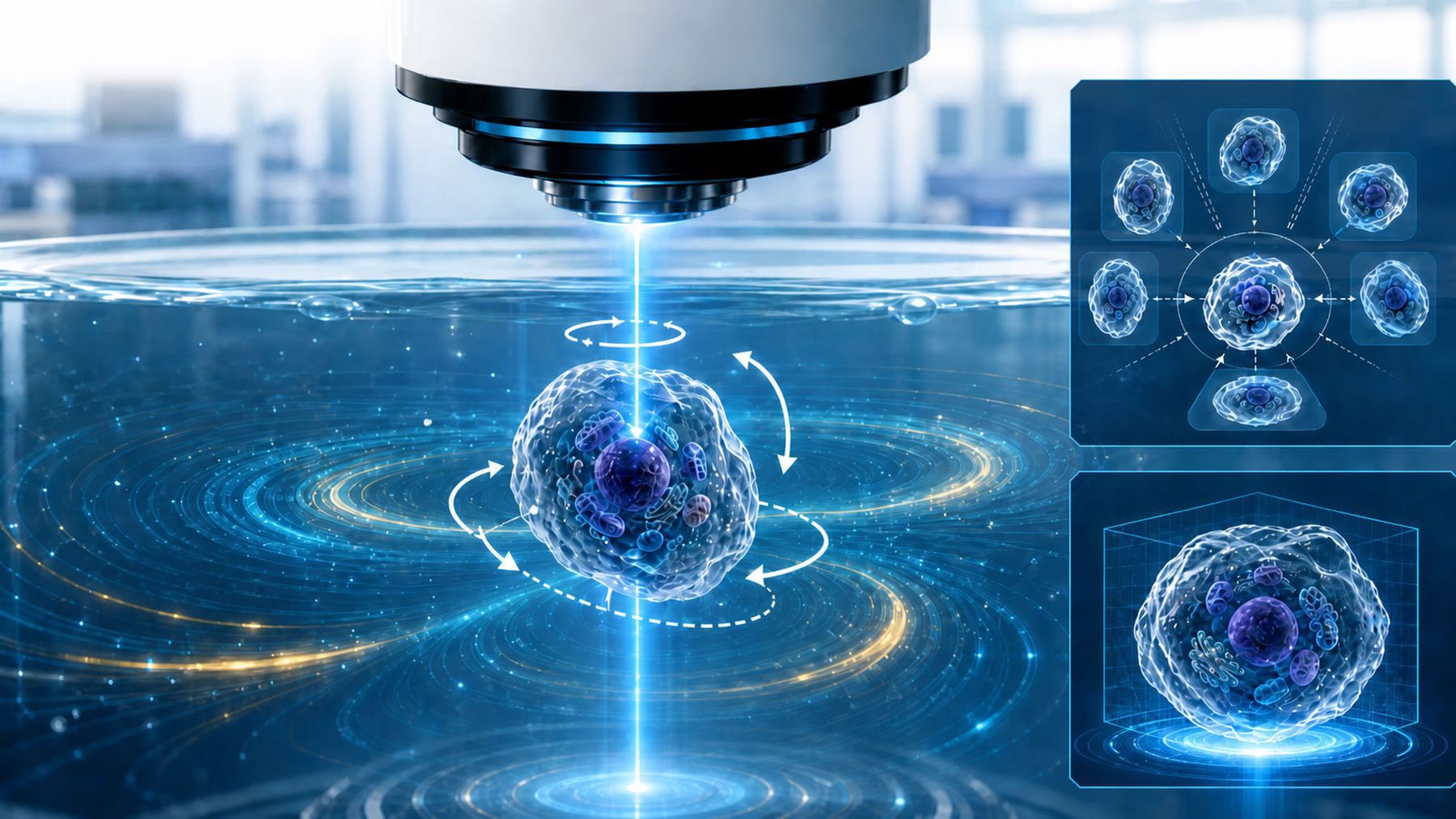
Researchers have developed a new laser-based method that can rotate microscopic samples in all three spatial directions without touching them.
Until now, rotating extremely delicate microscopic samples in every direction without touching them has been a major technical challenge. Researchers at the Karlsruhe Institute of Technology (KIT) have now created a laser-based method that can rotate tiny samples such as cells freely in all three dimensions without physical contact.
The technique works by using a laser to create small temperature differences in the surrounding liquid. These temperature changes generate gentle fluid currents that move and rotate the sample. Because the process avoids direct handling, it helps protect fragile materials while improving the accuracy of three-dimensional imaging, an important advancement for basic medical research.
Improving 3D Microscopic Imaging
Modern optical microscopes can capture highly detailed images in a single flat plane, much like a photograph. However, accurately recording depth remains difficult.
To build precise three-dimensional models, scientists must capture images from multiple angles and combine them. Doing so requires rotating the sample being studied. The new KIT method makes that possible in a much gentler way than previous techniques.
The research team, led by Professor Moritz Kreysing and Dr. Fan Nan at KIT’s Institute of Biological and Chemical Systems, heats small areas of the liquid surrounding the sample with a laser. The resulting fluid movement allows researchers to guide floating microscopic objects with high precision without using mechanical tools such as tiny needles, pipettes, or grippers.
“We do not manipulate the sample directly,” says Nan. “Instead, we control the movement of the surrounding liquid so that the object aligns itself.”
Potential Applications Beyond Microscopy
Scientists have studied laser-driven fluid flows for years, but earlier approaches only allowed movement within a single plane. The new system can also produce controlled rotation in three dimensions. By rapidly scanning the laser, the researchers create a spiral-shaped flow that slowly spins microscopic objects, similar to a small paper boat turning in a miniature whirlpool.
This three-dimensional control gives researchers a clearer view of cellular structures from multiple perspectives. “When samples can be aligned more precisely, we see more details,” says Kreysing. “This is a key prerequisite for better understanding biological structures and processes.”
Kreysing says the technique could eventually be useful not only for biological imaging, but also for contact-free micromanipulation, microscopic robotics, and ultra-precise manufacturing at extremely small scales.
Reference: “Helical opto-thermoviscous flows drive out-of-plane rotation and particle spinning in a highly viscous micro-environment” by Fan Nan, Weida Liao, Adrián Puerta, Josephine Spiegelberg, Elena Erben, Ralf Mikut, Stephan Allgeier, Martin Wegener, Eric Lauga and Moritz Kreysing, 11 May 2026, Light: Science & Applications.
DOI: 10.1038/s41377-026-02303-8
Never miss a breakthrough: Join the SciTechDaily newsletter.
Follow us on Google and Google News.